
Why Cloud Automation Reduces Drift in Your Infrastructure
Discover why cloud automation reduces drift in infrastructure. Learn how enforcing a single source of truth enhances stability and security.

Cloud automation reduces configuration drift by enforcing a single, version-controlled source of truth for every resource in your environment. When your infrastructure is defined as code and every change flows through a pipeline, the live state of your cloud has nowhere to diverge to. That is the core mechanism, and everything else, GitOps reconciliation, policy as code, self-healing rollbacks, builds on it.
Configuration drift happens when the actual state of a running system no longer matches its declared, intended state. A security group rule gets tweaked in the console at 2 AM. A hotfix script runs on one node but not the others. An engineer spins up a test instance and forgets to tag it. Each of these is a small divergence, but they compound fast, especially across multi-cloud and multi-region environments.
Cloud automation addresses this through several interlocking mechanisms:
- Infrastructure as Code (IaC): Terraform, Pulumi, and AWS CloudFormation define every resource declaratively. The code is the truth; the console is read-only.
- GitOps continuous reconciliation: Tools like Flux and Argo CD watch your Git repository and automatically push the declared state back to the live environment whenever they detect a gap.
- Policy as code: Open Policy Agent (OPA) and AWS Config rules block non-compliant changes before they land, not after.
- Automated drift detection: Scheduled or event-driven comparisons surface discrepancies as small, actionable signals rather than quarterly audit surprises.
- Self-healing infrastructure: When drift is detected, automated rollback restores the declared state without waiting for a human to notice.
- Immutable infrastructure: Servers are replaced, not patched in place, eliminating the “snowflake server” problem entirely.
Together, these practices are why cloud automation reduces drift more reliably than any manual process can.
Table of Contents
- What causes configuration drift in cloud environments?
- How drift damages your operations, security, and budget
- How cloud automation tackles configuration drift directly
- Operational culture and best practices for managing drift
- Security implications of configuration drift
- Compliance benefits of keeping drift under control
- Which tools actually help you reduce drift?
- Challenges and limitations of cloud automation in preventing drift
- Key Takeaways
What causes configuration drift in cloud environments?
Drift rarely starts with a catastrophic mistake. It usually starts with something that felt reasonable at the time.
Manual changes through GUIs and consoles, often called “ClickOps,” are the most common culprit. An engineer opens the AWS console to adjust a security group during an incident, fixes the immediate problem, and moves on. The IaC code never gets updated. Now your Terraform state and your live environment disagree, and the next terraform apply will either overwrite the fix or fail outright.
The main sources of drift you will encounter:
- ClickOps and console edits: Any change made outside a pipeline bypasses version control and peer review.
- Emergency hotfixes: Urgent patches applied directly to running instances that never make it back into code.
- Untracked scripts: One-off automation scripts that create or modify resources without registering them in IaC.
- Shadow IT: Teams provisioning resources outside the approved workflow, creating orphaned assets with no owner.
- Inconsistent multi-environment updates: A change applied to staging but not production, or vice versa, because the rollout was manual.
- Temporary changes that become permanent: A “quick test” instance that runs for six months because nobody remembered to tear it down.
- Provider-induced changes: Cloud providers occasionally modify default settings, add new metadata, or deprecate resource attributes, causing drift that nobody on your team initiated.
The snowflake server problem is the end state of all of these. When a server has accumulated enough undocumented manual changes, it becomes unique and irreproducible. You cannot replace it safely, you cannot clone it reliably, and you definitely cannot explain its configuration to an auditor.
How drift damages your operations, security, and budget
The operational impact of drift is not abstract. I have seen a single misconfigured security group rule, applied manually during an incident and never reconciled, sit undetected for weeks before it caused a production outage during a routine deployment. That is the pattern: drift hides until it bites.
Drift causes unpredictable deployments, missed security patches, and audit failures, and the cost of unplanned downtime can run into thousands of dollars per minute for production systems. The damage shows up across several dimensions:
- Outages from state mismatch: A deployment assumes a specific resource configuration that no longer exists in production. The deploy fails, or worse, succeeds but behaves incorrectly.
- Security vulnerabilities: An unauthorized IAM policy change or an open port added during debugging creates an attack surface that your security team does not know exists.
- Compliance failures: Auditors expect your live environment to match your documented configuration. Drift makes that match impossible to guarantee without continuous validation.
- Orphaned resource costs: Unmanaged instances, unattached volumes, and forgotten load balancers accumulate charges with no corresponding business value.
- Debugging overhead: When your live state diverges from your declared state, every troubleshooting session starts with a question you should not have to ask: “Is this actually what the code says it should be?”
Drift is also an indicator of process maturity. When your team is regularly making manual changes, that is a signal worth reading: something in your pipeline is creating enough friction that engineers are bypassing it. Effective teams use drift alerts as feedback to find those bottlenecks, not just to fix the immediate divergence.
How cloud automation tackles configuration drift directly
The automation cycle for drift prevention follows a clear loop: declare, enforce, detect, remediate, repeat. Each stage removes a category of human error.

IaC as the authoritative source of truth is where it starts. When every resource is defined in Terraform, Pulumi, or CloudFormation, the code becomes the contract. Nobody provisions a database by clicking through a wizard; they write a resource block, open a pull request, and let the pipeline apply it. IaC with Git as the single source of truth enforces state consistency and makes unauthorized changes visible immediately.
GitOps continuous reconciliation takes that further. Tools like Flux CD and Argo CD run a control loop: they watch the Git repository for the declared state, compare it to the live cluster or environment, and automatically apply corrections when they diverge. GitOps removes human error by enforcing policy as code and immutable states, enabling real-time automated reconciliation without waiting for a human to trigger a pipeline run.
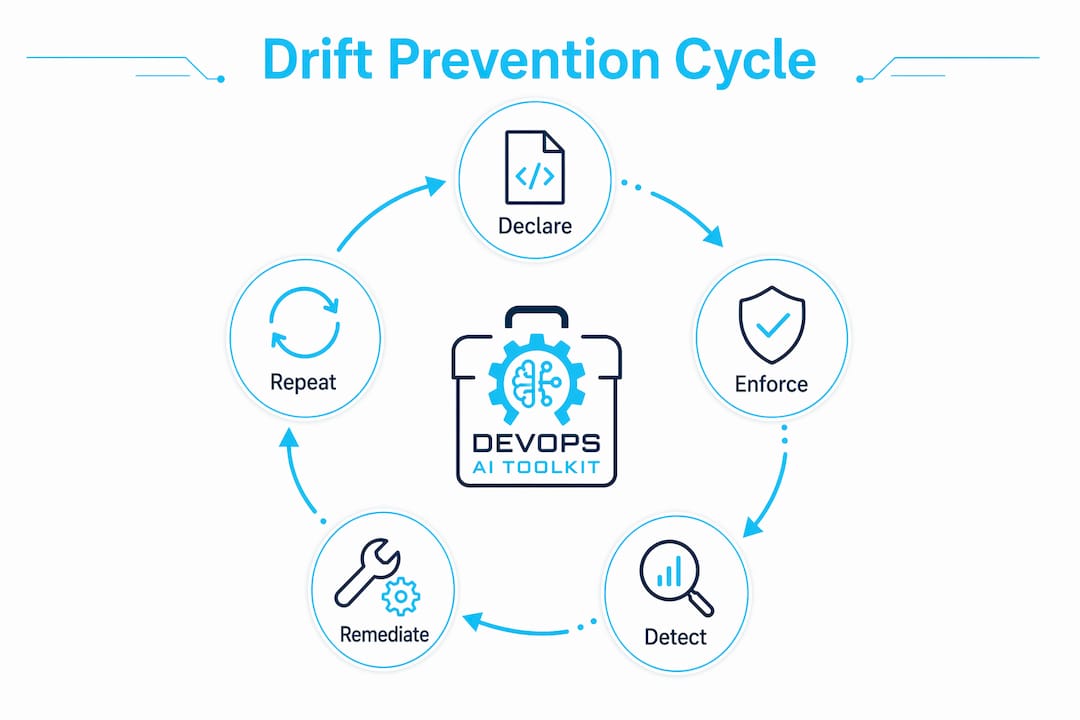
Policy as code adds a proactive layer. OPA, AWS Config, and Azure Policy evaluate every proposed change against a ruleset before it is applied. A rule that says “no security groups may allow 0.0.0.0/0 on port 22” will block that change at the gate, not surface it in a post-incident review.
Automated drift detection runs scheduled or event-driven comparisons between declared and live state. Continuous drift detection shifts teams from risky quarterly audits to ongoing validation, surfacing discrepancies as small, actionable signals. You can build this directly into your CI/CD pipeline with tools like terraform plan on a cron schedule or dedicated drift detection services.
Self-healing infrastructure closes the loop. When drift is detected and classified as critical, an automated remediation workflow restores the declared state, either by re-applying the IaC or triggering a rollback. For automated rollback strategies that keep deployments safe, the principle is the same: the system corrects itself without waiting for a pager alert to wake someone up.
One important gap to know: standard drift detection compares defined state to reality but misses unmanaged or orphaned resources that were never added to IaC in the first place. Asset discovery tooling, like AWS Config’s resource inventory or Terraform’s import workflow, is necessary to bring those resources under code management before they can be tracked.
Operational culture and best practices for managing drift
Technical tooling handles the mechanics. Culture handles the edge cases, and the edge cases are where drift actually lives.
The teams I have seen manage drift well share one trait: they treat infrastructure as immutable by default. Operational culture that treats IaC as immutable effectively eliminates the snowflake server problem, substantially reducing drift impact. That means no SSH-ing into production to tweak a config file. No console edits, even small ones. Every change, no matter how minor, goes through a pull request.
Enforce strict change controls. Every modification to infrastructure should require a PR, a review, and a pipeline run. This is not bureaucracy; it is the only way to keep your declared state and live state synchronized.
Handle emergency break-glass procedures carefully. Manual emergency changes must be audited and rapidly synced back to IaC code to avoid reconciliation conflicts and system instability. When you have to make a manual fix under pressure, the automated reconciliation loop will eventually overwrite it unless you update the code first. That silent revert can cause a second outage worse than the first.
Pro Tip: When a break-glass change is necessary, immediately open a draft pull request documenting what you changed and why. Set a time-bound reminder, no more than 24 hours, to merge the corresponding IaC update. This keeps the reconciliation loop from undoing your emergency fix and gives you an audit trail.
Use drift alerts as workflow feedback. Drift is an indicator of process maturity issues; when engineers are regularly bypassing pipelines, something in the workflow is creating friction. Treat recurring drift patterns as a signal to improve your IaC templates or pipeline ergonomics, not just as incidents to close.
Distinguish cosmetic drift from critical drift. Not every divergence is an emergency. A tag mismatch on a non-production resource is not the same as an IAM policy change on a production database. AI-driven triage prioritizes security-relevant drift for engineers, preventing alert fatigue caused by non-critical differences. Tools that apply this kind of prioritization let your team focus remediation effort where it actually matters.
Validate continuously for audit readiness. Drift cannot be eliminated completely, only managed through continuous validation and rapid remediation to keep infrastructure transparent and audit-ready. Scheduled terraform plan runs, AWS Config conformance packs, and GitOps reconciliation reports all feed into an audit trail that you can hand to a compliance team without scrambling.
For a practical implementation, building continuous Terraform drift detection into your pipeline is one of the highest-leverage changes you can make to your DevOps workflow.
Security implications of configuration drift
Drift and security vulnerabilities tend to travel together. An unauthorized change to a security group, a modified IAM role, or a disabled encryption setting rarely shows up in a security scan if it was made outside your IaC pipeline. It just sits there, invisible to your declared state, until someone exploits it or an auditor finds it.
The security risk is structural. When your live environment diverges from your declared state, your threat model is based on a configuration that no longer exists. Security teams are reviewing policies and controls that may have been silently overridden by a manual change three weeks ago. That gap between what you think your environment looks like and what it actually looks like is where attackers find their footing.
Specific security risks that drift creates:
- Exposed ports and services: A debugging rule that opens port 22 to the internet, added during an incident and never removed.
- IAM privilege escalation: A role with elevated permissions granted temporarily and never revoked.
- Disabled encryption: A storage bucket or database instance where encryption was turned off to troubleshoot a performance issue.
- Unpatched instances: Servers that diverged from the standard AMI or base image and missed security patch cycles.
Policy as code addresses this directly. Tools like OPA and AWS Config enforce security baselines continuously, not just at provisioning time. Reviewing CloudFormation templates for drift with AI adds another layer, catching security-relevant divergence in templates before they reach production. For organizations subject to HIPAA, the HIPAA Security Rule requires documented, auditable controls over system configurations, which drift directly undermines.
Compliance benefits of keeping drift under control
Compliance frameworks, whether SOC 2, PCI DSS, HIPAA, or FedRAMP, share a common requirement: your live environment must match your documented controls. Drift makes that match impossible to guarantee without continuous validation.
The compliance benefit of automation is not just that it prevents drift. It is that it produces evidence. Every pipeline run, every policy evaluation, every GitOps reconciliation event generates a log entry. When an auditor asks “can you prove this security control was in place on March 15th?”, you have a timestamped, immutable record from your CI/CD system rather than a manual spreadsheet someone filled out the week before the audit.
Continuous drift detection shifts the compliance posture from reactive to proactive. Instead of scrambling to reconcile your live environment with your documentation before an audit window, you are continuously validating that they match. Drift alerts become compliance signals, not just operational ones. For teams managing AWS Config rules and compliance, automated conformance packs can map directly to specific control requirements, giving you framework-aligned coverage without manual mapping exercises.
Cloud environment management practices for 2026 increasingly treat compliance as a continuous pipeline stage, not a periodic audit event. That shift is only possible when your infrastructure state is always declared, always validated, and always reconcilable.
Which tools actually help you reduce drift?
The tooling ecosystem for drift prevention is mature. These are the tools worth knowing:
Terraform is the most widely used IaC tool for multi-cloud environments. Its terraform plan command surfaces drift between state files and live infrastructure, and running it on a schedule gives you continuous detection. Pair it with Terraform Cloud or Atlantis for pull-request-driven workflows.

Pulumi offers the same IaC model but lets you write infrastructure definitions in TypeScript, Python, Go, or C#. For teams that find HCL limiting, Pulumi’s general-purpose language support makes complex logic easier to express.
AWS CloudFormation and AWS Config work together natively for AWS-centric environments. CloudFormation manages declared state; AWS Config continuously evaluates live resources against rules and conformance packs. The combination gives you both provisioning and ongoing compliance validation in one ecosystem.
Flux CD and Argo CD are the primary GitOps operators for Kubernetes environments. Both watch a Git repository and continuously reconcile the cluster state to match. Argo CD adds a visual dashboard that makes drift visible at a glance; Flux is lighter-weight and integrates tightly with Helm and Kustomize.
Open Policy Agent (OPA) and its Kubernetes-native form, Gatekeeper, enforce policy as code at admission time. No non-compliant resource gets created or modified without passing the policy evaluation first.
Spacelift and Env0 are drift-aware IaC management platforms that add scheduling, policy enforcement, and drift detection on top of Terraform and OpenTofu. They are particularly useful for platform teams managing IaC at scale across multiple workspaces.
AWS Systems Manager State Manager handles configuration drift at the OS and application layer, not just the infrastructure layer. It continuously applies configuration documents to EC2 instances and reports on compliance, catching drift that IaC tools miss because it happens inside the instance rather than to the instance.
For teams dealing with Terraform-specific drift, fixing Terraform state drift before it bites you covers the practical remediation steps in detail.
Challenges and limitations of cloud automation in preventing drift
Automation handles the predictable cases well. The hard cases are where you need to be honest about what it cannot do on its own.
Legacy and manually managed resources are the biggest gap. Standard drift detection only works on resources that are already under IaC management. Orphaned instances, manually created databases, and resources imported from acquisitions often sit outside your state files entirely. You cannot detect drift in something you have not declared. Asset discovery is a prerequisite, not an afterthought.
Multi-cloud complexity multiplies the problem. Each cloud provider has its own resource model, its own API behavior, and its own set of provider-induced changes. A Terraform provider update can introduce drift by changing how it interprets existing resource attributes. Managing drift consistently across AWS, Azure, and GCP requires provider-specific knowledge and often separate tooling stacks.
Alert fatigue is real. Continuous drift detection generates a lot of signals, and not all of them matter equally. Without prioritization, your team ends up triaging tag mismatches and cosmetic differences alongside actual security-critical changes. AI-driven triage helps, but it requires tuning and ongoing maintenance to stay accurate. For teams dealing with this, triaging Terraform drift alerts with AI without blind reapplies is a workflow worth building.
Automated remediation carries its own risk. Self-healing sounds ideal until your reconciliation loop overwrites a legitimate emergency fix at 3 AM. Automated rollback needs guardrails: time-bounded suppression windows, human approval gates for production environments, and clear escalation paths when the declared state itself is wrong.
Cultural resistance slows adoption. The tooling is the easy part. Getting every engineer on a team to stop making console changes, to write a PR for every infrastructure modification, and to trust the pipeline over their own hands-on instincts takes time and deliberate reinforcement. Teams that skip the cultural work end up with IaC tooling that coexists with ClickOps rather than replacing it.
Drift cannot be eliminated completely. The goal is continuous management: keeping divergence small, surfacing it fast, and remediating it before it compounds. That is what detecting and fixing infrastructure config drift looks like in practice.
If you are building or tightening your drift prevention workflow, Devopsaitoolkit’s automation AI prompts give you 88 copy-paste prompts built specifically for cloud and DevOps automation tasks. They cover IaC generation, drift remediation scripts, policy-as-code templates, and more, so you spend less time writing boilerplate and more time on the problems that actually need your attention.
Key Takeaways
Cloud automation reduces configuration drift by enforcing version-controlled, declared infrastructure state and continuously reconciling live environments against that source of truth.
| Point | Details |
|---|---|
| IaC is the foundation | Every resource defined in code removes the console as a change vector and makes drift immediately visible. |
| GitOps closes the reconciliation loop | Continuous reconciliation tools automatically correct live state when it diverges from the Git-declared configuration. |
| Drift cannot be fully eliminated | Continuous validation and rapid remediation keep infrastructure transparent and audit-ready rather than drift-free. |
| Break-glass changes need immediate PR follow-up | Manual emergency fixes must be synced to IaC within 24 hours or automated reconciliation will silently overwrite them. |
| Alert fatigue undermines detection | AI-driven triage prioritizes security-critical drift over cosmetic mismatches, preserving engineer focus and efficiency. |
Recommended
- Detecting and Fixing Infrastructure Config Drift — DevOps AI ToolKit
- Reviewing CloudFormation Templates for Drift With AI
- Fixing Terraform State Drift Before It Bites You — DevOps AI ToolKit
- Building Continuous Terraform Drift Detection Into Your
Get 500 Battle-Tested DevOps AI Prompts — Free
500 battle-tested, copy-paste AI prompts engineered by a senior systems engineer — every one with fill-in placeholders and safety/back-out notes. Drop your email and it's yours.
- 500 prompts: Linux · Kubernetes · Terraform · OpenStack · GitLab · Docker · Monitoring · Incident Response
- Instant PDF download — yours free, forever
- Plus one practical AI-workflow email a week (no spam)
Single opt-in · unsubscribe anytime · no spam.