
The Role of Service Mesh in DevOps: 2026 Guide
How a service mesh optimizes microservice communication, enforces mTLS security, and delivers full observability — plus the real operational trade-offs in 2026.
- #service-mesh
- #kubernetes
- #istio
- #observability
- #microservices

A service mesh is a dedicated infrastructure layer that manages, secures, and observes all communication between microservices without requiring changes to application code. The role of service mesh in DevOps has grown from a niche Kubernetes add-on to a core platform engineering concern, especially as teams run 20, 50, or 100+ services in production. Tools like Istio, Linkerd, Envoy, and the emerging sidecar-less Cilium eBPF approach each solve the same core problem: your services need to talk to each other reliably, securely, and with full visibility. If you are managing cloud-native infrastructure and have not yet evaluated a service mesh, this guide covers the architecture, the real operational trade-offs, and how to adopt one without wrecking your team.
How does service mesh architecture support DevOps goals?
A service mesh splits into two planes: the control plane and the data plane. The control plane, handled by components like Istiod in Istio, pushes configuration to every proxy in the cluster. The data plane, made up of sidecar proxies like Envoy, intercepts all inbound and outbound traffic for each service. This separation means your application code never touches routing logic, retry policies, or TLS configuration directly.
The sidecar proxy pattern is the traditional approach. Envoy runs as a container alongside your application pod and intercepts all service traffic, applying policies on routing, security, and observability. The control plane pushes updates centrally. Your developers write business logic; the mesh handles the network contract.

The industry is actively moving away from the sidecar model for high-scale environments. Sidecar-less architectures like Istio Ambient Mesh and Cilium eBPF offload proxy work to the Linux kernel, reducing resource consumption by up to 90% compared to traditional sidecar deployments. That is a significant shift for teams running hundreds of pods.
For configuration management, GitOps is the right model. Tools like Flux CD and ArgoCD manage Istio configs and mTLS policies in version control, giving you full auditability and rollback capability. Treating mesh configuration as code is not optional in production. It is how you prevent configuration drift from silently breaking security policies at 2 a.m.
Pro Tip: Start your GitOps mesh setup with a single namespace before rolling out cluster-wide. This lets you validate your Flux CD or ArgoCD pipeline against real traffic without risking production services.
Key architectural components to understand before adoption:
- Control plane: Manages certificates, service discovery, and policy distribution (Istiod in Istio, the Linkerd control plane)
- Data plane: Sidecar proxies (Envoy) or kernel-level processing (Cilium eBPF) that enforce policies at runtime
- mTLS: Mutual TLS authentication between every service pair, enforced automatically by the mesh
- Traffic management: Virtual services, destination rules, and retry policies defined in YAML and applied without code changes
- Observability pipeline: Metrics, traces, and logs generated by the proxy layer and shipped to Prometheus, Jaeger, or Grafana
What are the operational benefits and challenges of adopting a service mesh?
The security benefit alone justifies evaluation for most teams. A service mesh centralizes network security with identity-based access control and automatic encryption inside the cluster, removing the dependency on developers to implement TLS correctly in every service. Mesh audit logs and telemetry also detect abnormal access patterns before they become incidents.
Observability is the second major win. Every sidecar proxy generates request metrics, distributed traces, and access logs automatically. You get golden-signal monitoring across all services without instrumenting each one individually. For teams running Prometheus and Grafana, this is a direct integration that surfaces latency, error rates, and traffic volume per service pair.
Traffic management is where DevOps teams unlock real release agility. Canary deployments, fault injection for chaos testing, and automatic retries are all configurable at the mesh layer. You can shift 5% of traffic to a new service version, observe the metrics, and roll forward or back without a code deploy.
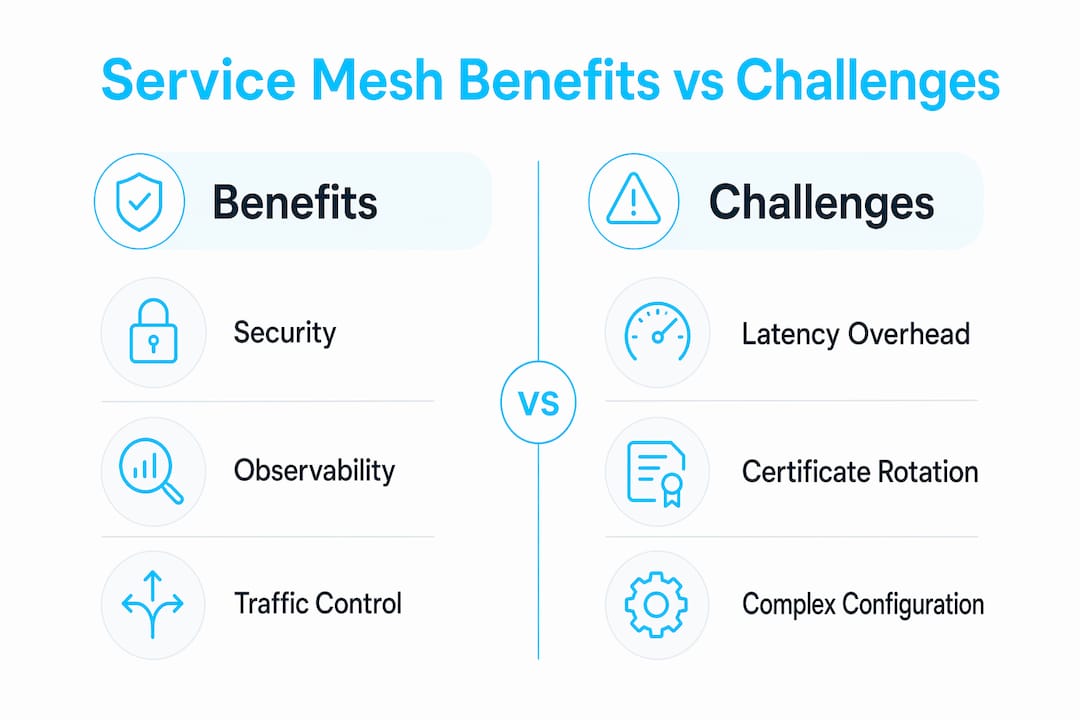
The challenges are real and worth naming directly.
| Area | Benefit | Challenge |
|---|---|---|
| Security | Automatic mTLS, identity-based access control | Certificate rotation complexity, strict-mode migration risk |
| Observability | Full telemetry without code changes | High-cardinality metrics can overwhelm Prometheus at scale |
| Traffic management | Canary releases, retries, fault injection | YAML configuration sprawl if not managed with GitOps |
| Performance | Consistent policy enforcement | 1–3ms latency per hop with sidecar proxies; ~0.5ms with eBPF |
| Operations | Centralized policy control | Requires two senior engineers per cluster for stable management |
The latency numbers matter for high-throughput services. Traditional Envoy sidecars add roughly 1–3ms per hop and consume around 50MB of memory per instance. That overhead compounds across a deep call chain. Sidecar-less eBPF implementations bring that down to approximately 0.5ms per hop. For most CRUD services, the sidecar overhead is acceptable. For low-latency financial or AI inference workloads, eBPF is worth the migration effort.
Pro Tip: Before enforcing strict mTLS cluster-wide, run in permissive mode for two weeks and monitor your mesh telemetry for unexpected plaintext connections. You will almost always find a legacy service or a misconfigured job that needs fixing first.
How does integrating service mesh improve DevOps team collaboration?
Service mesh adoption clarifies team ownership in a way that most organizations struggle to achieve otherwise. Platform engineering teams own the mesh lifecycle and control plane, while application teams manage traffic policies relevant to their own services. This split reduces friction and improves both operational efficiency and security compliance.
Here is how that plays out in practice across a typical DevOps workflow:
- Platform team deploys and upgrades the mesh control plane. They own Istio or Linkerd version management, certificate-authority configuration, and cluster-wide mTLS policy. Application teams never touch this layer.
- Application teams define service-level traffic policies. They write VirtualService and DestinationRule manifests for their own services, committing them to Git. The platform team reviews and merges via pull request.
- CI/CD pipelines apply mesh configs alongside application deployments. ArgoCD or Flux CD syncs mesh configuration changes in the same pipeline that deploys new container images. Policy and code ship together.
- Incident response uses mesh telemetry as the first signal. When a service degrades, the mesh surfaces which upstream dependency is throwing errors and at what rate. Engineers skip the “which service is broken?” phase and go straight to root cause.
- Security posture improves without developer involvement. Because the mesh enforces identity-based access control at the infrastructure layer, developers do not need to implement service-to-service authentication in application code. That logic lives once, in the mesh, and applies everywhere.
This model also removes duplicated networking code from applications. Teams that previously maintained custom retry logic, circuit breakers, and TLS handshake code in every service can delete that code and rely on the mesh. Fewer lines of application code means fewer bugs and faster onboarding for new engineers. For teams exploring how DevOps security best practices intersect with infrastructure automation, this separation of concerns is one of the clearest wins a service mesh delivers.
Which service mesh tools fit different DevOps environments?
Service mesh adoption is recommended for environments running 20 or more microservices, where the operational benefits outweigh the complexity cost. Below that threshold, a well-configured API gateway and application-level libraries often suffice.
| Tool | Proxy | Memory per proxy | Best for | Complexity |
|---|---|---|---|---|
| Istio | Envoy | ~50MB | Large clusters, advanced traffic management | High |
| Linkerd | Linkerd2-proxy | ~10MB | Mid-size clusters, simplicity focus | Medium |
| Cilium | eBPF (kernel) | Minimal | High-performance, kernel-level enforcement | Medium-High |
| Istio Ambient Mesh | No sidecar | Near zero | Resource-constrained or large-scale clusters | Medium |
Linkerd is the right starting point for teams new to service mesh. Its proxy uses roughly 10MB of RAM versus Envoy’s 50MB, and its operational surface is smaller. Istio gives you more control over traffic management and integrates with a wider ecosystem, but it demands more from your platform team. Cilium eBPF is the forward-looking choice for teams prioritizing performance and kernel-level security, particularly for AI workloads where latency budgets are tight.
For adoption strategy, a phased approach is the only one I have seen work reliably in production. Start with permissive mTLS, observe traffic patterns, then enforce strict mode, and only then introduce traffic management features like canary routing and fault injection. This crawl-walk-run method minimizes service disruption and builds team confidence at each stage.
A few pitfalls to avoid:
- Do not enable strict mTLS before auditing all service-to-service communication paths
- Do not skip GitOps for mesh config. Manual
kubectl applyin production creates drift you cannot audit - Do not understaff the platform team. A stable mesh requires dedicated senior engineers who own upgrades, monitoring, and incident response
For teams building AI-enhanced DevOps workflows, pairing a service mesh with AI-assisted observability tools creates a strong foundation for automated incident detection and response.
Key takeaways
A service mesh is the most direct way to enforce consistent security, observability, and traffic control across microservices without touching application code.
| Point | Details |
|---|---|
| Architecture drives DevOps alignment | Control plane and data plane separation lets platform teams own policy while developers own traffic rules. |
| mTLS is the highest-value first step | Automatic mutual TLS removes developer-implemented auth and centralizes identity-based access control. |
| Sidecar-less is the direction of travel | Cilium eBPF and Istio Ambient Mesh reduce proxy overhead by up to 90% versus traditional Envoy sidecars. |
| GitOps prevents configuration drift | Flux CD and ArgoCD applied to mesh configs give you auditability and rollback for every policy change. |
| Staff before you ship | Two dedicated senior engineers per cluster is the realistic minimum for a stable production mesh. |
Where I think most teams get service mesh wrong
I have watched teams adopt Istio because it was on a conference slide, skip the phased rollout, and spend three months firefighting certificate rotation issues and broken health checks. The technology is not the problem. The sequencing is.
Service mesh is often misunderstood as a fix-all networking solution. What it actually does is surface the gaps you already have in observability and identity management. If your services have no consistent naming convention or your CI/CD pipeline does not enforce image signing, a service mesh will make those gaps visible and painful. That is a good thing, but you need to be ready for it.
My honest view on the managed mesh trend: invisible service mesh offerings built on Istio Ambient Mode are the right answer for most organizations that do not have a dedicated platform engineering team. You get mTLS by default without owning the control plane. The trade-off is less flexibility on traffic management, but most teams do not need 80% of Istio’s feature set anyway.
The future belongs to sidecar-less architectures, and AI workload demands are accelerating that shift. Low-latency inference services cannot absorb 3ms per hop across a 10-service call chain. eBPF-based meshes will become the default within two to three years, and teams that start evaluating Cilium now will have a significant operational advantage.
Start with mTLS. Get your GitOps pipeline solid. Then add traffic management. In that order, every time.
— James
Take your service mesh workflows further with DevOps AI ToolKit
If you are wiring up mTLS policies, canary release pipelines, or incident response runbooks, the prompt library here is built for exactly the kind of production environments where a misconfigured mesh policy actually matters. The CI/CD pipeline supply-chain hardening prompt is a practical starting point when you are securing the pipeline that ships your mesh configuration. Browse the full AI prompt library for DevOps engineers to find workflows covering Kubernetes, CI/CD security hardening, and alert triage.
FAQ
What is the role of service mesh in DevOps?
A service mesh provides a dedicated infrastructure layer that manages, secures, and observes microservice communication without application code changes. It enforces mTLS, traffic routing, and telemetry collection automatically across all services in a cluster.
When should a DevOps team adopt a service mesh?
Service mesh adoption is recommended for environments running 20 or more microservices, where the operational benefits of centralized security and observability outweigh the complexity cost of managing a control plane.
What is the performance impact of a service mesh?
Traditional sidecar proxies like Envoy add roughly 1–3ms of latency per hop and consume around 50MB of memory per instance. Sidecar-less eBPF implementations like Cilium reduce that to approximately 0.5ms per hop with significantly lower resource usage.
How does GitOps improve service mesh operations?
GitOps tools like Flux CD and ArgoCD store Istio configurations, traffic rules, and mTLS policies in version control. This prevents configuration drift, enables rollback, and creates a full audit trail for every policy change in production.
What is the difference between Istio and Linkerd?
Istio uses Envoy as its data plane proxy and offers advanced traffic management at the cost of higher resource usage and operational complexity. Linkerd uses a lighter Rust-based proxy consuming roughly 10MB of RAM and is better suited for teams prioritizing simplicity over feature depth.
Recommended
- How to Choose the Right DevOps as a Service Provider
- Building a Slack ChatOps Bot for DevOps Teams: A Practical Guide
- The Best AI Tools for DevOps Engineers in 2026
Get 500 Battle-Tested DevOps AI Prompts — Free
500 battle-tested, copy-paste AI prompts engineered by a senior systems engineer — every one with fill-in placeholders and safety/back-out notes. Drop your email and it's yours.
- 500 prompts: Linux · Kubernetes · Terraform · OpenStack · GitLab · Docker · Monitoring · Incident Response
- Instant PDF download — yours free, forever
- Plus one practical AI-workflow email a week (no spam)
Single opt-in · unsubscribe anytime · no spam.