
The Role of OPA in Kubernetes Security: 2026 Guide
Discover the role of OPA in Kubernetes security. Learn how OPA Gatekeeper enhances your cluster's protection by enforcing critical policies.

Open Policy Agent (OPA) is defined as a centralized Policy Decision Point that evaluates JSON-based admission requests and enforces declarative security controls before resources are persisted in a Kubernetes cluster. The role of OPA in Kubernetes security goes well beyond simple access control. Where Kubernetes RBAC answers “who can do what,” OPA answers “which resource configurations are actually allowed.” Deployed as OPA Gatekeeper, it integrates directly with Kubernetes admission webhooks, intercepting every API request before it reaches etcd. For cloud security teams managing production clusters, this distinction is not academic. It is the difference between a cluster that blocks bad configs at the gate and one that discovers them after the fact.
How does OPA integrate with Kubernetes admission control?
OPA Gatekeeper integrates via admission webhooks to intercept API server requests before any resource is written to the cluster. Kubernetes supports two webhook types: ValidatingAdmissionWebhook, which accepts or rejects requests, and MutatingAdmissionWebhook, which can modify them in flight. Gatekeeper primarily uses the validating webhook to enforce policy decisions.
The Gatekeeper architecture has three core components:
- Controller Manager: Compiles
ConstraintTemplateandConstraintCRDs into executable Rego policies. - Webhook Server: Evaluates live admission requests in real time and returns allow or deny decisions.
- Audit Controller: Periodically rescans existing cluster resources to detect violations that slipped through before a policy was applied.
The Audit Controller runs every 60 seconds by default. That matters because resources deployed before a policy existed can silently violate new rules. The audit loop catches that drift without requiring manual inspection.
| Component | Function | Trigger |
|---|---|---|
| Controller Manager | Compiles ConstraintTemplates into Rego | On CRD creation or update |
| Webhook Server | Evaluates admission requests | Every API server request |
| Audit Controller | Scans existing resources for violations | Every 60 seconds |
Kubernetes v1.30 introduced ValidatingAdmissionPolicy using CEL (Common Expression Language), which runs inside the API server process and eliminates webhook latency and TLS management overhead. For simple field checks, CEL is the right call. For complex logic involving cross-resource lookups or external data, Gatekeeper is still the tool you need.
Pro Tip: Set Gatekeeper’s failurePolicy to Ignore during initial rollout. This prevents the webhook from blocking all traffic if Gatekeeper itself goes down, giving you time to stabilize before switching to Fail.
What security controls does OPA provide beyond Kubernetes RBAC?
RBAC and OPA Gatekeeper serve complementary roles in a complete Kubernetes security framework. RBAC controls identity-based access: which users or service accounts can call which API verbs on which resources. OPA Gatekeeper controls content-based compliance: whether the actual resource specification meets your security standards. RBAC cannot read a pod manifest and reject it because it requests privileged: true. OPA can.
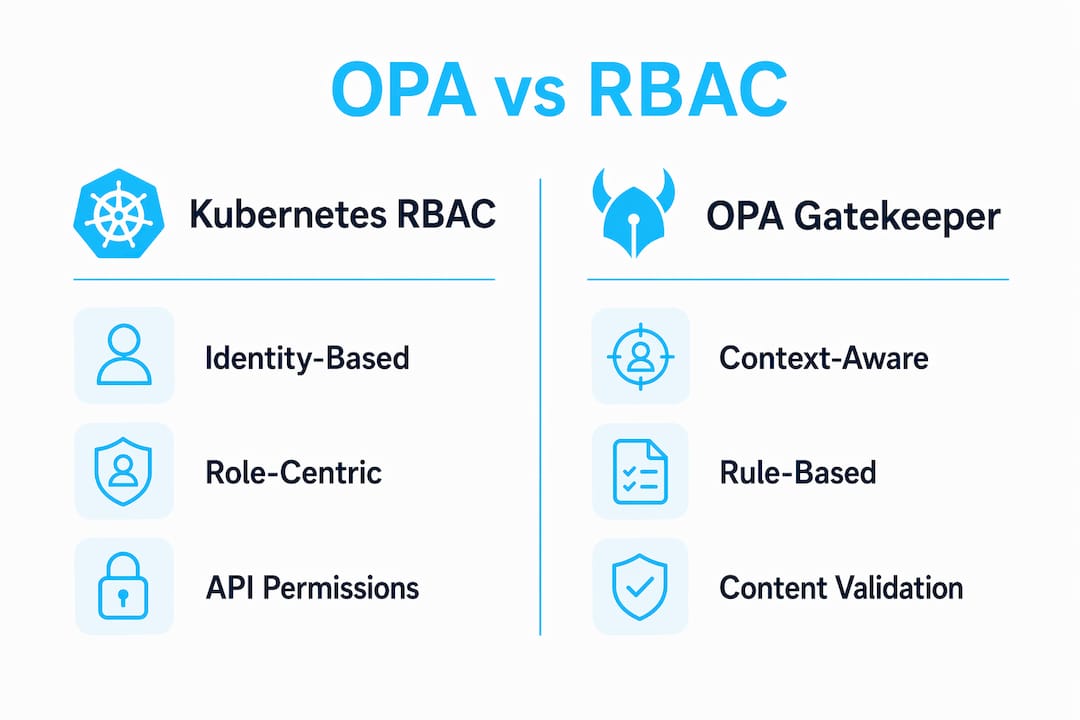
| Dimension | Kubernetes RBAC | OPA Gatekeeper |
|---|---|---|
| Policy model | Role-based | Rule-based (Rego) |
| Controls | Who can access what | Which resource specs are allowed |
| Content validation | Not supported | Fully supported |
| Enforcement point | API server authorization | Admission webhook |
| Versioning | Manual | CRD-native, Git-friendly |
A concrete example: RBAC can prevent a developer from creating ClusterRoleBindings. But if that developer has permission to create pods, RBAC alone cannot stop them from deploying a container running as root with host network access. An OPA policy can block that pod spec entirely, regardless of who submitted it.
Combining RBAC with OPA Gatekeeper gives you a complete policy framework that covers both the identity layer and the configuration layer. Skipping either one leaves a real gap. You can explore how these two mechanisms work together in depth in this guide on Kubernetes RBAC implementation.
Pro Tip: Audit your existing RBAC bindings before writing OPA policies. Teams often discover overly permissive roles that OPA policies then have to compensate for. Fix the RBAC first, then layer OPA on top.
What are best practices for implementing OPA policies in Kubernetes?
Getting OPA Gatekeeper into production without causing incidents requires a structured approach. The policy lifecycle has four phases: write, test, deploy, and audit. Skipping any phase creates risk.

Writing and structuring policies
Gatekeeper policies use two CRD types: ConstraintTemplate (defines the Rego logic) and Constraint (applies the template to specific resource kinds and namespaces). Rego’s declarative logic model evaluates rules over structured JSON, making it a natural fit for Kubernetes AdmissionReview requests. Rego supports both AND logic (multiple conditions in one rule body) and OR logic (multiple rule bodies). Keep each ConstraintTemplate focused on a single concern. Mixing “no privileged containers” and “required labels” into one template makes testing and debugging painful.
Phased enforcement rollout
Never go straight to deny on a new policy. Phased enforcement is the safest path:
- dryrun: Violations are logged but nothing is blocked. Use this to assess impact across your cluster.
- warn: Violations return a warning to the submitter but the request still succeeds. Good for developer awareness.
- deny: Violations are rejected. Only move here after dryrun and warn confirm the policy behaves as expected.
This sequence prevents mass blocking of legitimate workloads when a policy has unintended scope.
CI/CD integration and policy testing
Policy-as-Code enables version control, automated testing, and consistent enforcement across environments. Store your ConstraintTemplates and Constraints in Git alongside your application manifests. Run opa test in your CI pipeline against unit tests for each Rego policy before merging. Tools like Conftest let you validate Kubernetes manifests against OPA policies before they ever reach the cluster. This is the shift-left approach that catches violations at PR time, not at deployment time. Devopsaitoolkit covers this workflow in detail in its guide on policy-as-code with OPA.
Securing OPA communication
Secure OPA communication using mutual TLS between the API server and the Gatekeeper webhook server. Restrict access to your policy bundle server so that only authorized Gatekeeper instances can pull policy updates. Redact sensitive values from decision logs to avoid leaking secrets through audit trails. These are not optional hardening steps. They are baseline requirements for any production admission controller.
Pro Tip: Run at least two Gatekeeper webhook replicas with pod anti-affinity rules. A single replica creates a single point of failure for your entire admission control path.
How is OPA evolving alongside native Kubernetes admission controls?
The admission control space in Kubernetes shifted significantly with the general availability of ValidatingAdmissionPolicy in Kubernetes v1.30. CEL-based policies run inside the API server, removing the need for a separate webhook process, TLS certificates, and the latency that comes with an external call. For teams that only need simple field validation, such as “image must come from an approved registry” or “resource limits must be set,” CEL is now the preferred path.
OPA Gatekeeper remains the right choice when your policies need:
- Cross-resource lookups (checking if a referenced ConfigMap exists before allowing a pod)
- External data integration (querying an inventory system or CMDB at admission time)
- Complex multi-condition logic that CEL cannot express
- Consistent policy enforcement across non-Kubernetes infrastructure using the same Rego rules
The practical answer for most teams in 2026 is a hybrid model. Use CEL for simple, high-volume validations where latency matters. Use Gatekeeper for the complex policies that actually require Rego’s expressiveness. This split reduces Gatekeeper’s webhook load and keeps your CEL policies fast and maintainable.
Shift-left enforcement is the other major trend. Running OPA policy checks in CI/CD pipelines, against infrastructure-as-code before cluster deployment, catches violations when they are cheapest to fix. Enforcement levels in these pipeline checks can be configured as mandatory (blocking the pipeline), advisory (warning only), or disabled per policy. This mirrors the dryrun/warn/deny model in Gatekeeper itself and creates a consistent policy experience from code commit to cluster runtime. Teams using this approach find that by the time a manifest reaches the cluster, it almost never fails admission. The pipeline already caught it.
The Rego learning curve is real. Engineers new to OPA should start with CEL for simple checks, then invest in Rego training for the policies that genuinely need it. Mixing both mechanisms intentionally, rather than defaulting to one, produces a more maintainable and performant security posture.
Key takeaways
OPA Gatekeeper enforces content-based policy compliance at the admission layer, filling the gap that Kubernetes RBAC leaves by controlling which resource specifications are allowed, not just who can submit them.
| Point | Details |
|---|---|
| OPA fills the RBAC gap | RBAC controls identity access; OPA Gatekeeper controls resource content compliance. |
| Audit Controller prevents drift | The 60-second audit scan catches violations on resources deployed before a policy existed. |
| Phase enforcement rollout | Always progress through dryrun, then warn, then deny to avoid blocking legitimate workloads. |
| CEL for simple, OPA for complex | Use ValidatingAdmissionPolicy (CEL) for field checks and reserve Gatekeeper for cross-resource or external data policies. |
| Shift-left with CI/CD | Running OPA checks in pipelines catches violations at PR time, before they reach the cluster. |
Why I think most teams implement OPA in the wrong order
I’ve watched teams install Gatekeeper, write a handful of policies, set enforcementAction: deny, and immediately break their staging environment. The instinct to go straight to enforcement is understandable. You want the guardrails up. But the cluster doesn’t care about your intentions.
The teams that get OPA right start with the audit phase. They install Gatekeeper, write their first policies in dryrun, and spend two weeks reading violation reports before they block a single request. That audit data tells you which workloads are already non-compliant and which teams need to update their manifests. Without it, you’re flying blind into deny.
The other thing I consistently see underestimated is the value of securing your admission control path itself. Teams focus on writing good Rego and forget that the webhook server is a high-privilege component. If an attacker can manipulate what Gatekeeper sees, your policies are worthless. Mutual TLS and strict network policies around the Gatekeeper namespace are not optional.
My honest recommendation: treat OPA policy management like application code. Version it, test it in CI, review it in PRs, and monitor it in production. The teams that do this find that their policy library becomes a genuine security asset. The teams that treat it as a one-time configuration task end up with stale policies that nobody trusts.
— James
Devopsaitoolkit and Kubernetes policy management
Managing OPA Gatekeeper policies at scale means keeping Rego logic tested, audited, and integrated into your deployment pipeline. Devopsaitoolkit builds AI-driven workflows specifically for cloud engineers doing exactly that kind of work.
The AI DevOps tools on Devopsaitoolkit cover incident response, policy review, and Kubernetes security auditing workflows. If you’re building out your OPA policy library or trying to wire Gatekeeper into your CI/CD pipeline, the workflow guides and prompt libraries give you a practical starting point built by engineers who run production Kubernetes clusters. No theory, no vendor slides. Just workflows that work.
FAQ
What is the role of OPA in Kubernetes security?
OPA acts as a centralized Policy Decision Point that evaluates admission requests against declarative Rego policies before any resource is written to the cluster. It enforces content-based compliance controls that Kubernetes RBAC cannot provide.
How does OPA Gatekeeper differ from Kubernetes RBAC?
RBAC controls which users or service accounts can perform API operations. OPA Gatekeeper controls whether the resource specification itself meets your security and compliance requirements, such as blocking privileged containers or requiring resource limits.
What is the Gatekeeper Audit Controller?
The Audit Controller is a Gatekeeper component that scans existing cluster resources every 60 seconds to detect policy violations on resources that were deployed before a policy was applied.
When should I use CEL instead of OPA Gatekeeper?
Use ValidatingAdmissionPolicy with CEL for simple field validations where webhook latency is a concern. Reserve OPA Gatekeeper for policies that require cross-resource lookups, external data, or complex multi-condition Rego logic.
How do I safely roll out a new OPA policy?
Start with enforcementAction: dryrun to log violations without blocking requests, then move to warn so submitters see feedback, and only switch to deny after confirming the policy scope is correct and no legitimate workloads are affected.
Recommended
- Securing a Kubernetes Cluster: Pod Security and Admission
- OPA/Gatekeeper vs Kyverno: Choosing a Kubernetes Policy
- Pod Security Standards in Practice: Hardening Workloads at
- Kubernetes Security Hardening: Pods, RBAC, and Network Policy That Actually Contain a Breach — DevOps AI ToolKit
Get 500 Battle-Tested DevOps AI Prompts — Free
500 battle-tested, copy-paste AI prompts engineered by a senior systems engineer — every one with fill-in placeholders and safety/back-out notes. Drop your email and it's yours.
- 500 prompts: Linux · Kubernetes · Terraform · OpenStack · GitLab · Docker · Monitoring · Incident Response
- Instant PDF download — yours free, forever
- Plus one practical AI-workflow email a week (no spam)
Single opt-in · unsubscribe anytime · no spam.