
The Role of CDN Cloud Infrastructure in Web Performance
Discover the critical role of CDN cloud infrastructure in enhancing web performance. Learn how it reduces latency and improves content delivery.

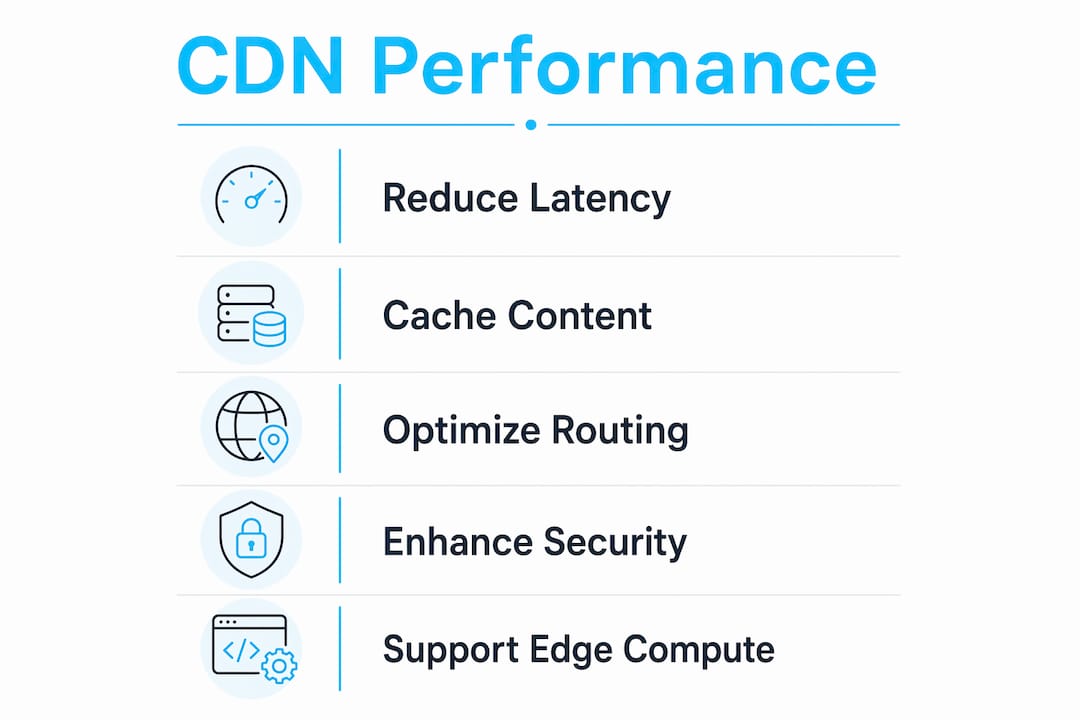
CDN cloud infrastructure is defined as a globally distributed network of edge servers that cache, route, and secure content as close to end users as possible. The industry standard term is Content Delivery Network, and its role in modern cloud architecture goes far beyond simple file caching. A well-configured CDN reduces latency, offloads origin servers, terminates TLS at the edge, and now runs serverless compute functions. Understanding the full role of cdn cloud infrastructure is non-negotiable for any architect building applications that serve users across regions.
How does CDN cloud infrastructure reduce latency and improve content delivery?
A CDN reduces latency by serving content from geographically close Points of Presence rather than a distant origin server. The physics are simple: light travels at a fixed speed, and round-trip time between New York and Sydney is roughly 200 ms. A local PoP cuts that to under 20 ms. That difference is the gap between a fast app and one users abandon.

Caching strategies: pull vs. push
CDNs use two primary caching models. A pull CDN lazily fetches content from the origin on the first request, then caches it at the edge for subsequent users. A push CDN preloads content to edge locations before any request arrives. Pull works well for unpredictable traffic patterns. Push suits large, known assets like software installers or video files where you want zero cache-miss latency on day one.
Cache hit ratio is the metric that tells you how well your CDN is actually working. A well-tuned CDN setup for static assets achieves a cache hit ratio of 90%–99%, reducing origin server request volume by the same margin. That means your origin handles only 1%–10% of total incoming traffic. During a traffic spike, that protection is what keeps your origin alive.
Routing methods: anycast and DNS-based load balancing
Routing is the other half of CDN performance. Anycast routing announces a single IP address from multiple PoPs simultaneously, directing each user to the nearest one at the network layer. This gives you near-instant failover without waiting for DNS TTL to expire. DNS-based geo-routing is slower and less accurate by comparison. For latency-critical applications, anycast is the correct choice.
Pro Tip: Monitor your cache hit ratio per content type, not just globally. Images and fonts should hit 95%+. If your HTML pages are caching, verify your Vary headers are set correctly to avoid serving wrong content to different users.
What security enhancements does CDN cloud infrastructure provide?
Modern CDNs act as security layers, not just performance layers. By sitting in front of your origin, a CDN absorbs attack traffic before it reaches your infrastructure. This architectural position makes it the right place to enforce security policies at scale.
The core security functions a CDN provides include:
- DDoS mitigation: Distributing attack traffic across hundreds of PoPs prevents any single point from being overwhelmed. Anycast routing spreads volumetric floods across the network automatically.
- Web Application Firewall (WAF): A CDN-integrated WAF blocks malicious traffic at the edge before it reaches your application servers, filtering SQL injection, XSS, and known bot signatures.
- TLS termination: Handling TLS handshakes at the edge PoP reduces round-trip overhead for the user and offloads cryptographic processing from your origin.
- Bot management and rate limiting: CDNs apply behavioral analysis and rate limits at the edge, stopping credential stuffing and scraping attacks without touching your application code.
The scale of DDoS attacks that CDNs now absorb is striking. In 2024, a 5.6 Tbps UDP flood was mitigated autonomously in 80 seconds by distributed CDN infrastructure. No human was in the loop. That kind of automated, distributed defense is simply not achievable with a single-origin setup.
A CDN’s distributed architecture means that absorbing a terabit-scale attack is an operational routine, not an emergency. The attack surface is spread across hundreds of PoPs, and anycast routing ensures no single node bears the full load. For most organizations, this level of DDoS resilience would be impossible to replicate independently.
How do modern CDNs support dynamic content and edge computing?
Static caching is table stakes. The more interesting question is what CDNs do for content that cannot be cached: API responses, authenticated pages, personalized feeds, and real-time data. This is where dynamic acceleration and edge compute change the architecture.
Dynamic acceleration improves delivery of uncacheable API traffic through three mechanisms. First, TLS termination at the edge reduces handshake latency for every user request. Second, connection pooling between the CDN and your origin reuses persistent TCP connections, eliminating the overhead of establishing new ones. Third, private backbone routing between CDN PoPs and your origin avoids congested public internet paths. Together, these cut API response times without touching your application code.
Edge compute takes this further by running logic at the PoP itself. JavaScript and WebAssembly functions execute at the edge, handling tasks that previously required a round trip to the origin. Common use cases include:
- Authentication and JWT verification: Validate tokens at the edge and reject unauthorized requests before they hit your origin.
- A/B testing: Serve different page variants based on user attributes without a server-side render cycle.
- Personalization: Modify response headers or inject content based on geolocation, device type, or cookie values.
- Request rewriting: Transform URLs, add headers, or redirect users based on business logic at the network edge.
CDNs now implement HTTP/3, Brotli, and TLS 1.3 at scale, enabling protocol-level performance improvements without any backend changes. Your origin stays on HTTP/1.1 internally while users get HTTP/3 end-to-end. That is a meaningful upgrade delivered purely through CDN configuration.
Pro Tip: Use edge functions for JWT verification rather than passing every request to your auth service. This alone can cut auth-related latency by 60–80 ms for users far from your origin region. Test with a canary deployment before rolling out globally.
What are best practices for deploying CDN cloud infrastructure?
Getting CDN architecture right requires more than pointing DNS at an edge provider. The decisions you make around origin shielding, cache control, and multi-CDN routing have a direct impact on both performance and reliability.
Origin shielding and tiered caching
Origin shielding forces all edge PoPs to proxy cache misses through a single designated intermediate cache before reaching your origin. Without it, a cache miss on 50 PoPs simultaneously means 50 requests hit your origin at once. Tiered caching with origin shielding collapses those 50 requests into one. This is especially critical during viral traffic events when your cache is cold and demand spikes suddenly.
Multi-CDN patterns for resilience
Single CDN providers are single points of failure. Multi-CDN patterns load-balance traffic across two or more providers, enabling automatic failover when one provider has an outage or performance degradation. You route traffic using DNS-based load balancing or a traffic management layer that monitors real-time health across providers. The operational overhead is real, but for global applications where downtime costs are high, the tradeoff is clear.
Cache control and purging strategy
Cache-Control headers are the contract between your application and the CDN. Set max-age too low and you lose the performance benefit. Set it too high and stale content reaches users after a deployment. The practical answer is long max-age values combined with content-addressed filenames (hashed URLs) for static assets, and short or no-cache for HTML. For purging, use soft purge (serve stale while revalidating) rather than hard purge to avoid cache stampedes during high-traffic periods.
| Consideration | Recommended approach |
|---|---|
| Origin protection | Enable origin shielding to collapse cache misses to a single origin request |
| Resilience | Deploy multi-CDN routing with health-check-based failover |
| Cache control | Use hashed filenames for static assets with long max-age values |
| Dynamic content | Apply dynamic acceleration with private backbone routing for API traffic |
| Edge compute | Run auth and personalization logic at the edge to reduce origin round trips |
Pro Tip: Use your CDN’s real-time log streaming to debug cache behavior in production. Checking X-Cache and CF-Cache-Status response headers on individual requests tells you exactly whether a hit or miss occurred and why. This beats guessing from aggregate metrics every time.
Key takeaways
CDN cloud infrastructure delivers its full value only when caching, security, dynamic acceleration, and edge compute are configured together as a unified architecture.
| Point | Details |
|---|---|
| Latency reduction | Serving from local PoPs cuts round-trip time from 200 ms to under 20 ms for distant users. |
| Origin offload | A well-tuned CDN achieves 90%–99% cache hit ratios, reducing origin load to 1%–10% of traffic. |
| Security at the edge | CDN-integrated WAFs, DDoS absorption, and TLS termination protect origins without application changes. |
| Edge compute | Running JWT verification and A/B testing at the edge eliminates unnecessary origin round trips. |
| Architectural resilience | Multi-CDN routing with origin shielding prevents both provider failures and cache stampedes. |
CDN infrastructure has grown up. Here is what that means for your architecture.
I have been watching CDN architecture evolve for years, and the shift from “cache your images here” to “run your auth logic here” is genuinely significant. Most teams I talk to still think of their CDN as a static asset cache with a WAF bolted on. That mental model is about five years out of date.
The part that gets underestimated is edge compute. Running JWT verification at the edge is not a micro-optimization. It is a fundamental change to where your security boundary lives. When you move that check to the PoP, you stop paying the latency cost of a round trip to your auth service for every single request. For global applications, that compounds fast.
The risk I see teams run into is treating CDN configuration as a one-time setup. Cache-Control headers go stale. Origin shielding gets disabled during a debugging session and never re-enabled. Multi-CDN routing rules drift. CDN configuration needs the same discipline as infrastructure-as-code. Version it, test it, and monitor it with the same rigor you apply to your Kubernetes manifests.
The adoption of HTTP/3 and TLS 1.3 at the CDN layer is the other thing worth paying attention to. You get protocol-level performance gains without touching your backend. That is a rare free lunch in infrastructure engineering. Take it.
— James
CDN optimization workflows from Devopsaitoolkit
Engineers who want to move faster on CDN configuration and debugging have a practical resource in Devopsaitoolkit.

Devopsaitoolkit provides AI-powered workflows built for real cloud engineers managing production infrastructure. The CDN debugging and DNS guides walk through diagnosing cache misses, misconfigured headers, and routing failures with AI assistance. The NGINX performance tuning workflows cover the origin-side configuration that makes CDN caching effective. For engineers who want structured, tested approaches to CDN architecture, Devopsaitoolkit’s AI workflows cover caching strategy, edge security, and performance tuning in production environments.
FAQ
What is the role of CDN cloud infrastructure?
CDN cloud infrastructure distributes content across global edge servers to reduce latency, offload origin servers, and enforce security policies at the network edge. Its role extends beyond caching to include TLS termination, DDoS mitigation, WAF enforcement, and edge compute execution.
How does a CDN improve latency for global users?
A CDN serves content from the nearest Point of Presence rather than a distant origin, cutting round-trip times from 200 ms to under 20 ms for geographically remote users. Anycast routing directs each user to the closest PoP at the network layer for the fastest possible path.
What is origin shielding and why does it matter?
Origin shielding routes all cache misses through a single intermediate cache before reaching the origin, collapsing simultaneous misses into one origin request. This prevents cache stampedes during traffic spikes and protects origin infrastructure from sudden load surges.
Can a CDN handle dynamic and uncacheable content?
A CDN improves dynamic content delivery through TLS termination at the edge, connection pooling, and private backbone routing between PoPs and the origin. Edge compute functions also handle logic like authentication and personalization directly at the PoP without an origin round trip.
What is a multi-CDN architecture and when should you use it?
A multi-CDN architecture routes traffic across two or more CDN providers with health-check-based failover, eliminating single-provider outages as a cause of downtime. It is the right choice for global applications where availability requirements are high and single-provider risk is unacceptable.
Recommended
- Debugging Cloud CDN and Cloud DNS With AI: Caching and
- CloudFront Caching and Performance With AI — DevOps AI
- AI-Assisted NGINX Performance Tuning Without Cargo-Culting
- AWS CDK Patterns That Keep Infrastructure Code Maintainable
Get 500 Battle-Tested DevOps AI Prompts — Free
500 battle-tested, copy-paste AI prompts engineered by a senior systems engineer — every one with fill-in placeholders and safety/back-out notes. Drop your email and it's yours.
- 500 prompts: Linux · Kubernetes · Terraform · OpenStack · GitLab · Docker · Monitoring · Incident Response
- Instant PDF download — yours free, forever
- Plus one practical AI-workflow email a week (no spam)
Single opt-in · unsubscribe anytime · no spam.