
The Role of Artifact Registry in DevOps Pipelines
Discover the role of artifact registry in DevOps to enhance traceability and security. Ensure your CI/CD pipeline is robust and efficient.

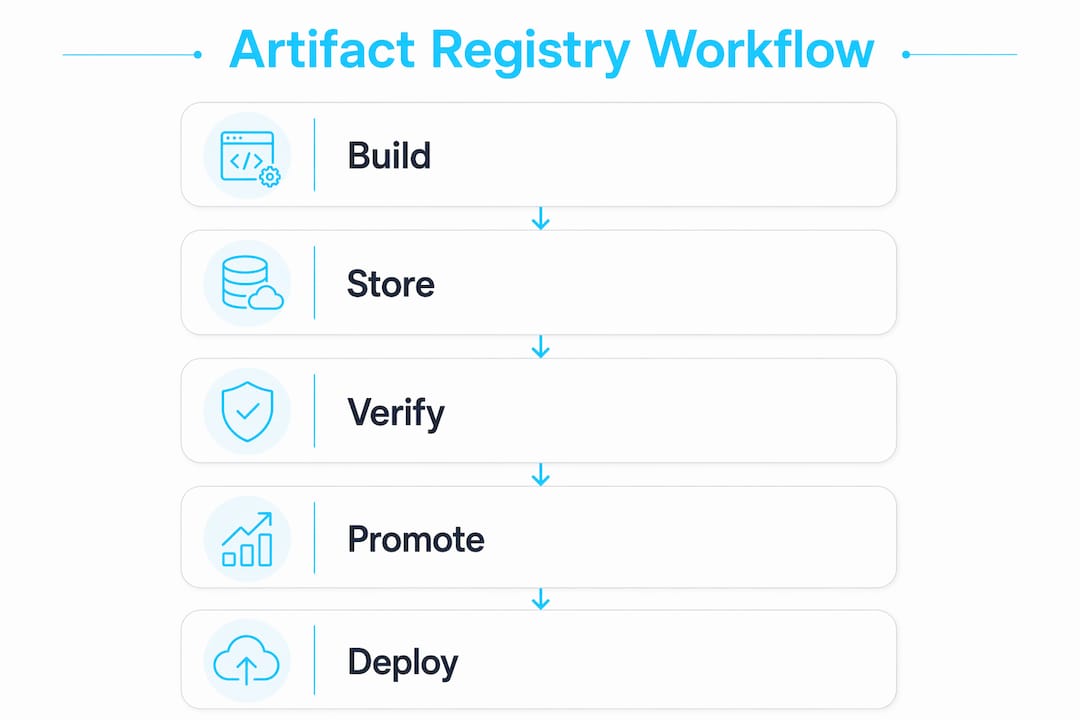
An artifact registry is defined as the immutable, centralized repository that sits between Continuous Integration and Continuous Delivery, serving as the single source of truth for every build output your pipeline produces. The role of artifact registry in DevOps goes far beyond simple file storage. It enforces the principle that what gets tested is exactly what gets deployed, byte for byte, with no recompilation and no environment-specific surprises. Modern registries handle over 40 package formats, from Docker and OCI images to Maven, npm, PyPI, Helm charts, NuGet packages, and AI/ML models. If your CI/CD pipeline skips a proper registry, you are flying blind on traceability, rollback, and supply chain security.
What is the role of artifact registry in DevOps pipelines?
An artifact registry acts as the critical boundary between CI and CD, where CI owns build correctness and CD owns deployment correctness. That boundary only works when both sides trust the same immutable artifact. Without it, teams rebuild from source per environment, which introduces non-determinism and makes production incidents nearly impossible to trace.
The registry also defines organizational ownership. CI pushes a verified artifact; CD pulls and deploys it. Tracking exact production versions and maintaining audit trails becomes straightforward when every deployment references a specific, immutable artifact version rather than a freshly compiled binary. This separation is not just a workflow preference. It is the foundation for reliable incident response, compliance audits, and rollback procedures.

Artifact registries have also evolved into supply chain management platforms that enforce governance, vulnerability scanning, and auditability at every lifecycle stage. That evolution matters because modern software ships with hundreds of third-party dependencies, each carrying its own risk surface.
How do registries enforce immutability and artifact promotion?
The “build once, deploy everywhere” principle is a failure mitigation strategy that ensures byte-for-byte artifact consistency across dev, staging, and production. Rebuilding identical source code per environment introduces non-determinism. Compiler versions, dependency resolution order, and environment variables can all produce subtly different binaries that pass testing but fail in production.
Artifact promotion solves this cleanly. Instead of rebuilding, you move the same artifact through environments by updating its metadata tags. An artifact tagged dev-ready becomes staging-ready after integration tests pass, then prod-ready after final approval. Artifacts are never modified; only metadata tags change to mark environment readiness. This gives you a clean audit trail and reliable rollback at every stage.
Key benefits of immutability and promotion tagging:
- Reliable rollbacks: Any previous production artifact remains available and unchanged, so reverting is a tag swap rather than a rebuild.
- Clean audit trails: Every promotion event is timestamped and attributed, which satisfies compliance requirements without extra tooling.
- Reduced deployment discrepancies: The same binary that passed staging tests runs in production, eliminating “works on my machine” failures.
- Traceability: You can trace any running service back to its exact source commit, build log, and test results.
Pro Tip: Tag artifacts with both a semantic version and a build ID. The semantic version communicates intent to humans; the build ID links back to the exact CI run for forensic tracing.
What artifact types do modern registries manage?
Modern artifact management covers far more than container images. Professional artifact managers support over 40 package formats including Docker, OCI images, Maven JARs, npm packages, PyPI wheels, Helm charts, NuGet packages, and AI/ML models. That breadth reflects how modern software supply chains actually work: a single application might ship a Python ML model, a Go binary, a Helm chart for Kubernetes deployment, and a set of npm frontend assets.
AI/ML models are now treated as first-class artifacts. They carry versioned weights, training metadata, and dependency manifests, and they require the same governance controls as any other production binary. Agentic AI components add another layer, since they may include prompt templates, tool definitions, and runtime configs that all need version control and audit trails.
| Artifact type | Common format | Typical DevOps usage |
|---|---|---|
| Container images | Docker, OCI | Kubernetes deployments, microservices |
| JVM packages | Maven, Gradle | Java and Kotlin application builds |
| JavaScript packages | npm, Yarn | Frontend builds, Node.js services |
| Python packages | PyPI, wheel | Data pipelines, ML model serving |
| Kubernetes configs | Helm charts | Application packaging and release |
| .NET packages | NuGet | Windows services, .NET microservices |
| ML models | ONNX, pickle, SavedModel | Inference services, AI pipelines |
Universal artifact managers handle this diversity under one governance layer. You get unified access controls, retention policies, and vulnerability scanning across every format rather than managing separate registries per language ecosystem. That consolidation reduces operational overhead and closes security gaps that appear when teams run ad hoc storage for non-container artifacts.
Artifact registry vs. container registry: which do you need?
Container registries are optimized specifically for OCI images and Kubernetes workflows. They handle image layering, manifest lists for multi-architecture builds, and fast pull operations at scale. If your entire stack is containerized and your governance needs are minimal, a container registry covers the basics.
Artifact registries manage broader binary and package ecosystems with retention policies, metadata controls, and multi-format support. They are the right choice when you need formal release controls, cross-format governance, or supply chain security features like vulnerability scanning and software bill of materials (SBOM) generation.
| Dimension | Container registry | Artifact registry |
|---|---|---|
| Primary format | OCI/Docker images | 40+ formats including containers |
| Governance features | Basic access control | Retention policies, promotion tagging, audit logs |
| Supply chain security | Image scanning | Scanning, SBOM, license compliance |
| Best for | Pure container workflows | Multi-language, multi-format ecosystems |
| Kubernetes integration | Native | Supported, often via Helm chart repos |
Most mature engineering teams end up using both. The container registry handles high-volume image pulls in Kubernetes, while the artifact registry manages the broader release pipeline including libraries, Helm charts, and ML models. The governance and supply chain security requirements of your organization are the deciding factor.
What are the best practices for artifact registry integration?
Getting artifact registry integration right requires treating it as infrastructure, not an afterthought. These steps reflect what actually works in production environments.
-
Manage registry infrastructure as code. Terraform and policy-as-code tools prevent configuration drift and ensure retention policies, access controls, and proxy settings apply consistently across environments. A registry configured by hand will drift. One defined in code stays auditable and reproducible.
-
Configure upstream proxying for all public dependencies. Upstream proxying caches public packages, isolates your builds from external registry outages, and creates an audit trail of every third-party package your pipeline consumes. This single pattern eliminates a large class of build failures and supply chain risks simultaneously.
-
Enforce immutability at the registry level. Disable overwrite permissions on release repositories. Snapshots and development builds can be mutable, but anything tagged for staging or production must be write-protected. This is a registry configuration, not a team convention.
-
Integrate vulnerability scanning into the promotion gate. Scan artifacts before they advance from dev to staging. Block promotion on critical CVEs. This puts security enforcement at the artifact level rather than relying solely on source code scanning, which misses binary-level vulnerabilities.
-
Use role-based access control (RBAC) tied to pipeline identity. CI pipelines should have write access to development repositories only. Promotion to staging and production should require a separate service account with audited credentials. This limits blast radius if a pipeline credential is compromised.
-
Automate retention and cleanup policies. Unbounded artifact storage creates cost and compliance problems. Define retention rules: keep the last N builds per branch, retain all release artifacts indefinitely, and purge snapshot builds after 30 days. Codify these rules in Terraform or your registry’s API.
Pro Tip: Integrate your artifact registry with your CI/CD pipeline security checks so that every promotion event triggers an automated audit log entry. This gives you a complete chain of custody from source commit to production deployment without any manual documentation.
Common CI/CD pipeline mistakes often trace back to skipping these fundamentals: teams rebuild per environment, skip vulnerability gates, or store artifacts in ad hoc locations that have no retention policy or access control.
Key Takeaways
An artifact registry is the immutable contract between CI and CD that ensures every deployment is traceable, reproducible, and secure across all environments.
| Point | Details |
|---|---|
| Immutability is non-negotiable | Artifacts must never be modified after creation; only metadata tags should change during promotion. |
| Build once, deploy everywhere | Rebuilding per environment introduces non-determinism; the same binary must traverse all stages. |
| Registries go beyond containers | Modern registries handle 40+ formats including ML models, Helm charts, and language packages. |
| Infrastructure as code prevents drift | Define registry configuration in Terraform to enforce consistent policies across all environments. |
| Upstream proxying improves resilience | Caching public dependencies locally isolates builds from outages and creates third-party audit trails. |
Why I think most teams underestimate their artifact registry
I have seen teams spend weeks hardening their CI pipelines with static analysis, secret scanning, and test coverage gates, then push the resulting binary to an S3 bucket with no versioning, no access control, and no retention policy. That is not a registry. That is a file share with a URL.
The most dangerous misconception I keep running into is that rebuilding from the same source tag is “safe enough.” It is not. Compiler toolchain updates, transitive dependency resolution changes, and environment variable differences all mean that two builds from the same commit can produce different binaries. The build-once principle exists precisely because this failure mode is real and common.
The other thing teams consistently underestimate is the organizational boundary value. When CI owns the artifact and CD consumes it, you get clean accountability. Incidents become easier to diagnose because you can always answer: “What exact artifact was running?” Without a proper registry, that question takes hours to answer. With one, it takes seconds.
AI/ML model governance is where I see the next wave of registry adoption. Teams that already manage containers and packages well are now asking how to version, scan, and promote ML models through the same promotion pipeline. The answer is the same registry, extended with model-specific metadata. The immutable infrastructure patterns that work for containers apply directly to model artifacts.
— James
Artifact registry workflows, built for production engineers
Devopsaitoolkit provides AI-powered workflows, prompt libraries, and automation guides built specifically for engineers managing production CI/CD pipelines, Kubernetes clusters, and software supply chains.
The DevOps AI ToolKit includes ready-to-use prompts for artifact promotion pipelines, supply chain hardening, and registry configuration as code. Whether you are setting up upstream proxying in Terraform, enforcing RBAC on your artifact repositories, or integrating vulnerability scanning into your promotion gates, the toolkit gives you tested workflows rather than blank-page problems. Check the pricing page to find the plan that fits your team’s scale and workflow needs.
FAQ
What is an artifact registry in DevOps?
An artifact registry is a centralized, immutable repository that stores build outputs such as container images, packages, and binaries between CI and CD stages. It serves as the single source of truth that ensures deployed artifacts match tested artifacts exactly.
Why is immutability important in artifact management?
Immutability prevents artifacts from being modified after creation, which eliminates non-determinism between environments and enables reliable rollbacks. Only metadata tags change during promotion; the artifact binary itself stays unchanged.
What is the difference between an artifact registry and a container registry?
A container registry is optimized for OCI images and Kubernetes workflows, while an artifact registry manages broader ecosystems including Maven, npm, PyPI, Helm charts, and ML models with governance and retention controls. Teams with multi-format pipelines need an artifact registry; container-only teams can use either.
How does artifact promotion work in a CI/CD pipeline?
Artifact promotion moves the same immutable artifact through dev, staging, and production by updating metadata tags rather than rebuilding. This guarantees byte-for-byte consistency and creates a clean audit trail at every stage.
How do artifact registries support software supply chain security?
Artifact registries enforce vulnerability scanning, SBOM generation, access controls, and audit logging at the artifact level. Upstream proxying also caches and audits third-party dependencies, reducing exposure to compromised public packages.
Recommended
- Orchestrating Multi-Project Pipelines in GitLab Without the
- Monorepo Pipelines in GitLab: Only Build What Actually Changed — DevOps AI ToolKit
- Common CI/CD Pipeline Mistakes That Kill Deployments
- Dynamic Child Pipelines in GitLab: Generating YAML on the
Get 500 Battle-Tested DevOps AI Prompts — Free
500 battle-tested, copy-paste AI prompts engineered by a senior systems engineer — every one with fill-in placeholders and safety/back-out notes. Drop your email and it's yours.
- 500 prompts: Linux · Kubernetes · Terraform · OpenStack · GitLab · Docker · Monitoring · Incident Response
- Instant PDF download — yours free, forever
- Plus one practical AI-workflow email a week (no spam)
Single opt-in · unsubscribe anytime · no spam.