
SRE vs DevOps Differences Explained for Engineers
Discover the sre vs devops differences explained. Learn how these approaches impact software delivery and operations for your team.

Site Reliability Engineering (SRE) and DevOps are related but fundamentally different approaches to software delivery and operations. DevOps is a cultural philosophy that breaks down silos between development and operations teams, measured by DORA metrics like deployment frequency and lead time. SRE is an engineering discipline, originated at Google, that applies software engineering practices to operations with quantifiable reliability targets called Service Level Objectives (SLOs) and error budgets. Getting the SRE vs DevOps differences explained correctly matters because organizations that confuse the two often end up with neither fast delivery nor reliable systems.
What are the fundamental differences between SRE and DevOps?
DevOps and SRE are complementary. DevOps builds the highway for fast delivery. SRE builds the guardrails that make speed safe.

DevOps is a cultural movement. It focuses on collaboration, pipeline automation, and shipping software faster. Teams measure success with DORA metrics: Lead Time for Changes, Deployment Frequency, Mean Time to Recovery (MTTR), and Change Failure Rate. The goal is to shrink the gap between writing code and running it in production.
SRE takes a different angle. It treats reliability as a feature, not an afterthought. SRE teams define SLIs (Service Level Indicators), set SLOs as targets, and track error budgets to quantify how much unreliability a service can tolerate. Where DevOps asks “how fast can we ship?”, SRE asks “how reliable does this need to be, and are we within budget?”
The measurement systems reflect these priorities clearly:
| Dimension | DevOps | SRE |
|---|---|---|
| Primary focus | Delivery velocity and collaboration | Production reliability and safety |
| Key metrics | DORA: Lead Time, Deployment Frequency, MTTR, Change Failure Rate | SLx: SLIs, SLOs, SLAs, error budgets |
| Origin | Cultural movement, cross-industry | Google engineering practice |
| Success signal | Faster, more frequent releases | Services staying within SLO targets |
| Automation priority | CI/CD pipelines, infrastructure as code | Toil elimination, SLO tooling |
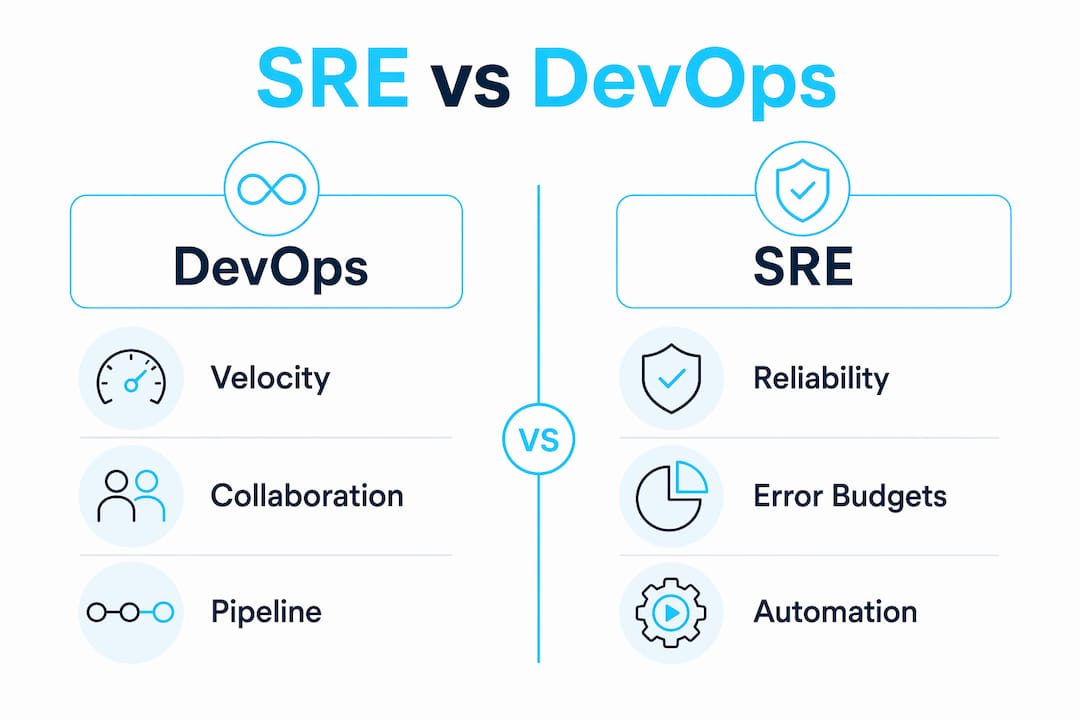
The practical implication is that DevOps and SRE use different metrics to define “done.” A DevOps team celebrates a 10-minute deployment pipeline. An SRE team celebrates a month where error budget consumption stayed under 20%.
How do team structures and roles differ between SRE and DevOps?
DevOps does not prescribe a specific job title or team shape. Most DevOps implementations embed engineers within product teams. These engineers own the full delivery pipeline, from code commit through production monitoring. The model is cross-functional by design, and the “DevOps engineer” role varies widely across organizations.
SRE structures are more defined. SRE teams organize into three common models based on team size and organizational maturity:
- Embedded model: 1–3 SREs sit inside development teams. They work directly with developers on reliability concerns and own on-call rotations for their services.
- Dedicated model: 4–10 SREs form a separate team that supports multiple product teams. They set reliability standards and consult on architecture decisions.
- Consulting model: Used in large organizations where specialist SREs review systems and advise teams without owning day-to-day operations.
One of the sharpest structural differences is the 50% toil cap in SRE. Google’s SRE model mandates that no SRE spends more than half their time on operational toil, which is manual, repetitive work that does not improve the system. The other half goes to automation, tooling, and project work. DevOps has no equivalent formal rule. This distinction matters because without the toil cap, ops-heavy roles tend to consume engineers entirely in reactive work, which is exactly the burnout pattern SRE was designed to prevent.
On-call and incident response also differ. SRE teams run structured on-call rotations with defined escalation paths and blameless postmortems after incidents. DevOps teams handle incidents too, but the process is less standardized. Postmortems in DevOps culture exist, but they are not always tied to formal SLO review cycles the way they are in SRE.
What automation and measurement practices distinguish SRE from DevOps?
Both disciplines rely heavily on automation, but they automate different things. DevOps and SRE share tooling like CI/CD platforms, infrastructure as code, and observability stacks, but apply them with different priorities.
DevOps automation priorities
- CI/CD pipelines that move code from commit to production with minimal human intervention
- Infrastructure as code using tools like Terraform or Ansible to provision environments consistently
- Deployment automation including blue/green deployments and canary releases
- Monitoring and alerting as part of the delivery pipeline
SRE automation priorities
- Toil elimination through scripting and tooling that removes manual operational steps
- SLO tracking with Prometheus and custom dashboards that surface error budget consumption in real time
- Automated incident response playbooks that reduce time to mitigation
- Capacity planning automation to predict and prevent reliability failures before they happen
Error budgets deserve a closer look because they are one of the most misunderstood SRE concepts. An error budget equals the difference between 100% availability and the SLO target. With a 99.9% SLO, the error budget is roughly 43.8 minutes of allowed downtime per month. That number is not just a threshold. It is a negotiation tool.
Error budgets function as a neutral boundary between development and operations. When the budget is healthy, development teams can deploy features freely. When the budget is exhausted, feature releases pause until reliability is restored. This removes the politics from the reliability conversation and replaces it with data.
Pro Tip: Track error budget burn rate, not just remaining budget. A service that burns 80% of its monthly budget in the first week needs attention now, not at month end.
MTTR and Change Failure Rate appear in both frameworks. In DevOps, they measure pipeline health. In SRE, they directly correlate with SLO consumption. That overlap is useful. Teams that share these metrics across DevOps and SRE functions get a common language for reliability conversations.
When should you implement DevOps and SRE together?
The sequencing question is one I hear constantly from engineers moving into platform or reliability roles. The answer is almost always: DevOps first, SRE second.
Organizations typically adopt DevOps broadly first to break silos and automate pipelines, then overlay SRE practices as systems mature and reliability becomes measurable. Here is a practical sequence:
- Start with DevOps foundations. If your team still deploys manually or runs releases on a monthly cycle, SRE practices will not stick. Fix the pipeline first. Automate builds, tests, and deployments. Establish a culture where developers own their services in production.
- Identify services that need reliability targets. Not every service needs an SLO. Customer-facing systems, payment flows, and always-on APIs are the right starting points. Define SLIs for these services before writing a single SLO.
- Set your first SLOs conservatively. A 99.5% SLO gives you more error budget to work with than 99.9%. Start where you can actually measure and meet the target, then tighten it as your observability matures.
- Introduce the toil cap gradually. Ask your ops-heavy engineers to track how much time they spend on manual work each week. Once you have data, set a team target to reduce toil by automating the most frequent tasks first.
- Run blameless postmortems across both teams. Shared postmortems between DevOps and SRE engineers build the mutual understanding that makes the combined model work. Toil elimination with AI can accelerate this by surfacing patterns in incident data automatically.
Pro Tip: Use your first SLO review meeting to align development and SRE teams on what “reliability” means for each service. Disagreements in that meeting are cheaper than disagreements during an outage.
Mature organizations implement DevOps as an organizational culture while deploying SRE as a specialized function that standardizes and automates reliability across teams. The two are not in competition. They solve different problems at different layers of the same system.
Key Takeaways
SRE and DevOps are complementary disciplines: DevOps builds delivery velocity through cultural change and pipeline automation, while SRE enforces reliability through SLOs, error budgets, and the 50% toil cap.
| Point | Details |
|---|---|
| Different metrics, different goals | DevOps uses DORA metrics; SRE uses SLOs, SLIs, and error budgets to govern reliability. |
| SRE has formal team models | Embedded, dedicated, and consulting structures match team size and organizational maturity. |
| Error budgets replace politics | A 99.9% SLO gives 43.8 minutes of monthly downtime budget, creating a data-driven release gate. |
| Toil cap is SRE-specific | SREs spend no more than 50% on operational toil; DevOps has no equivalent formal rule. |
| Sequence matters | Adopt DevOps foundations first, then overlay SRE practices as services mature and reliability becomes measurable. |
Where I land after years of watching both in production
The most common mistake I see is organizations hiring SREs before they have a working CI/CD pipeline. That is backwards. SRE practices require a baseline of delivery automation to function. You cannot manage an error budget if you cannot deploy a fix in under an hour.
The second mistake is treating SRE as a rebranded ops team. SRE is a specific implementation of DevOps principles, not a replacement for them. SREs write code. They build tooling. They automate themselves out of manual work. If your SRE team spends most of its time responding to alerts and writing runbooks, something has gone wrong in the adoption.
Career-wise, the choice between an SRE role and a DevOps role comes down to where you want to spend your energy. SRE roles demand deep troubleshooting and automation coding, often with demanding on-call schedules. DevOps roles reward cross-functional collaboration and the ability to move fast across many systems. Both paths are valuable. The engineers I have seen thrive long-term are the ones who understand both frameworks well enough to know which tool to reach for.
The goal is fast, safe delivery. DevOps gets you fast. SRE keeps it safe. You need both.
— James
Devopsaitoolkit has workflows for both sides of this equation
Engineers who want to put these principles into practice need more than theory. Devopsaitoolkit builds AI workflows for cloud engineers who manage production infrastructure across Kubernetes, Prometheus, GitLab, and Linux environments.
The platform includes prompt libraries built specifically for SRE automation tasks, including SLO tracking, incident triage, and toil identification. For DevOps engineers, the Linux Admin Prompt Pack covers 100 battle-tested prompts for the administration tasks that eat hours every week. Whether you are building your first CI/CD pipeline or tuning error budgets on a production service, Devopsaitoolkit gives you the AI-assisted workflows to move faster without breaking things.
FAQ
What is the core difference between SRE and DevOps?
DevOps is a cultural philosophy focused on breaking silos and accelerating software delivery, measured by DORA metrics. SRE is an engineering discipline that applies software practices to operations, measured by SLOs and error budgets.
Can a team practice both SRE and DevOps at the same time?
Yes. Most mature engineering organizations use DevOps as the cultural foundation and SRE as a specialized reliability function layered on top. The two frameworks are designed to complement each other.
What is an error budget in SRE?
An error budget is the allowed downtime derived from an SLO target. A 99.9% SLO translates to roughly 43.8 minutes of allowed downtime per month. When the budget runs out, feature releases pause until reliability is restored.
What does the 50% toil rule mean for SRE teams?
SREs spend no more than 50% of their time on manual operational work. The remaining time goes to automation, tooling, and project work that improves the system and prevents future toil.
Is SRE better than DevOps for reliability?
SRE provides more precise reliability governance through SLOs and error budgets, making it the stronger choice for customer-facing, always-on systems. DevOps is the better starting point for teams still building delivery automation and cross-functional culture.
Recommended
- Best AI Tools for SRE Teams in 2026 (A Practitioner’s Guide)
- AI SRE Agents Compared (2026): Bits AI, PagerDuty & More
- How to Choose the Right DevOps as a Service Provider — DevOps AI ToolKit
- Identifying and Eliminating Toil with AI: An SRE Playbook
Get 500 Battle-Tested DevOps AI Prompts — Free
500 battle-tested, copy-paste AI prompts engineered by a senior systems engineer — every one with fill-in placeholders and safety/back-out notes. Drop your email and it's yours.
- 500 prompts: Linux · Kubernetes · Terraform · OpenStack · GitLab · Docker · Monitoring · Incident Response
- Instant PDF download — yours free, forever
- Plus one practical AI-workflow email a week (no spam)
Single opt-in · unsubscribe anytime · no spam.