
Secrets Management in DevOps: A Practical Guide
Discover the crucial role of secrets management in DevOps. Secure your credentials effectively and protect your systems from costly breaches.

Secrets management in DevOps is the structured practice of securing, storing, and automating the lifecycle of sensitive credentials across infrastructure and deployment pipelines. Every API key, database password, TLS certificate, and SSH token your systems use is a secret. The role of secrets management in DevOps goes beyond locking credentials in a vault. It covers the full lifecycle: creation, storage, access, rotation, revocation, and auditing, as defined by the OWASP Secrets Management Cheat Sheet. Poor handling has real consequences. Credential-stuffing breaches cost an average of $4.8 million per incident and take 292 days to identify and contain. That number should reframe how your team thinks about a .env file sitting in a repo.
What are the core components of effective secrets management?
Effective secrets management for DevOps teams rests on five pillars: centralized storage, lifecycle automation, fine-grained access control, identity integration, and continuous auditing. Miss one and the others start to crack.
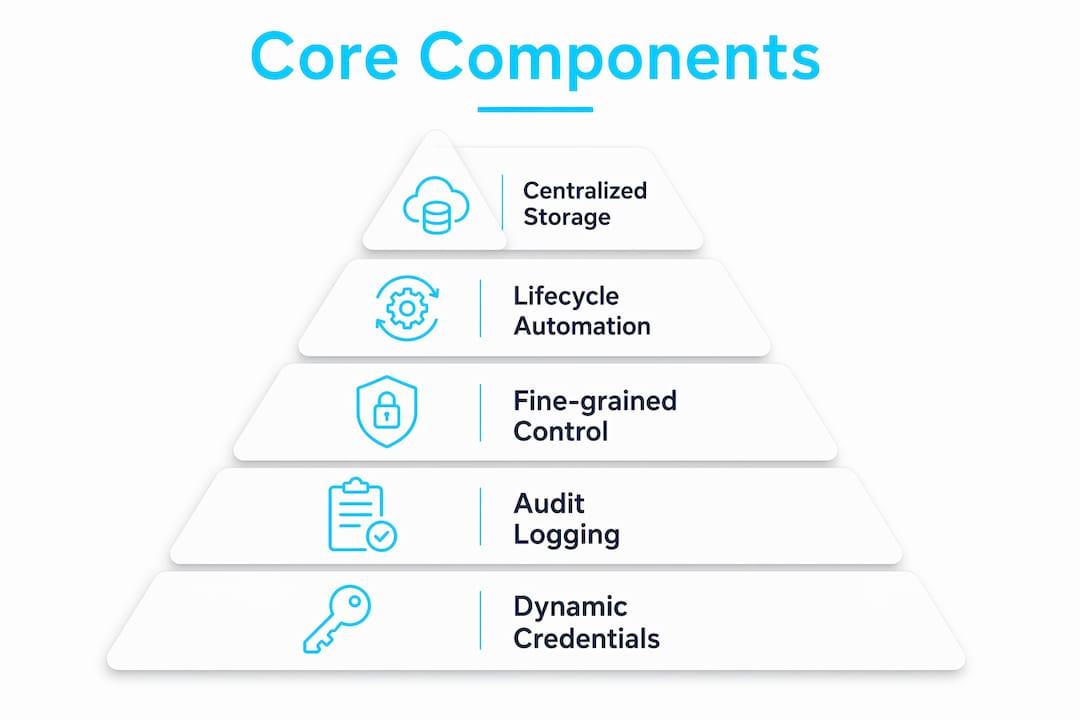
Centralized vs. decentralized architecture
Centralizing secrets simplifies auditing and policy enforcement but can create bottlenecks. Decentralized models give teams more autonomy but complicate standardization. The right choice depends on your team size, operational model, and how strictly you need to enforce policy. Most mature organizations land somewhere in between: a central secrets platform with self-service access patterns for individual teams.
Lifecycle automation and dynamic credentials
Static, long-lived credentials are the root cause of most secrets-related breaches. OWASP recommends dynamic short-lived credentials as the standard, where secrets are generated on demand and expire automatically. This removes the window of opportunity for an attacker who intercepts a credential. Automated rotation, combined with expiry policies, means no human needs to remember to change a password every 90 days.

Access control tied to identity
Fine-grained access control means a service only gets the secret it needs, nothing more. Tying access to an identity provider (IdP) like Okta, Azure AD, or your Kubernetes service account system means access policies follow the identity, not a static token. When someone leaves your organization, IdP-integrated access revocation removes their secret access automatically. Manual offboarding processes fail. Automated ones do not.
- Centralized storage: One authoritative source of truth for all secrets, with versioning and audit logs.
- Dynamic credentials: Secrets generated at runtime with short TTLs, reducing exposure windows.
- Identity-based access: Access tied to workload or user identity, not hardcoded tokens.
- Automated rotation: Secrets rotate on a schedule or on demand without manual intervention.
- Audit logging: Every access event is recorded, timestamped, and queryable for compliance.
Pro Tip: Start with audit logging before you tackle rotation. You cannot fix what you cannot see. Knowing which services access which secrets tells you exactly where to focus your automation effort first.
How does secrets management improve CI/CD pipeline security?
CI/CD pipelines are the most common place secrets get exposed. A developer adds a database password to a pipeline variable, it ends up in a build log, and suddenly it is in your SIEM and your incident queue at the same time.
The fix is identity-based secret retrieval at runtime. Here is how a well-structured pipeline handles it:
- The CI job authenticates with an OIDC token. The pipeline runner presents a short-lived identity token to a central vault, proving who it is without storing any credentials.
- The vault validates the token and issues a scoped secret. The secret is specific to that job, that environment, and that moment in time.
- The job uses the secret and it expires. No secret persists after the job finishes. There is nothing to rotate manually and nothing to leak.
- Every access is logged. The vault records which pipeline, which job, and which secret was accessed, giving you a full audit trail.
Modern CI/CD pipelines should authenticate with OIDC tokens to a central vault to fetch short-lived secrets on demand. This eliminates static secrets in pipeline configs entirely. If you are using GitLab CI, the OIDC-based secrets pattern removes long-lived keys from your pipeline variables completely.
Preventing secrets from appearing in logs requires explicit masking rules and, more reliably, never passing secrets as environment variables to commands that echo their arguments. Use file-based injection or in-memory retrieval instead.
Pro Tip: Scan your existing pipeline configs for hardcoded secrets before you build the new workflow. Tools like git-secrets or trufflehog will surface what you already have in history. Fix the past before you architect the future.
What are the common pitfalls in secrets management for DevOps teams?
Most secrets management failures are not technical. They are operational. Teams build a vault, connect a few services, and then stop. Six months later, half the organization is still using .env files and Slack messages to share credentials.
Secrets sprawl is the most common challenge. Secrets stored in disconnected places, including environment variables, config maps, CI variables, and local files, undermine both security and operational efficiency. You cannot rotate what you cannot find.
- Manual offboarding gaps: When access revocation is not automated, departed employees or decommissioned services retain secret access indefinitely.
- Rotation without retry logic: Automating secret rotation requires retry logic and concurrent access handling. A naive rotation script that swaps a credential mid-request will cause outages.
- Ignoring development environments: Developers often use production-equivalent secrets locally. This is where most accidental commits happen.
- Compliance gaps from poor auditing: Large organizations struggle to produce access logs for specific secrets during audits. Without structured logging from day one, this becomes a painful retroactive effort.
Shifting left on secret detection means catching a leaked credential at commit time, not after it has been pushed to a shared repository and pulled by a dozen services. Pre-commit hooks and CI pipeline scanners reduce remediation cost exponentially compared to post-push detection. The earlier you catch it, the cheaper it is to fix.
The offboarding problem deserves special attention. Automated access tied to IdP synchronization prevents lapses in offboarding that can otherwise expose secrets to unauthorized personnel for weeks. Build this into your HR and IT workflows, not just your security runbooks.
Which tools and automation strategies work for modern secrets management?
The right tooling depends on your infrastructure, but the patterns are consistent across platforms. The goal is to make the secure path the easy path for every developer on your team.
Managed identities provide a secure way for applications to authenticate without storing credentials directly. This reduces the secrets management burden at the application layer significantly. On Kubernetes, workload identity and service account token projection serve the same purpose.
Infrastructure as code (IaC) tools like Terraform integrate with secrets managers to inject credentials at provisioning time without writing them to state files. The secrets in IaC pattern requires explicit configuration to avoid leaking values into plan outputs or remote state. Get this wrong and your Terraform state becomes a credential store.
| Approach | Best for | Key consideration |
|---|---|---|
| Centralized vault with OIDC | CI/CD and microservices | Requires identity federation setup |
| Managed identities | Cloud-native workloads | Platform-specific, reduces secret count |
| IaC secret injection | Provisioning workflows | Must exclude secrets from state outputs |
| Pre-commit scanning | Developer workstations | Catches leaks before they reach repos |
| IdP-synced access lifecycle | Team and org-level access | Automates onboarding and offboarding |
Automating the access lifecycle with IdP synchronization means new engineers get the right access on day one and lose it on their last day without anyone filing a ticket. Pair this with a unified audit dashboard and you have the compliance story most security teams ask for. For production-grade patterns, the Vault and Sealed Secrets guide covers the operational details that matter when things go wrong at 2 AM.
Key Takeaways
Secrets management in DevOps is a lifecycle discipline, not a one-time configuration. Teams that automate credential creation, rotation, and revocation tied to identity reduce breach risk and eliminate the manual friction that slows deployments.
| Point | Details |
|---|---|
| Lifecycle automation is the foundation | Automate creation, rotation, and revocation to remove human error from the critical path. |
| OIDC replaces static pipeline secrets | Use identity tokens in CI/CD to fetch short-lived credentials at runtime instead of storing them. |
| Secrets sprawl is the top operational risk | Audit all secret storage locations before building new workflows to avoid managing two systems. |
| IdP integration closes the offboarding gap | Tie access revocation to your identity provider so departing users lose access automatically. |
| Shift-left scanning cuts remediation cost | Pre-commit hooks catch leaked credentials before they reach shared repositories. |
Why I think most teams underestimate secrets management
I have seen teams spend months hardening their Kubernetes network policies and zero days thinking about how their CI runner authenticates to a database. The network policy protects against an attacker who has already gotten in. A leaked credential in a pipeline variable is the attacker getting in.
The operational velocity argument is the one that actually moves teams. When you automate secret rotation, you stop getting paged at 3 AM because a certificate expired. When you use OIDC in your pipelines, you stop having a rotation backlog of 40 static keys that nobody wants to touch. The DevOps security practices that stick are the ones that make the engineer’s day easier, not harder.
My honest recommendation: start with the audit log and the offboarding workflow. Not the vault architecture, not the rotation schedule. Know what you have and make sure ex-employees cannot access it. Everything else builds from there.
The teams I have seen get this right all share one trait. They treat secrets management as an engineering problem with operational consequences, not a compliance checkbox. That mindset shift is what separates a team that has a vault from a team that actually uses it well.
— James
Devopsaitoolkit and secrets management workflows
Secrets management gets complicated fast, especially when you are managing Kubernetes, GitLab, Terraform, and Prometheus across multiple environments.
Devopsaitoolkit builds AI-powered workflows for exactly this kind of work. The prompt libraries and automation guides cover secrets injection patterns, OIDC setup, rotation automation, and IaC secret handling for real production infrastructure. If your team is spending hours on manual credential management or patching secrets sprawl across environments, the Devopsaitoolkit pricing page shows the plans built for engineering teams who need to move faster without cutting corners on security.
FAQ
What is secrets management in DevOps?
Secrets management in DevOps is the practice of securing, storing, rotating, and auditing sensitive credentials like API keys, passwords, and certificates across infrastructure and pipelines. It covers the full credential lifecycle from creation through revocation.
Why does secrets management matter for CI/CD pipelines?
Static secrets stored in pipeline variables are a common source of credential leaks. Using OIDC tokens to fetch short-lived secrets at runtime eliminates persistent credentials from pipeline configurations entirely.
What is secrets sprawl and how do you fix it?
Secrets sprawl occurs when credentials are stored in multiple disconnected locations, including environment files, CI variables, and config maps. The fix is centralizing secrets in a single vault and auditing all existing storage locations before migrating.
How does automated secret rotation work without causing downtime?
Automated rotation requires retry logic and concurrent access handling so services can use the old credential while the new one propagates. Naive rotation scripts that swap credentials mid-request cause outages without this logic.
What is the shift-left approach to secrets security?
Shift-left means detecting secret leaks at commit time using pre-commit hooks or CI pipeline scanners, before credentials reach shared repositories. Catching a leak at commit time costs far less to remediate than discovering it after a push.
Recommended
- Managing Secrets in Production: Vault, Sealed Secrets, and the Patterns That Actually Hold — DevOps AI ToolKit
- Managing Secrets in Infrastructure as Code Without Leaking Them — DevOps AI ToolKit
- DevOps Security Best Practices Every Engineering Team Should Follow — DevOps AI ToolKit
- Secrets Management in GitLab CI: Stop Storing Long-Lived Keys With OIDC — DevOps AI ToolKit
Get 500 Battle-Tested DevOps AI Prompts — Free
500 battle-tested, copy-paste AI prompts engineered by a senior systems engineer — every one with fill-in placeholders and safety/back-out notes. Drop your email and it's yours.
- 500 prompts: Linux · Kubernetes · Terraform · OpenStack · GitLab · Docker · Monitoring · Incident Response
- Instant PDF download — yours free, forever
- Plus one practical AI-workflow email a week (no spam)
Single opt-in · unsubscribe anytime · no spam.