
How to Reduce MTTR with AI Tooling: SRE Guide 2026
Discover how to reduce MTTR with AI tooling. Implement a telemetry-first approach to quickly enhance system reliability and performance.

A telemetry-first, phased AI pilot targeting alert correlation, automated root-cause analysis, and guarded remediation is the fastest path to measurable MTTR reduction. Teams that pair this approach with process change and data centralization typically see measurable MTTR gains within the first few months, scaling to larger improvements over time. Here is where to start:
- Centralize telemetry first. Logs, traces, metrics, and deployment history must land in one queryable layer before AI can correlate across them. OpenTelemetry is the practical standard for getting there without vendor lock-in.
- Pick one high-impact service. Choose something with frequent incidents and consistent existing telemetry. Full-stack coverage is not the goal in week one.
- Run AI in advisory mode. Human-in-loop is not a crutch; it is how you build trust in AI outputs before you let them touch production.
- Define your SLO-aligned success metric before day one. A 30–50% reduction in alert correlation time or a measurable drop in duplicate alerts per incident are both visible within weeks.
Devopsaitoolkit’s MTTR prompt library gives you copy-paste starting points for each of these steps so you are not writing prompts from scratch during a live incident.
Table of Contents
- Why does MTTR stay high in modern production environments?
- How does AI actually reduce MTTR across each incident phase?
- What telemetry does AI need to investigate effectively?
- Practical AI workflows and copy-paste prompts for SREs
- How should you structure a 30–60 day pilot?
- How do you evaluate AI tooling for MTTR reduction?
- What are the most common implementation pitfalls?
- How do you measure MTTR improvements and demonstrate ROI?
- What should your team do in the next 30 days?
- Key Takeaways
- The AI maturity trap is real, and most teams fall into it
- Devopsaitoolkit gives you pilot-ready prompts and playbooks
- Useful sources and further reading
Why does MTTR stay high in modern production environments?
The honest answer is context fragmentation. Logs live in one tool, traces in another, deployment metadata in a third, and service ownership in a wiki nobody updates. When an alert fires at 2 AM, the on-call engineer spends the first 10–15 minutes just assembling the picture, not diagnosing it. That assembly cost is where most MTTR hides.
Alert fatigue compounds the problem. When hundreds of raw alerts fire for a single degraded dependency, engineers waste triage time triaging noise rather than the actual failure. Duplicate alerts, flapping thresholds, and missing correlation IDs all feed this pattern.

Instrumentation gaps break AI outputs just as badly as they break human investigation. An AI agent that cannot see traces for a service, or that sees logs with inconsistent service.name labels, will either miss the root cause or propose a wrong one confidently. Garbage in, garbage out applies here more than anywhere.
Pro Tip: Instrument the “failure window” first. Capture a 5–10 minute window around alert timestamps with high-cardinality traces and correlated logs. That window is where AI gets its evidence. If it is dark, no model compensates for the missing signal.
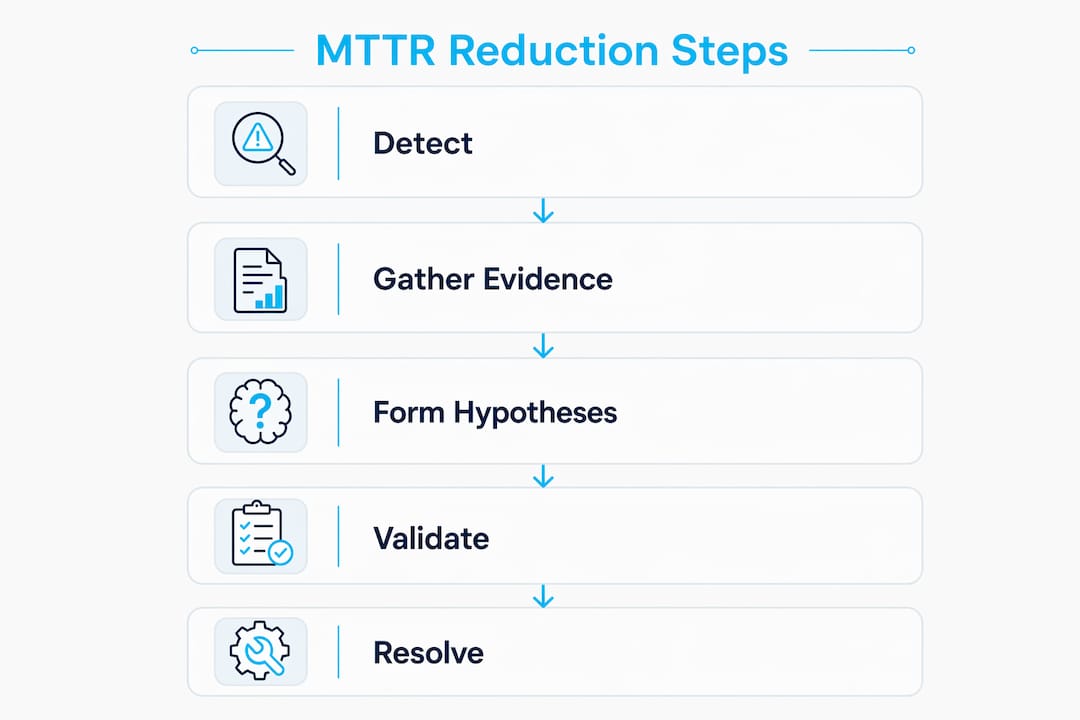
Understanding where incident time actually goes is the prerequisite for knowing which AI use case to apply first.
How does AI actually reduce MTTR across each incident phase?
AI does not magically fix incidents. It compresses specific phases of the timeline. Here is where each capability lands and what output an SRE will actually see.
-
Detection (compresses MTTD). Anomaly detection learns what normal telemetry looks like across thousands of metrics and flags deviations before thresholds cross. The practical output is an earlier alert with a confidence score attached, not just a threshold breach.
-
Triage (compresses MTTA). Alert correlation and deduplication group thousands of raw events into a single actionable incident record. The AI enriches that record with owner, recent deploys, blast radius, and related service topology before a human looks at it. This is often the single biggest early MTTR win.
-
Diagnosis/RCA (compresses diagnosis time). This is where AI has the highest leverage. A RAG-grounded agent queries logs, traces, metrics, and recent commits simultaneously, then returns ranked root-cause hypotheses with evidence chains and confidence scores. A well-structured RCA output looks like this:
Likely root cause (confidence: 87%): OOMKill on
payments-workerpod triggered by a ConfigMap change deployed at 14:32 UTC. Evidence: (1)payments-workermemory RSS crossed 1.8 GB at 14:34 UTC per cAdvisor metrics; (2) tracespan_id=a3f9shows 503s fromcheckout-apibeginning 90 seconds after the ConfigMap rollout. -
Remediation (compresses repair time). AI-powered runbooks propose the next action. For low-risk, repeatable fixes (cache clear, pod restart, feature flag toggle), guarded auto-remediation can execute with a human-approval gate. Require a confidence score threshold and a visible reasoning chain before any auto-action fires. Agentic AI platforms that surface these evidence chains let engineers verify before acting, which is the only safe model for production.
-
Deployment/regression detection. AI can evaluate a proposed change against historical incident data and flag rollouts likely to cause failures before they execute. This prevents incidents rather than just resolving them faster.
What telemetry does AI need to investigate effectively?
Telemetry quality is the single most common reason AI-driven MTTR initiatives fail. The AI is usually fine. The data is not. Here is the minimum viable signal set and the hygiene rules that make it usable.

| Signal | Minimum requirement | Common gap |
|---|---|---|
| Logs | Structured (JSON), timestamped, with service.name and trace_id | Unstructured text, missing correlation IDs |
| Traces | High-cardinality spans, sampled at >10% for critical paths | 1% sampling during incidents; missing for third-party services |
| Metrics | SLO-aligned (error rate, latency p99, saturation) | Inconsistent label names across teams |
| Deployment history | Commits, feature flags, rollout metadata with timestamps | No change tracking; deploys not correlated to alert timeline |
| Ownership/topology | Service maps, on-call roster, runbooks linked to services | Stale ownership labels; runbooks not linked to services |
Beyond signals, data hygiene determines whether AI can correlate across them. Consistent timestamps (NTP-synced across all emitters), preserved correlation IDs through every service hop, and standardized label naming (service vs service.name vs workload.name cannot all mean the same thing) are non-negotiable. Every label mismatch is a chance for the AI to miss a connection or propose the wrong root cause.
For security-conscious teams, prefer Model Context Protocol-style integrations that give AI agents access only to incident-scoped files and ephemeral repo views. VPC-bound or self-hosted connectors keep proprietary code and telemetry out of public models.
Pro Tip: Run these four checks in your pilot’s first 7–14 days: (1) time-sync check across all log emitters, (2) missing-trace detection for your target service’s critical paths, (3) label gap audit comparing service.name across logs/traces/metrics, (4) deployment event coverage — confirm every deploy in the past 30 days appears in your change history.
Practical AI workflows and copy-paste prompts for SREs
The investigative loop that works in practice follows this pattern: Detect → gather evidence → form hypotheses → validate queries → converge on root cause → propose remediation → human review → verify. Modern agentic AI runs the middle steps in parallel rather than sequentially, which is where the time savings come from.
Three workflows to run in your pilot
Workflow 1: Alert enrichment and rapid owner assignment
- Ingest the raw alert from your monitoring tool.
- AI queries the service map and on-call roster to identify the owning team.
- AI pulls the last three deploys for that service and attaches them to the incident record.
- Output: enriched incident ticket with owner, blast radius estimate, and recent change context. Human reviews and pages the right team.
Workflow 2: Parallel hypothesis RCA
- AI receives the enriched incident and spawns parallel queries: one against logs, one against traces, one against metrics, one against recent commits.
- Each query returns evidence for or against a candidate root cause.
- AI ranks hypotheses by confidence score and presents the top two with supporting evidence chains.
- Human engineer reviews, selects, and confirms before any remediation is proposed.
Workflow 3: Guarded remediation for safe auto-actions
- AI proposes a remediation (pod restart, cache flush, feature flag toggle).
- Approval gate fires: confidence score must exceed threshold, action must be on the pre-approved safe-action list, and a human must sign off.
- Action executes with a rollback trigger pre-staged. Outcome is logged for audit.
Copy-paste prompts
RCA starter prompt:
Given the following alert context: [paste alert body], recent deploys: [paste last 3 deploys with timestamps], and the attached log excerpt: [paste 20–30 lines around alert timestamp], identify the two most likely root causes. For each, list the supporting evidence and assign a confidence score (0–100). Flag any missing telemetry that would change your assessment.Runbook selection prompt:
The incident is: [one-sentence description]. The affected service is: [service name]. Available runbooks: [list titles]. Which runbook applies? State the matching criteria and the first three steps.Safe-remediation approval prompt:
Proposed action: [action]. Confidence score: [score]. Evidence summary: [two sentences]. Is this action on the approved safe-action list? What is the rollback procedure? Confirm human approval before executing.Safety checklist for all three workflows: scope agent tokens to the incident’s namespace, limit repo access to incident-scoped files only, and set a hard confidence-score threshold below which no auto-action fires. The AI incident response guide covers what these guardrails look like at 3 AM when you are tired and tempted to skip them.
How should you structure a 30–60 day pilot?
A staged pilot framework prevents the most common failure mode: deploying AI before the data is ready and then blaming the model when it underperforms.
| Phase | Timeline | Goal | Key activities |
|---|---|---|---|
| Phase 0: Baseline | Pre-pilot | Define current state | Measure MTTR/MTTD per service; inventory telemetry and runbooks |
| Phase 1: Telemetry validation | Days 1–14 | Fix data gaps | Correlation ID audit; label normalization; synthetic alert checks |
| Phase 2: Advisory AI | Days 15–30 | Prove value safely | Enable alert correlation and RCA in advisory mode; collect MTTD, MTTA, diagnosis time |
| Phase 3: Guarded automation | Days 30–60 | Expand scope | Enable auto-remediation for approved safe actions; measure success rate and rollback frequency |
Pilot success criteria checklist:
- Measurable MTTR drop vs. pre-pilot baseline (target: at least 10–20% reduction in the first 3–6 months, with 40–70% possible over 6–18 months)
- Triage time reduction visible in per-incident data
- False-positive remediation rate below agreed threshold (suggest <5%)
- Engineers report trust in AI suggestions (qualitative, via retro)
- Rollback frequency stable or declining across phase 3
Define the success metric before you deploy anything. A 30–50% reduction in alert correlation time is visible within weeks and is a strong early indicator that AI is compressing the diagnostic phase. That evidence is what earns the expansion to more services or automated remediation.
How do you evaluate AI tooling for MTTR reduction?
Not all tools compress the same MTTR phases. Use this scorecard to ask the right questions before committing to a pilot.
| Dimension | What to ask | Pass threshold |
|---|---|---|
| Telemetry integration | Can it read logs, traces, metrics, and deployment history natively or via OpenTelemetry? | All four signal types accessible |
| Explainability | Does it surface confidence scores and evidence chains for every finding? | Yes, inspectable by engineer |
| Automation controls | Does it have RBAC, approval gates, audit logs, and rollback mechanics? | All four present |
| Operational fit | What is the onboarding effort? Can it run alongside existing tooling? | <2 weeks to first value |
| Security/data handling | VPC-bound or self-hosted connectors available? Ephemeral repo access only? | Both available |
| Investigation latency | How long does an RCA take during a live incident? | <2 minutes for initial hypothesis |
Buyer’s checklist before signing:
- Confirm the tool can ingest your existing telemetry without requiring a full re-instrumentation.
- Ask for a demo on a real past incident from your environment, not a canned scenario.
- Verify that auto-remediation actions are scoped and reversible by default.
- Check whether the tool supports eBPF-based collectors or similar first-party telemetry, which reduces blind spots compared to API-only integrations.
- Confirm compliance posture matches your data residency requirements.
For a broader comparison of tool categories and fit, the AI DevOps tools overview on Devopsaitoolkit covers how to match tool architecture to your existing stack.
What are the most common implementation pitfalls?
Most AI-driven MTTR initiatives that stall do so for predictable reasons. Here is what to watch for and how to fix it before it costs you the pilot.
-
Rushing to autonomous remediation before telemetry quality is verified. Automation amplifies whatever is true about your signals. Bad signals become faster disruption, not faster resolution. Mitigation: enforce a telemetry validation gate (Phase 1 above) and keep human-in-loop for the full first 30 days.
-
Noisy or inconsistent labels leading to wrong RCA. If
service.namemeans different things in logs versus traces, the AI will correlate incorrectly. Mitigation: run a label audit in week one, enforce naming conventions in your CI pipeline, and add lightweight normalization rules in the pilot’s ingestion layer. -
Model hallucinations or overconfident suggestions. AI will occasionally propose a root cause with high confidence that is simply wrong. Mitigation: require visible evidence chains for every finding, set a confidence threshold below which suggestions are flagged as low-confidence, and log all rejected suggestions. Those rejections are training signal for prompt and telemetry improvement.
-
Poor change management and lack of runbook ownership. AI-suggested runbooks that nobody owns or that are six months out of date will fail at the worst moment. Mitigation: assign a named owner to every runbook, add a runbook review step to your post-incident flow, and treat stale runbooks as a reliability risk. The rollback guidance on Devopsaitoolkit is a useful reference for building those review criteria.
-
Measuring only end-to-end MTTR. If you only track the aggregate number, you cannot tell whether AI is compressing diagnosis time or whether faster deploys are driving the change. Measure each phase separately from day one.
How do you measure MTTR improvements and demonstrate ROI?
Metric definitions
- MTTD (Mean Time to Detect): time from incident start to first alert.
- MTTA (Mean Time to Acknowledge): time from alert to engineer engagement.
- Diagnosis time: time from acknowledgment to confirmed root cause.
- MTTR: time from detection to full resolution.
- Auto-resolve rate: percentage of incidents resolved without human intervention.
Measure per-service and weight by business impact. A 40% MTTR reduction on a low-traffic internal service is less meaningful than a 15% reduction on your payment API.
Dashboard widgets to track
- MTTR trend line (weekly, per service)
- Triage time distribution (p50, p90 per incident)
- Automation success rate (auto-actions that resolved without rollback)
- False-positive remediation rate
- Alert volume and deduplication rate
ROI calculation
Estimate engineer-hours saved per month (baseline diagnosis time minus AI-assisted diagnosis time, multiplied by incident frequency). Multiply by your loaded labor rate. Add avoided customer-impact cost (estimated revenue at risk per hour of downtime, multiplied by hours avoided). Compare that total to tool cost plus integration effort over 12 months.
Teams that pair AI tooling with process change and data centralization commonly achieve significant MTTR reductions over several months. Early-phase gains within the first few months are realistic and serve as useful indicators for budgeting.
What should your team do in the next 30 days?
Three steps, in order. Do not skip to step three.
-
Centralize telemetry for one high-impact service. Pick the service with the most frequent incidents and the most consistent existing instrumentation. Get logs, traces, metrics, and deployment history into a single queryable layer. OpenTelemetry is the right standard to build on.
-
Run a 30–60 day advisory-mode pilot. Enable alert correlation and AI-assisted RCA in read-only, suggestion-only mode. Collect MTTD, MTTA, and diagnosis time from day one. Do not enable auto-remediation until phase 3.
-
Measure and expand automation gradually. After the pilot, review the data against your success criteria. If MTTR improved and the false-positive rate is acceptable, expand to a second service or enable guarded auto-remediation for your lowest-risk action category.
Immediate checklist before you start:
- Baseline MTTR and diagnosis time documented for the target service
- Correlation IDs verified end-to-end through the service’s critical paths
- SLOs defined for the pilot service (error rate, latency p99)
- Success metrics and owners assigned
- Runbooks reviewed and ownership confirmed
Go/no-go criteria after the pilot: MTTR improved by at least 10–20% vs. baseline after the first few months, AI-suggested remediations were accurate at least 90% of the time, and the on-call team reports trust in the suggestions during retros. If any criterion fails, fix the underlying data or process issue before expanding scope.
Key Takeaways
A telemetry-first, phased AI pilot targeting alert correlation and advisory-mode RCA consistently produces substantial MTTR reduction, with early 10–20% gains in 3–6 months and longer-term improvements of 40–70% as measured across industry benchmarks.
| Point | Details |
|---|---|
| Telemetry quality is the prerequisite | Fix label gaps, correlation IDs, and timestamp sync before enabling AI investigation. |
| Alert correlation is the fastest early win | Grouping raw alerts into actionable incidents compresses triage time and reduces on-call noise immediately. |
| Advisory mode before automation | Run AI in suggestion-only mode for the first 30 days to build engineer trust and validate output quality. |
| Measure each MTTR phase separately | Tracking MTTD, diagnosis time, and MTTA individually shows exactly where AI is compressing the timeline. |
| Devopsaitoolkit accelerates pilots | Copy-paste MTTR prompts, runbook templates, and telemetry checklists reduce pilot setup time from weeks to days. |
The AI maturity trap is real, and most teams fall into it
Here is the honest version of what I see happen when teams try to reduce MTTR with AI tooling: they get excited about the 40–70% reduction numbers, skip the telemetry validation phase, deploy an AI agent against inconsistent data, and then spend three months debugging why the RCA suggestions are wrong. The AI did not fail. The data did.
The cultural blocker is subtler than the technical one. Engineers who have spent years building diagnostic intuition sometimes experience AI-assisted RCA as a threat to that expertise rather than an extension of it. The framing matters. AI surfaces hypotheses and evidence; the engineer decides. That distinction keeps the team engaged and keeps the system safe. When AI suggestions are treated as drafts for expert review rather than verdicts, adoption goes up and trust builds faster.
The other thing I would push back on is the idea that AI is a one-time deployment. The prompts that work well in month one will drift as your services evolve. Rejected AI suggestions are the most valuable feedback signal you have. Log them, review them in post-incident retros, and use them to improve both your prompts and your telemetry coverage. Treat AI as an ongoing ops investment, not a tool you configure and forget.
The teams that get the most out of this approach are the ones that stay curious about why the AI was wrong, not just relieved when it is right.
Devopsaitoolkit gives you pilot-ready prompts and playbooks
The hardest part of starting an AI-driven MTTR pilot is not the tooling. It is showing up to week one with nothing to run. Devopsaitoolkit solves that with battle-tested MTTR prompt libraries, downloadable runbook templates, and telemetry checklists built specifically for SREs managing Kubernetes, Prometheus, OpenStack, and production Linux infrastructure.
Every prompt in the library maps to a specific incident phase: alert enrichment, parallel hypothesis RCA, runbook selection, and guarded remediation approval. The blameless RCA facilitation prompt is particularly useful for post-incident reviews where you want structured evidence chains without blame spirals. The pilot checklist covers the exact telemetry validation steps from Phase 1 of the framework above, formatted to drop straight into a sprint board.
Visit devopsaitoolkit.com to grab the free MTTR prompt pack and the pilot checklist. You can be running your first AI-assisted triage within the hour.
Useful sources and further reading
- How AI Cuts MTTR: Benchmarks + a 10-Step Runbook — IrisAgent: MTTR reduction benchmarks and a practical runbook for AI-assisted incident response.
- Reduce MTTR with AI — LogicMonitor: Staged pilot framework, common pitfalls, and a 30–60 day implementation guide.
- How to Reduce MTTR with AI: What Actually Works — Metoro: Telemetry quality requirements, diagnosis phase compression, and eBPF-based instrumentation approaches.
- Automate SRE Workflows with AI — Rootly: Alert noise reduction, AI-assisted debugging, and safe auto-remediation with human oversight.
- Model Context Protocol — Getting Started — Anthropic: Secure, incident-scoped agent access patterns for teams with sensitive code and telemetry.
- Steps to AIOps Maturity: Improve MTTR with AI — BigPanda: AIOps maturity phases, automated incident analysis, and root-cause change tracking.
Recommended
- Reduce MTTR with AI AI Prompts — 44 Free, Copy-Paste Prompts
- Reducing MTTR: Where the Time Actually Goes and How to Cut It — DevOps AI ToolKit
- Identifying and Eliminating Toil with AI: An SRE Playbook
- AI for MTTR: Reduce Mean Time to Resolution with AI
Get 500 Battle-Tested DevOps AI Prompts — Free
500 battle-tested, copy-paste AI prompts engineered by a senior systems engineer — every one with fill-in placeholders and safety/back-out notes. Drop your email and it's yours.
- 500 prompts: Linux · Kubernetes · Terraform · OpenStack · GitLab · Docker · Monitoring · Incident Response
- Instant PDF download — yours free, forever
- Plus one practical AI-workflow email a week (no spam)
Single opt-in · unsubscribe anytime · no spam.