
Engineers: Automate OpenStack Security Audit Evidence, Log Correlation
OpenStack audit playbook for engineers: checklist plus automated evidence capture and host-to-API log correlation so you build continuous compliance, not...

An OpenStack security audit verifies that your access controls, encryption, and logging actually work the way you claim they do, and it lives or dies on one deliverable: a mapping of every in-scope control to time-bound, verifiable evidence. Internal audits are your own gap analysis against that mapping; external audits make an outside party validate it. Build toward continuous compliance from day one, because scrambling to produce six months of evidence in a week never ends well.
TL;DR:
- Prioritize auditing Keystone and hypervisor components first to prevent initial breaches from affecting tenant workloads and reducing overall scope.
- Organize and document control-related files, logs, and scans continuously to generate verifiable evidence early, avoiding last-minute data collection.
- Automate compliance validation within your CI/CD processes, log correlation, and log retention to embed continuous audit readiness into daily operations.
- Conduct internal component-by-component pass/fail checks based on OpenStack Security Guide criteria, focusing on ownership, permissions, and TLS enforcement.
- Select auditors experienced with OpenStack and package evidence proactively, as well-organized data shortens audit duration and decreases associated costs.
Table of Contents
- Your OpenStack Security Audit Checklist to Run Right Now
- How Do You Determine the Scope of an OpenStack Security Audit?
- What Are the Four Phases of an OpenStack Security Audit?
- Internal Audit Checklist by OpenStack Component
- How Long Does an External OpenStack Compliance Check Take?
- Building Continuous Compliance Into Your OpenStack Pipeline
- Common Audit Pitfalls Engineers Keep Repeating
- Audits Are an Operational Capability, Not a Compliance Chore
- Turn Audit Prep Into a Repeatable Playbook, Not a Fire Drill
- Where to Verify the Details Yourself
- Sources
- FAQ
Your OpenStack Security Audit Checklist to Run Right Now
Before you touch a compliance framework or schedule an auditor call, run this sequence. It surfaces the blockers that stall audits and generates your first real evidence artifacts in the process.
- Define scope and rank services by risk. Start with identity and compute, since a compromise there cascades everywhere else.
- Snapshot config ownership and permissions for every OpenStack component (Keystone, Nova, Neutron, Horizon, Cinder or Swift).
- Export TLS configurations for every service endpoint and confirm your token and authentication strategy is documented.
- Pull auditd and API logs covering the full window your audit will assess, not just the last week.
- Run baseline vulnerability scans against nodes and exposed APIs to catch known CVEs before an auditor does.
Each step produces a file, a log export, or a scan report. Keep them organized by control and date. That folder structure becomes your evidence package later. Building it now saves you a frantic evening before fieldwork starts.
How Do You Determine the Scope of an OpenStack Security Audit?
Scope creep kills audit timelines faster than any technical finding. Start with the components that control everything else: Keystone and the hypervisor and compute layer, since a breach there gives an attacker command-and-control over tenant workloads. That prioritization isn’t arbitrary. The OpenStack Security Guide recommends focusing on sensitive functions specifically to reduce audit effort without sacrificing coverage of the risks that matter.
From there, map each control back to a business process or data flow. Storage encryption ties to customer data handling; RBAC ties to tenant isolation. If you exclude something, a legacy Swift cluster behind a private VLAN, for instance, document the compensating control (network isolation, restricted access) rather than just leaving it out silently. Auditors trust documented exclusions far more than gaps they discover themselves.
What Are the Four Phases of an OpenStack Security Audit?
Every audit, internal or external, moves through the same four phases. Knowing what each one demands lets you schedule staff time and avoid last-minute evidence gathering.
- Planning. Build your control inventory, set the audit timeframe, and assign an owner to each control area. This is where scope decisions from the previous section get formalized in writing.
- Fieldwork. Auditors test both design and operating effectiveness. Design tests ask “does this control exist on paper?” Operating tests ask “did it actually function during the audit window?” Expect evidence requests for config exports, access logs, and change tickets.
- Reporting. Findings get documented, remediation plans get drafted with owners and deadlines, and management signs off on the results.
- Wrap-up. The real work starts here. Findings get folded into your continuous monitoring setup so the same gap doesn’t reappear at next year’s audit.
Skipping wrap-up is the most common mistake teams make. An audit that ends with a signed PDF and no process change just guarantees a repeat finding.
Internal Audit Checklist by OpenStack Component
Internal audits work best as a component-by-component pass/fail exercise. Here’s what to verify on each, based directly on the checks the OpenStack Security Guide treats as pass/fail items.
- Keystone (Identity): Confirm service accounts aren’t reused across components, fernet tokens are enabled instead of UUID tokens, the deprecated admin token is disabled, all endpoints enforce TLS, and
insecure_debugis set to false. - Nova (Compute): Configuration files should be owned by the
novauser, with permissions at 640 or stricter and the containing directory at 750. Verify the Glance integration uses authenticated, encrypted channels rather than plaintext image transfer. - Neutron (Networking): Same ownership and permission rules apply, owned by
neutron, 640/750. Check thatauth_strategyis set to Keystone and that TLS covers the API endpoint, not just the dashboard. - Horizon (Dashboard): Confirm the dashboard sits behind TLS and that session timeouts and cookie flags are configured, not left at defaults.
- Cinder/Swift (Block/Object Storage): Verify ownership on config files and confirm access controls on volumes and containers actually match your tenant isolation policy, not just your intent.
Run these as executable tests, save the output, and file it under the matching control. That output is your evidence, not just your checklist.
How Long Does an External OpenStack Compliance Check Take?
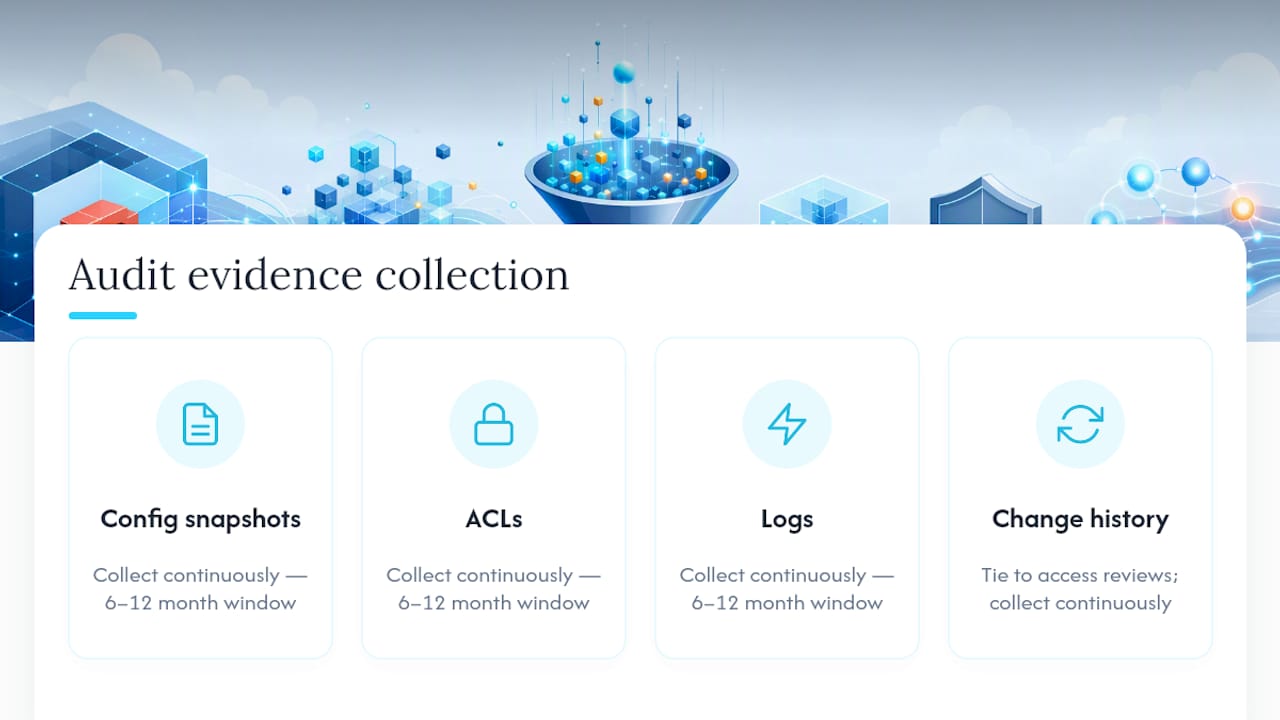
External auditors want four categories of evidence: configuration snapshots, access control lists, logs, and change history tied to access reviews. None of that is a point-in-time artifact. A SOC 2 audit typically evaluates control effectiveness over a 6 to 12 month window, which means you need continuous evidence collection running well before the audit is scheduled, not a scramble in the final week.
When selecting an auditor, prioritize one with actual cloud and OpenStack experience over a generalist IT auditor, such as a compliance-first managed IT platform with legal vertical focus specialist. Someone unfamiliar with Nova or Neutron will ask the wrong questions and miss the checks that matter. Package your evidence by control area in advance. Auditors who receive organized, indexed artifacts finish fieldwork faster, which usually means a shorter, cheaper engagement.
Building Continuous Compliance Into Your OpenStack Pipeline
Manual audit prep is where teams burn a month every year. The fix is embedding compliance checks directly into deployment, so evidence generates itself continuously instead of getting reconstructed retroactively.
- Add compliance verification steps to your CI/CD pipeline or Ansible playbooks so config drift gets caught the moment it happens, not six months later during fieldwork. The openstack-ansible-security project ships auditd rules that satisfy many STIG controls out of the box.
- Configure host-level
auditdrules with defined log retention, and forward logs to a syslog collector so retention itself is auditable. - Run infrastructure scanners like OpenVAS or Nessus against nodes and APIs, but don’t stop there. Correlate scanner output with service logs to catch what a scan alone misses.
- Join host-level audit events with OpenStack API call logs. This correlation is how you catch lateral movement or credential misuse that either log source would miss alone.
Pro Tip: Set up log correlation before you need it for an audit. Reconstructing six months of joined host and API events after the fact is far harder than streaming them into one pipeline from the start.
Tools that automate parts of this, from Python SDK scripting for OpenStack to scheduled export jobs, turn audit prep from an annual fire drill into a background process.
Common Audit Pitfalls Engineers Keep Repeating
The recurring failure is treating host logs and OpenStack API logs as separate universes. Auditors specifically look for that correlation, and its absence is a routine finding. Teams also assume network zone isolation covers them, then skip TLS verification on internal endpoints. Leftover noauth or debug flags on services are another repeat offender. Fix these with immutable log snapshots, documented retention, and playbooks you’ve actually tested, not just written.

Audits Are an Operational Capability, Not a Compliance Chore
Treating an audit as a once-a-year fire drill guarantees you’ll repeat the same findings next cycle. The teams that stop repeating findings are the ones who automate the highest-impact checks (TLS enforcement, permission drift, log correlation) first, then let the rest of the checklist follow.
— James
Turn Audit Prep Into a Repeatable Playbook, Not a Fire Drill
Automation playbooks and prompt libraries built specifically for OpenStack workflows, plus consulting engagements, can help close the gap between “here’s the checklist” and “here’s the evidence exported and organized,” which is where most audit prep actually stalls.
A typical engagement pairs a component-level automation playbook (think: scripted config ownership checks, TLS endpoint validation, auditd rule deployment) with an artifact export template that maps directly to what auditors ask for. If you’re managing the deployment side too, the AI DevOps tools and prompt libraries speed up incident triage and log correlation work that otherwise eats entire afternoons. Check pricing for consulting and audit engagement options, or start with Devopsaitoolkit to see which playbook fits your current OpenStack footprint.
Where to Verify the Details Yourself
Before your next audit cycle, bookmark these primary sources: the OpenStack Security Guide’s audit process breakdown, its component checklist for Identity, Compute, and Networking, and the openstack-ansible-security auditd configuration guide for STIG-aligned rules.
FAQ
Is OpenStack Still Relevant Today?
Yes. OpenStack remains a core platform for private and hybrid cloud deployments where organizations need control over infrastructure that public cloud providers can’t offer, particularly in regulated industries with strict data residency needs.
What Are the Three Main Components of OpenStack?
Most deployments center on Nova (compute), Neutron (networking), and Keystone (identity), though production environments typically add Cinder or Swift for storage and Horizon for the dashboard. All of them fall inside a proper security audit’s scope.
Is OpenStack the Same as AWS?
No. OpenStack is open-source software you deploy and manage on your own infrastructure, while AWS is a managed public cloud service. That distinction matters directly for audits, since you own the full security stack in OpenStack rather than inheriting a provider’s shared responsibility model.
What Is the Purpose of a Security Audit?
A security audit verifies that your stated security controls actually function as designed and operate consistently over time, producing documented evidence an internal team or external assessor can independently confirm. For OpenStack specifically, that means confirming identity, compute, networking, and storage controls all hold up under inspection, not just on paper.
How Often Should You Run an OpenStack Security Assessment?
Run internal checklist verification continuously through automation, and schedule a full internal audit at least quarterly even if external audits happen annually. Waiting a full year between checks is how minor config drift turns into a major finding.
Recommended
- Audit & Logging Policy Design Prompt
- Automating OpenStack with the Python SDK and CLI
- Audit Logging and Threat Detection: Building a Trail You Can Actually Investigate
- Compliance as Code: Turning SOC 2 and CIS Evidence Into a
Get 500 Battle-Tested DevOps AI Prompts — Free
500 battle-tested, copy-paste AI prompts engineered by a senior systems engineer — every one with fill-in placeholders and safety/back-out notes. Drop your email and it's yours.
- 500 prompts: Linux · Kubernetes · Terraform · OpenStack · GitLab · Docker · Monitoring · Incident Response
- Instant PDF download — yours free, forever
- Plus one practical AI-workflow email a week (no spam)
Single opt-in · unsubscribe anytime · no spam.