
Kubernetes Operator Pattern: A DevOps Engineer's Guide
What the Kubernetes Operator pattern is and how CRDs, controllers, and reconciliation loops automate stateful Day 2 operations like failover and backups in production.
- #kubernetes
- #operators
- #crd
- #controllers
- #automation

The Kubernetes Operator pattern is a method of extending Kubernetes with custom controllers that automate complex application lifecycle management by continuously reconciling desired state with actual cluster state. Unlike Helm, which performs a one-shot install, an Operator runs permanently inside your cluster and handles Day 2 operations like upgrades, backups, failovers, and certificate rotations automatically. The two core building blocks are Custom Resource Definitions (CRDs) and controllers built with frameworks like Operator SDK or controller-runtime. If you have ever manually triggered a Postgres failover at 2 a.m., understanding the operator pattern in Kubernetes is the answer to never doing that again.
What is the Kubernetes Operator pattern?
The Kubernetes Operator pattern is a software design approach where a custom controller watches a Custom Resource and drives the cluster toward a declared desired state. Kubernetes natively manages generic resources like Pods, Deployments, and Services. Operators extend that capability so Kubernetes understands complex, domain-specific applications like databases, message queues, and monitoring stacks.
The term “Operator” was coined by CoreOS in 2016. The concept captures the idea of encoding a human operator’s knowledge into software. That software then runs continuously, reacting to state changes without any manual intervention.
Three components define every Operator:
- Custom Resource Definition (CRD): Registers a new API type with the Kubernetes API server. Think of it as a schema that describes your application’s desired state.
- Custom Resource (CR): An instance of that CRD. You apply a YAML manifest declaring what you want, such as a three-node Postgres cluster with daily backups.
- Controller: The running process that watches CRs and takes action to make reality match the declaration.
The Operator SDK and Kubebuilder are the two most widely used frameworks for building controllers in Go. Both sit on top of the controller-runtime library, which handles the low-level watch and queue mechanics.
How does the Kubernetes Operator reconciliation loop work?
The reconciliation loop is the engine of every Operator. The loop is level-triggered, idempotent, and convergent, meaning it periodically compares current state to desired state and takes corrective action regardless of whether it missed an event. This design makes Operators resilient to network partitions, controller restarts, and API server blips.
Here is what happens on each reconciliation cycle:
- The controller receives a reconcile request for a specific CR (identified by namespace and name).
- It reads the current state of all related resources from the API server.
- It computes the difference between current state and the desired state declared in the CR.
- It creates, updates, or deletes resources to close that gap.
- It updates the CR’s
statussubresource with the current observed state.
The key distinction between an Operator and a plain Kubernetes controller is domain knowledge. A Deployment controller knows how to roll out Pods. A Postgres Operator knows how to promote a replica, rewrite pg_hba.conf, and trigger a WAL archive. That domain logic lives entirely in the reconcile function.
Finalizers and owner references are two patterns you must understand for safe resource lifecycle management. Finalizers block garbage collection until the controller has cleaned up external resources, such as cloud load balancers or S3 buckets. Owner references wire child resources back to the parent CR so Kubernetes deletes them automatically when the CR is removed.

Pro Tip: Never skip finalizer cleanup logic in development. A finalizer left on a deleted CR will block namespace termination indefinitely, and tracking down the cause under pressure is painful.
Kubernetes Operators vs. Helm: which tool fits your use case?
Helm excels at Day 1 installs and templating but has no built-in mechanism for Day 2 automation like self-healing, seamless upgrades, or automated backups. Operators run continuously and handle those ongoing tasks automatically. Kustomize sits in a third category: it handles configuration overlays without templating, but it has no runtime component at all.
| Capability | Helm | Kustomize | Kubernetes Operator |
|---|---|---|---|
| Initial install | Yes | Yes | Yes |
| Configuration templating | Yes | Partial | No |
| Automated upgrades | No | No | Yes |
| Self-healing | No | No | Yes |
| Backup and restore | No | No | Yes |
| Schema validation (CRD) | No | No | Yes |
| Operational complexity | Low | Low | High |
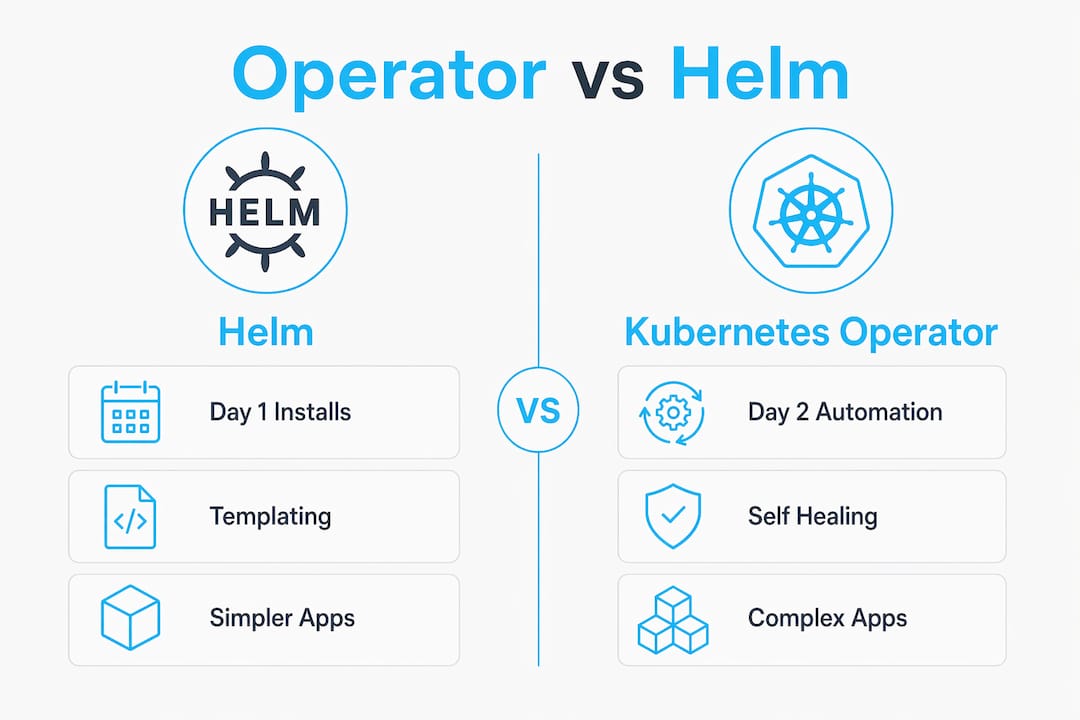
The right choice depends on application complexity and lifecycle requirements. Stateless apps with simple configuration belong in Helm charts. A Kafka cluster with topic management, partition rebalancing, and rolling upgrades belongs in an Operator.
The Operator Framework defines five maturity levels: Basic Install, Seamless Upgrades, Full Lifecycle, Deep Insights, and Auto Pilot. Starting with a Helm chart and advancing to an Operator when complexity demands is the recommended path. Most teams reach for an Operator too early and pay the complexity tax before they need to.
Pro Tip: If your runbook for upgrading an application fits on one page and requires no conditional logic, Helm is the right tool. Reach for an Operator when that runbook starts branching.
Benefits of Kubernetes Operators in production environments
The most direct benefit of Operators is the elimination of manual toil for stateful workloads. Operators reduce the bus factor by embedding operational runbook knowledge into software, so critical procedures execute consistently whether your senior SRE is available or not. That codification of institutional knowledge is one of the most underrated advantages in production environments.
Operators deliver the most value for these workload categories:
- Databases: The Postgres Operator (from Zalando or CrunchyData) automates failover, replica management, connection pooling via PgBouncer, and point-in-time recovery. The same logic that a DBA would run manually executes automatically on every cluster.
- Message queues: The Strimzi Operator for Apache Kafka handles topic creation, partition reassignment, rolling upgrades, and TLS certificate rotation without manual intervention.
- Monitoring stacks: The Prometheus Operator introduces
ServiceMonitorandPrometheusRuleCRDs, letting teams declare scrape targets and alerting rules as Kubernetes objects rather than editing config files directly. - Search and analytics: The Elastic Cloud on Kubernetes (ECK) Operator manages Elasticsearch cluster topology, index lifecycle policies, and Kibana deployments.
Beyond automation, Operators improve observability. A well-built Operator exposes Prometheus metrics on its own /metrics endpoint, reporting reconciliation errors, queue depth, and custom application health signals. You get cluster-level visibility into your application’s operational state without writing a separate monitoring agent.
Operators also automate complex ordered lifecycle events like schema migrations, which require careful sequencing across multiple pods. Running a migration manually during a rolling upgrade is error-prone. An Operator serializes those steps deterministically every time.
Kubernetes Operator best practices for production
Building a working Operator is straightforward. Building one that survives production is a different challenge. Follow these steps to get there:
- Scope RBAC tightly. Grant your controller only the permissions it needs. A controller that can read and write every resource in the cluster is a security liability. Use RBAC scoping and leader election to limit blast radius and prevent split-brain in multi-replica deployments.
- Implement leader election from day one. Running multiple controller replicas without leader election causes conflicting reconcile actions. Both Operator SDK and Kubebuilder support leader election through the controller-runtime
LeaderElectionflag. - Expose Prometheus metrics. Instrument your reconcile function with counters and histograms. Track reconcile duration, error rates, and the number of managed resources. This data is what separates a debuggable Operator from a black box.
- Test reconciliation logic with envtest. The envtest framework spins up a real API server and etcd binary for integration tests. Unit tests alone are not sufficient because reconcile logic interacts heavily with the API server’s watch and cache behavior.
- Handle finalizers defensively. Always check whether a finalizer is present before adding it. Always remove it only after confirming external cleanup succeeded. A finalizer that gets added but never removed will block deletion permanently.
- Ship via OLM bundles on OperatorHub. The Operator Lifecycle Manager (OLM) handles Operator installation, upgrades, and dependency management in a cluster. Packaging your Operator as an OLM bundle makes it installable from OperatorHub and signals production readiness to your users.
Pro Tip: Start at maturity level 1 (Basic Install) and ship it. Trying to build a level-5 Auto Pilot Operator before anyone uses it is the fastest way to build the wrong thing.
Common misconceptions about the Operator pattern
Several misunderstandings about Operators slow adoption and cause poor architectural decisions. Here are the ones I see most often:
- “A CRD is an Operator.” This is the most common confusion. A CRD is only a schema. Without a running controller watching that CRD, nothing happens. The Operator is the controller process, not the resource definition.
- “Operators are for every workload.” Operators add unnecessary complexity for simple stateless applications. A Node.js API with a Deployment and a Service does not need an Operator. Reach for one only when lifecycle complexity justifies it.
- “Operators are event-driven.” The reconciliation loop is level-triggered, not edge-triggered. The controller does not react to a single event and stop. It continuously re-evaluates state, which means a missed event does not leave the cluster in a broken state permanently.
- “Operators replace Helm entirely.” Many teams run both. Helm installs the Operator itself. The Operator then manages the application. These tools are complementary, not competing.
The bus-factor argument for Operators is real, but it cuts both ways. Codifying operational knowledge into software improves resilience, but it also means that knowledge must be maintained in code. If your team cannot maintain Go code, a well-documented Helm chart with a clear runbook may serve you better.
Key takeaways
The Kubernetes Operator pattern is the standard approach for automating stateful application lifecycle management in production clusters, combining CRDs, controllers, and reconciliation loops into a continuously running software system.
| Point | Details |
|---|---|
| Operators are not CRDs | A CRD is a schema; the Operator is the running controller that acts on it. |
| Reconciliation loop design | The loop is level-triggered and idempotent, making Operators resilient to missed events. |
| Operators vs. Helm | Use Helm for simple installs; adopt Operators when Day 2 lifecycle complexity demands automation. |
| Production requirements | RBAC scoping, leader election, Prometheus metrics, and envtest are non-negotiable for production. |
| Start at maturity level 1 | Ship a Basic Install Operator first and advance capability levels based on real operational need. |
Where I land after running Operators in production
I have shipped Operators for Postgres clusters, custom certificate authorities, and internal platform tooling. The pattern genuinely changes how you think about application management once it clicks. But I have also watched teams spend three months building a level-4 Operator for a workload that a Helm chart would have handled in a week.
My honest recommendation: treat the Operator maturity model as a forcing function. Before you write a single line of controller code, write down which maturity level you are targeting and why. If you cannot articulate a concrete operational pain that Helm does not solve, you are not ready for an Operator yet.
The tooling has matured significantly. Kubebuilder and Operator SDK both generate most of the scaffolding you need. The hard part is not the framework. The hard part is encoding your domain knowledge correctly and testing edge cases in the reconcile function. Invest in envtest coverage early. The bugs that surface in reconciliation logic under concurrent updates are the ones that will wake you up at 3 a.m.
One more thing: observability is not optional. An Operator without Prometheus metrics is a black box that you will eventually have to debug under pressure. Wire up your reconcile counters on day one. The Kubernetes security hardening guide covers RBAC patterns that translate directly into Operator permission scoping.
— James
Automate your Kubernetes workflows with DevOps AI ToolKit
If you are building or managing Operators, the operational complexity does not stop at the controller code. You still need CI/CD pipelines, manifest auditing, alert triage, and cluster security hardening working together. The manifest auditing workflow is particularly useful when you are reviewing CRD schemas and Operator RBAC configurations before shipping to production. And if you are wiring up alert routing for your Operator’s Prometheus metrics, the alert triage decision-tree builder prompt will save you a significant amount of time.
FAQ
What is the Kubernetes Operator pattern?
The Kubernetes Operator pattern is a method of extending Kubernetes with custom controllers that automate complex application lifecycle management by continuously reconciling desired state with actual cluster state using CRDs and domain-specific logic.
How do Kubernetes Operators work?
An Operator runs a reconciliation loop inside the cluster that watches a Custom Resource, computes the difference between desired and current state, and takes corrective action. The loop is level-triggered and idempotent, so it recovers automatically from missed events or controller restarts.
What is the difference between a CRD and an Operator?
A CRD is only a schema that registers a new API type with Kubernetes. An Operator is the running controller process that watches instances of that CRD and implements the reconciliation logic. A CRD without a controller does nothing.
When should I use an Operator instead of Helm?
Use Helm for stateless applications with straightforward install and upgrade requirements. Use an Operator when your application requires automated Day 2 operations like failover, schema migrations, backup orchestration, or self-healing that Helm cannot provide natively.
What frameworks are used to build Kubernetes Operators?
Kubebuilder and Operator SDK are the two primary frameworks for building Operators in Go. Both are built on top of the controller-runtime library. Operator SDK also supports Ansible and Helm-based Operators for teams that prefer those approaches.
Recommended
- Kubernetes Ingress and the Gateway API, Explained
- Deploying to Kubernetes From GitLab CI Without Losing Your Mind
- Auditing Kubernetes Manifests With AI: A Practical Workflow
- Deploying OpenStack with Kolla-Ansible: A Practical Guide
Get 500 Battle-Tested DevOps AI Prompts — Free
500 battle-tested, copy-paste AI prompts engineered by a senior systems engineer — every one with fill-in placeholders and safety/back-out notes. Drop your email and it's yours.
- 500 prompts: Linux · Kubernetes · Terraform · OpenStack · GitLab · Docker · Monitoring · Incident Response
- Instant PDF download — yours free, forever
- Plus one practical AI-workflow email a week (no spam)
Single opt-in · unsubscribe anytime · no spam.