
Best Krateo.io Alternatives for PlatformOps Teams 2026
Explore the best Krateo.io alternatives for PlatformOps teams. Discover tools like Backstage, Crossplane, Cloudpods, and Infra to enhance your workflow.

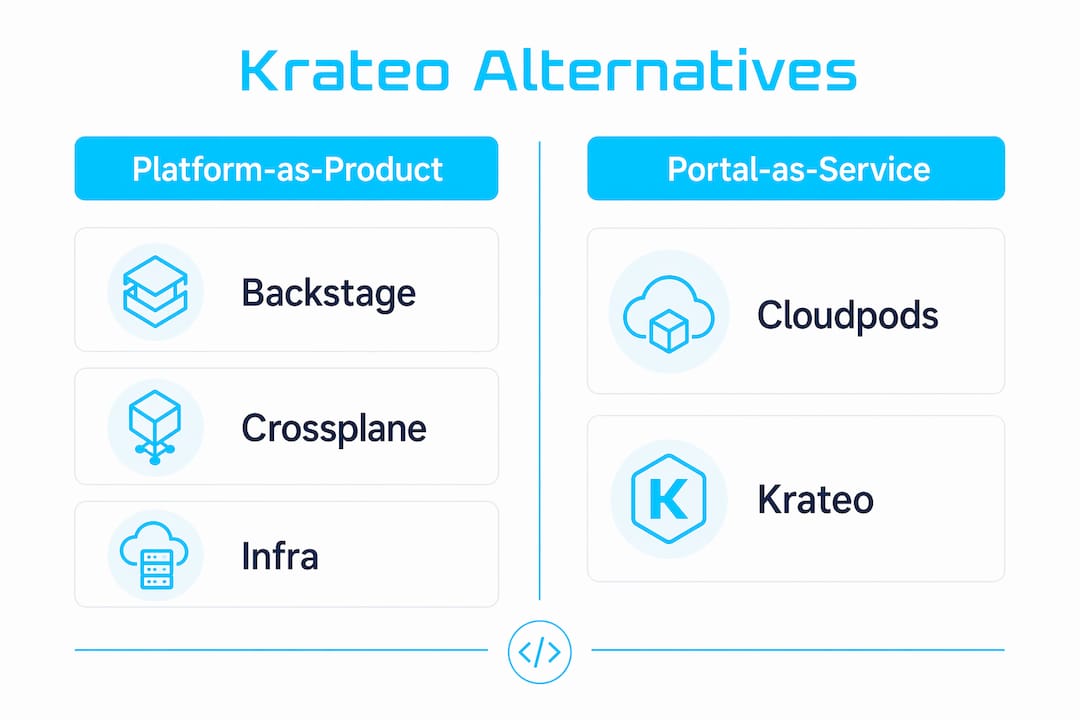
If you’re evaluating Krateo.io alternatives, the shortlist breaks down by function: Backstage for developer portal and service cataloging, Crossplane for IaC-style cloud-API composition on Kubernetes, Cloudpods for unified multi-cloud management, and Infra (infrahq) for dedicated IAM on clusters and servers.
- Backstage — best for engineering orgs that need a mature developer portal with plugin-driven UX and service catalog; suits teams with an experienced platform team.
- Crossplane — best for platform engineers who want to expose cloud resources as Kubernetes-native APIs without a portal layer; requires solid Kubernetes and CRD expertise.
- Cloudpods — best for organizations managing multiple cloud environments who need a single open-source control surface; lower Kubernetes depth required.
- Infra (infrahq) — best for teams whose primary gap is cluster and server access management, not full infrastructure lifecycle; pairs well with any of the above.
- Krateo — best for platform teams that want a composable, Kubernetes-native CMP with a self-service portal driven by Helm CRDs.
Table of Contents
- How do Krateo.io alternatives compare across PlatformOps dimensions?
- What is Krateo and how does its Kubernetes-native approach work?
- Practical migration and adoption checklist
- Which complementary tools pair well with an IDP or CMP?
- What does each alternative cost?
- How does each tool affect developer productivity?
- How do these tools handle security, compliance, and governance?
- What does community support look like for each tool?
- How do you choose the right tool for your team?
- Devopsaitoolkit accelerates your PlatformOps pilot
- Key Takeaways
How do Krateo.io alternatives compare across PlatformOps dimensions?
| Tool | Best for | Core function | Kubernetes-native | Portal / UX | Multi-cloud | Extensibility | Maturity | Ease of adoption | License | Integrations |
|---|---|---|---|---|---|---|---|---|---|---|
| Krateo | Platform-as-a-product / CMP | IDP + CMP | Yes | Yes | Yes | Helm CRD composition | Growing (265 GitHub stars) | Moderate; needs Helm schema expertise | Open-source | GitOps, RBAC, CI/CD |
| Backstage | Developer portal and cataloging | IDP / portal | No | Yes | Via plugins | Plugin ecosystem | Mature; CNCF project | Moderate; React/Node skills needed | Open-source | CI/CD, monitoring, identity |
| Crossplane | IaC-style cloud-API composition | IaC / cloud API | Yes | No | Strong | XRDs / Compositions | Mature; CNCF graduated | High; XRD authoring is complex | Open-source | GitOps, Terraform adjacent |
| Cloudpods | Unified multi-cloud management | Cloud orchestration | Partial | Yes | Strong | Modular | Established | Moderate | Open-source | Multi-cloud lifecycle |
| Infra (infrahq) | Cluster and server IAM | IAM | Yes | Limited | Partial | Limited | Active community; higher GitHub stars than Krateo | Moderate | Kubernetes RBAC, SSH |
The core trade-off is platform-as-a-product versus portal-as-a-service. Krateo’s CMP approach exposes infrastructure through Kubernetes APIs and composable CRDs, which keeps the portal thin and declarative. Backstage flips that: it centralizes developer UX and metadata in a rich portal, but the infrastructure wiring is your problem. Crossplane sits in a third lane entirely — it’s an IaC composition framework, not a portal, so comparing it directly to Krateo or Backstage is a category error unless you’re building a platform layer on top. Infra is narrower still: it solves authentication and access, not provisioning. Don’t confuse any of these with observability tools like Datadog or New Relic — those belong in your monitoring stack, not your IDP/CMP selection.
Pro Tip: Krateo’s core-provider generates CRDs only when a Helm chart includes values.schema.json. Audit your charts before committing to Krateo. For Crossplane, plan to rewrite provisioning logic as XRDs and Compositions — Helm charts don’t port directly.
What is Krateo and how does its Kubernetes-native approach work?
Krateo is an open-source Internal Developer Portal built on a Cloud Management Platform foundation. Rather than building a monolithic portal codebase, it exposes infrastructure through standard Kubernetes APIs and uses Composable Operations driven by Helm charts. Platform teams define what resources are available; developers consume them through a self-service portal backed by Kubernetes operators. It runs on any certified Kubernetes distribution with no vendor lock-in, and it integrates with Kubernetes RBAC for authentication flows.
Practical migration and adoption checklist
- Audit Helm charts for
values.schema.json— missing schemas block CRD generation in Krateo. - Map your Terraform state before introducing Krateo; resources Krateo creates at runtime won’t appear in Terraform state, so plan lifecycle workarounds early.
- Define your composition model — Krateo uses Helm-driven CRDs; Crossplane uses XRDs. Pick one before mixing both in a pilot.
- Start with one workload type (e.g., a single app namespace) and validate RBAC, GitOps sync, and portal rendering before expanding.
- Validate CI/CD hooks — check your GitLab CI or GitHub Actions pipeline can trigger Kubernetes reconciliation correctly.
A minimal pilot typically takes two to four weeks for a team with solid Kubernetes experience.
Which complementary tools pair well with an IDP or CMP?
None of the tools above replace your observability stack. Pair whichever IDP or CMP you choose with Prometheus and Grafana for metrics, Argo CD or Flux for GitOps delivery, and a policy engine like Kyverno or OPA/Gatekeeper for admission control. For IAM, Infra handles cluster and server access; for cloud identity, integrate your provider’s native IAM or Vault. Datadog and New Relic are monitoring tools — they answer “is my platform healthy?” not “how do I provision it?” Keeping those categories separate prevents you from evaluating the wrong tools against each other.
What does each alternative cost?
All five tools are open-source with no licensing fee. Your real cost is operational: engineering time to deploy, maintain, and extend the platform. Backstage carries the highest ongoing engineering overhead — a dedicated team to manage plugins and catalog integrations is common in larger orgs. Crossplane’s complexity is front-loaded in XRD authoring; once compositions are stable, operational cost drops. Krateo’s cost scales with how many Helm charts you need to schema-annotate and how many CRDs you manage. Cloudpods and Infra are narrower in scope, so their operational surface is smaller. For cloud security posture and governance tooling that sits alongside these platforms, managed cloud services can reduce the burden on smaller platform teams.
How does each tool affect developer productivity?
Backstage wins on day-one developer UX — the portal is polished and the catalog is immediately useful. Krateo’s self-service portal is functional but requires more upfront platform-team investment to surface the right CRDs to developers. Crossplane has no developer-facing portal by default; developers interact with Kubernetes manifests or whatever abstraction layer you build on top. Cloudpods provides a unified UI that non-Kubernetes engineers can navigate. Infra is invisible to most developers — it just makes cluster access work without SSH key sprawl.

How do these tools handle security, compliance, and governance?
Krateo delegates to Kubernetes RBAC and certificate-based authentication, which means your existing cluster security posture carries over. Backstage’s security model depends heavily on plugin implementation — catalog permissions and scaffolding access need explicit configuration. Crossplane inherits Kubernetes RBAC for composition access and supports OPA/Gatekeeper integration. Infra is purpose-built for access governance: it centralizes authentication to clusters and servers, which directly addresses audit and least-privilege requirements. For policy-as-code enforcement, none of these tools replace a dedicated admission controller — layer Kyverno or Gatekeeper on top regardless of which platform you choose.
What does community support look like for each tool?
Backstage is a CNCF project with broad industry adoption and an active plugin ecosystem — the community is the strongest of this group. Crossplane is also CNCF-graduated with a large contributor base and enterprise backing. Infra has an active open-source community and higher GitHub stars than Krateo as of mid-2026. Krateo’s community is growing — the main repository sits at 265 GitHub stars — with documentation and provider repos actively maintained. Cloudpods has an established user base focused on multi-cloud scenarios. For Krateo and Cloudpods specifically, plan for more self-directed troubleshooting; the Backstage and Crossplane communities have more public Q&A, SIG meetings, and third-party guides.
How do you choose the right tool for your team?
Ask three questions before shortlisting anything. First: do your developers need a portal today, or does your platform team need a composition layer first? If portal UX is the gap, Backstage. If infrastructure API composition is the gap, Crossplane or Krateo. Second: how Kubernetes-fluent is your team? Crossplane and Krateo both demand solid CRD and operator knowledge. Third: is IAM your actual bottleneck? If yes, Infra solves that faster than any of the others.
Red flags to watch: a team evaluating Crossplane without XRD authoring experience will stall in week two. A team adopting Krateo without schema-annotated Helm charts will hit CRD generation failures immediately. Any team mixing IDP/CMP tools with observability tools in the same evaluation is comparing the wrong things.
Realistic adoption timelines: Backstage catalog setup, four to eight weeks. Crossplane composition layer, six to twelve weeks depending on provider complexity. Krateo pilot with one workload type, two to four weeks. Infra cluster access rollout, one to two weeks.
Devopsaitoolkit accelerates your PlatformOps pilot
Whichever tool you shortlist, the hardest part is usually the first two weeks: generating GitOps manifests, writing cluster config reviews, and wiring up monitoring. Devopsaitoolkit gives platform engineers AI workflows, prompt libraries, and automation guides built specifically for Kubernetes, GitLab, Prometheus, and production infrastructure — the exact stack you’re working with. Use the Prometheus monitoring prompts to wire up observability alongside your IDP pilot without starting from scratch. The prompt library covers alert rule generation, runbook drafting, and cluster health queries — practical time-savers for any platform team running a two-to-four-week pilot. Start at devopsaitoolkit.com and pick the workflow that matches your first pilot task.
Key Takeaways
Backstage, Crossplane, Cloudpods, and Infra each solve a different layer of the platform engineering problem — choosing the wrong class of tool is more costly than choosing the wrong tool within the right class.
| Point | Details |
|---|---|
| Match tool class to gap | Portal gap: Backstage. Composition gap: Crossplane or Krateo. IAM gap: Infra. Multi-cloud gap: Cloudpods. |
| Krateo requires schema prep | Helm charts need values.schema.json or Krateo’s core-provider cannot generate CRDs. |
| Terraform friction is real | Krateo creates resources outside Terraform state; plan lifecycle workarounds before your pilot. |
| All five are open-source | Licensing cost is zero; operational and engineering time is the real TCO driver for every option. |
| Devopsaitoolkit | Provides AI workflows and prompt libraries to accelerate Kubernetes and Prometheus setup during any IDP/CMP pilot. |
Recommended
- Top 6 Sources for Kubekanvas.io Alternatives 2026
- Top 4 Sources for hyground.ai Alternatives 2026
- The Best AI Tools for DevOps Engineers in 2026 — DevOps AI ToolKit
- OPA/Gatekeeper vs Kyverno: Choosing a Kubernetes Policy
Get 500 Battle-Tested DevOps AI Prompts — Free
500 battle-tested, copy-paste AI prompts engineered by a senior systems engineer — every one with fill-in placeholders and safety/back-out notes. Drop your email and it's yours.
- 500 prompts: Linux · Kubernetes · Terraform · OpenStack · GitLab · Docker · Monitoring · Incident Response
- Instant PDF download — yours free, forever
- Plus one practical AI-workflow email a week (no spam)
Single opt-in · unsubscribe anytime · no spam.