
The Incident Commander Role: Responsibilities and Playbook
Discover the crucial responsibilities of an incident commander and how their leadership shapes effective incident management strategies.

The Incident Commander (IC) is the single accountable leader who holds full authority over an incident’s strategy, objectives, safety decisions, and resource allocation from the moment command is established until demobilization is complete. Per FEMA/NIMS guidance, that authority is not shared, voted on, or diluted by committee. One person owns the outcome.
- Authority origin: Command authority is delegated by an Agency Administrator or established through existing agency policy, giving the IC legal and operational standing to direct all on-scene resources.
- Single point of truth: Every strategic decision, IAP approval, and information release flows through the IC. Parallel command chains are a failure mode, not a feature.
- Cross-domain applicability: The role appears in NIMS/ICS emergency response and in modern IT/DevOps incident response under different labels but identical logic.
When multiple jurisdictions or agencies share responsibility, Unified Command replaces a single IC, producing one consolidated Incident Action Plan from a shared command group.
Key Takeaways
The incident commander role is the single most important structural decision you make when an incident starts: one accountable leader, clear authority, and immediate delegation determine whether your team restores service in 30 minutes or 3 hours.
| Point | Details |
|---|---|
| One leader, full authority | The IC holds delegated authority over strategy, safety, and resources from command establishment to demobilization. |
| IAP approval is the IC’s job | The IC approves the Incident Action Plan before each operational period; Section Chiefs execute it. |
| Transfer command with a checklist | Use a 10-step briefing covering status, objectives, safety, IAP, resources, and open actions to prevent information gaps. |
| IT/DevOps crosswalk is direct | War room = ICP, runbook + action log = IAP, Engineering Lead = Ops Section Chief. |
| Delegate or lose situational awareness | ICs who stay in tactical execution lose strategic visibility; delegate immediately and stay on the board. |
Table of Contents
- What does an incident commander do across emergency response and IT/DevOps?
- What are the core responsibilities of an incident commander?
- How does the command structure support the incident commander?
- Where does the IC’s authority come from, and when does Unified Command apply?
- When should you appoint an IC, and how do you transfer command safely?
- What skills and training does an incident commander need?
- How does the IC role map to IT, SRE, and DevOps incident response?
- IC checklist and IAP template for engineering teams
- Common IC mistakes and how to avoid them
- Sources
What does an incident commander do across emergency response and IT/DevOps?
The IC concept originates in the Incident Command System, a management framework developed after the 1970 California wildfires and later codified by FEMA under the National Incident Management System (NIMS). Wikipedia’s definition captures it cleanly: the IC is responsible for all aspects of an emergency response, including developing incident objectives, managing operations, applying resources, and taking responsibility for all persons involved.
That same logic migrated into IT and DevOps. When a production database goes down at 2 AM, someone has to own the room, set the objective (“restore read access within 30 minutes”), and stop five engineers from pulling in five directions. In IT/DevOps contexts, the IC is the designated leader who coordinates response, restores normal operations, centralizes decisions, and protects customer experience during critical incidents.
The terminology differs. Emergency response uses Incident Command Post (ICP), Incident Action Plan (IAP), and Section Chiefs. Engineering teams use war rooms, runbooks, and severity levels. The underlying structure, one accountable leader who delegates tactical execution and maintains strategic clarity, is identical. Academic literature supports this transferability, noting that formal command structure reduces confusion and speeds restoration of normal operations across healthcare, IT, and other non-firefighting domains.
What are the core responsibilities of an incident commander?
The IC’s job is not to fix the problem personally. It is to create the conditions under which the right people can fix it fast and safely. Every responsibility flows from that principle.
Core duties, as enumerated in FEMA’s ICS guidance and position descriptions:
- Ensure overall safety of all personnel and the public throughout the incident.
- Establish incident objectives and set priorities for the operational period.
- Establish the Incident Command Post (ICP) or, in IT, the war room or bridge call.
- Approve the Incident Action Plan (IAP) before each operational period begins.
- Authorize release of information to media, executives, or the public.
- Approve resource requests from Section Chiefs before resources are committed.
- Order demobilization when the incident is contained and resources can be released.
- Ensure after-action reporting is completed and findings are documented.
Three decisions illustrate what this looks like in practice. First, scope containment: the IC decides whether to contain a wildfire perimeter or request mutual aid, weighing resource availability against spread rate. Second, rollback vs. mitigation: in an IT incident, the IC decides whether to roll back a bad deployment or push a hotfix, based on risk and time-to-restore estimates from the engineering lead. Third, demobilization: the IC calls the stand-down when the incident is stable, not when every engineer feels comfortable, because holding resources past their useful window is its own failure mode.
The critical distinction is between approving the IAP and executing it. The IC approves; Section Chiefs execute. An IC who drifts into tactical work loses situational awareness at the strategic level, which is the most common way incidents spiral.
How does the command structure support the incident commander?
The IC sits above both Command Staff and General Staff, not inside either group. That separation preserves the IC’s authority and objective view.
Span of control matters here. ICS guidance recommends a 1:5 ratio (one supervisor to five subordinates) as the optimal range, with 1:3 to 1:7 as acceptable bounds. When the IC’s direct reports exceed that range, the organization must expand: add a Deputy IC, activate additional Sections, or establish Branches within Operations.
Deputies deserve a specific note. A Deputy IC is not an assistant. Per ICS transfer-of-command protocols, a Deputy must be fully qualified to assume IC duties at any moment. That means the Deputy attends all briefings, knows the current IAP, and can step in without a learning curve.
In IT, this structure maps to: a Communications Lead (PIO equivalent), a Safety/Risk owner, and functional leads for engineering, infrastructure, and customer success. You do not need all of them for a Sev-3. You do need them for a multi-day outage affecting production at scale.
Where does the IC’s authority come from, and when does Unified Command apply?
Command authority does not self-generate. It is delegated.
- Delegation of authority: An Agency Administrator (fire chief, CTO, VP of Engineering) formally delegates command authority to the IC, either through a written delegation letter or through established agency policy. That delegation defines the IC’s scope, constraints, and reporting requirements. Without it, the IC is a coordinator, not a commander.
- On-scene decision-making: Once delegated, the IC makes binding decisions without seeking approval for each one. That autonomy is the point. Requiring executive sign-off on every tactical call during an active incident is a governance anti-pattern that costs time and lives.
- Unified Command: When two or more jurisdictions or agencies share legal responsibility for an incident, NIMS guidance calls for Unified Command. A shared command group produces a single consolidated IAP, preventing conflicting objectives. In IT, this applies when a vendor outage and an internal misconfiguration both contribute to the same incident, requiring joint command between your team and the vendor’s incident lead.
- EOC relationship: Emergency Operations Centers coordinate support and resources but typically do not exercise tactical command over the IC. The EOC is a coordination hub; the IC is the on-scene authority. Conflating the two creates confusion about who can direct field resources.
When should you appoint an IC, and how do you transfer command safely?
Appoint an IC the moment an incident is declared. The first qualified person on scene assumes command by default under ICS. As incident complexity grows, a more qualified IC takes over through a formal transfer.
Transfer-of-command checklist (use this verbatim in your runbook):
- Confirm the incoming IC is present and ready to receive the briefing.
- Brief on current incident status: what happened, current scope, and trajectory.
- State active objectives: the operational period goals and any constraints.
- Cover safety issues: known hazards, personnel at risk, and any active protective actions.
- Hand off the IAP (or its IT equivalent: the incident ticket, runbook, and current action log).
- Review resource assignments: who is doing what, and what is pending.
- List open actions and decisions: anything unresolved that the incoming IC must address.
- Formally announce the transfer to all Command and General Staff (or war room participants).
- Confirm acknowledgment from the incoming IC verbally or in the incident channel.
- Document the transfer time in the incident log.
NIMS Appendix B treats transfer-of-command as a high-risk event. Information gaps at handoff are one of the leading causes of incident escalation. A structured briefing is not bureaucracy; it is the mechanism that prevents the incoming IC from making decisions based on stale or incomplete data.
For IT teams running critical incident escalation simulations, practicing this transfer protocol in tabletop exercises before a real incident is one of the highest-ROI training investments you can make.
What skills and training does an incident commander need?
The IC role demands two distinct skill sets: the soft skills to lead under pressure and the technical knowledge to make credible decisions fast.
Soft skills:
- Decisive communication under ambiguity
- Calm under pressure without suppressing urgency in the team
- Active listening across multiple simultaneous information streams
- Delegation without micromanagement
- Situational awareness at the strategic level
Technical skills:
- Incident systems knowledge (ICS structure, IAP process, or IT incident tooling)
- Domain expertise relevant to the incident type (infrastructure, network, application layer)
- Resource management and cost awareness
Formal qualification paths follow the FEMA National Qualification System Position Task Book, which documents competency-based tasks evaluators use to certify IC readiness. Progression runs from Type 3 (local/single-agency incidents) through Type 2 (regional, multi-agency) to Type 1 (national-level, complex incidents). Each level requires demonstrated performance against specific competencies, not just course completion.
For engineering teams, the Bureau of Labor Statistics frames emergency management as a distinct career track with formal qualification expectations. In DevOps, the equivalent path is: shadow an experienced IC on real incidents, own a runbook end-to-end, lead tabletop exercises, and progressively take command of lower-severity incidents before handling Sev-1s.
Pro Tip: Run a 90-minute tabletop exercise quarterly. Give one engineer the IC role, hand them a realistic scenario, and debrief on delegation decisions and communication clarity. It surfaces gaps in your runbooks faster than any audit.
How does the IC role map to IT, SRE, and DevOps incident response?
The crosswalk is direct. If your team uses ICS terminology in runbooks, here is the translation layer:
| ICS / NIMS Term | IT / DevOps Equivalent |
|---|---|
| Incident Commander | Incident Commander / Incident Lead |
| Incident Command Post (ICP) | War room, bridge call, or Slack incident channel |
| Incident Action Plan (IAP) | Incident ticket + runbook + action log |
| Operations Section Chief | Engineering Lead / On-call Lead |
| Planning Section Chief | Scribe / Situation Reporter |
| Logistics Section Chief | Infrastructure / Tooling Owner |
| Public Information Officer | Communications Lead / Status Page Owner |
| Safety Officer | Risk / Security Owner |
| Unified Command | Joint incident bridge with vendor or partner team |
| Demobilization | Incident close-out and post-mortem scheduling |
For a deeper breakdown tailored to engineering teams, the incident commander role explained for engineering teams guide covers this crosswalk with runbook templates.
Three IT-specific IC decisions illustrate the role in practice. First: rollback vs. hotfix. The IC weighs the engineering lead’s time estimate for a hotfix against the blast radius of a full rollback, then decides, not the engineer who wrote the code. Second: invoking external support. When the incident involves a cloud provider outage, the IC decides when to open a P1 support ticket and whether to escalate to the vendor’s account team, based on time-to-restore projections. Third: exec escalation. The IC determines when the incident severity warrants notifying leadership, drafts the exec summary, and controls what goes out, preventing five engineers from sending five different Slack messages to the CTO.
Setting up your war room infrastructure correctly before an incident means the IC can focus on decisions rather than logistics when it counts.
IC checklist and IAP template for engineering teams
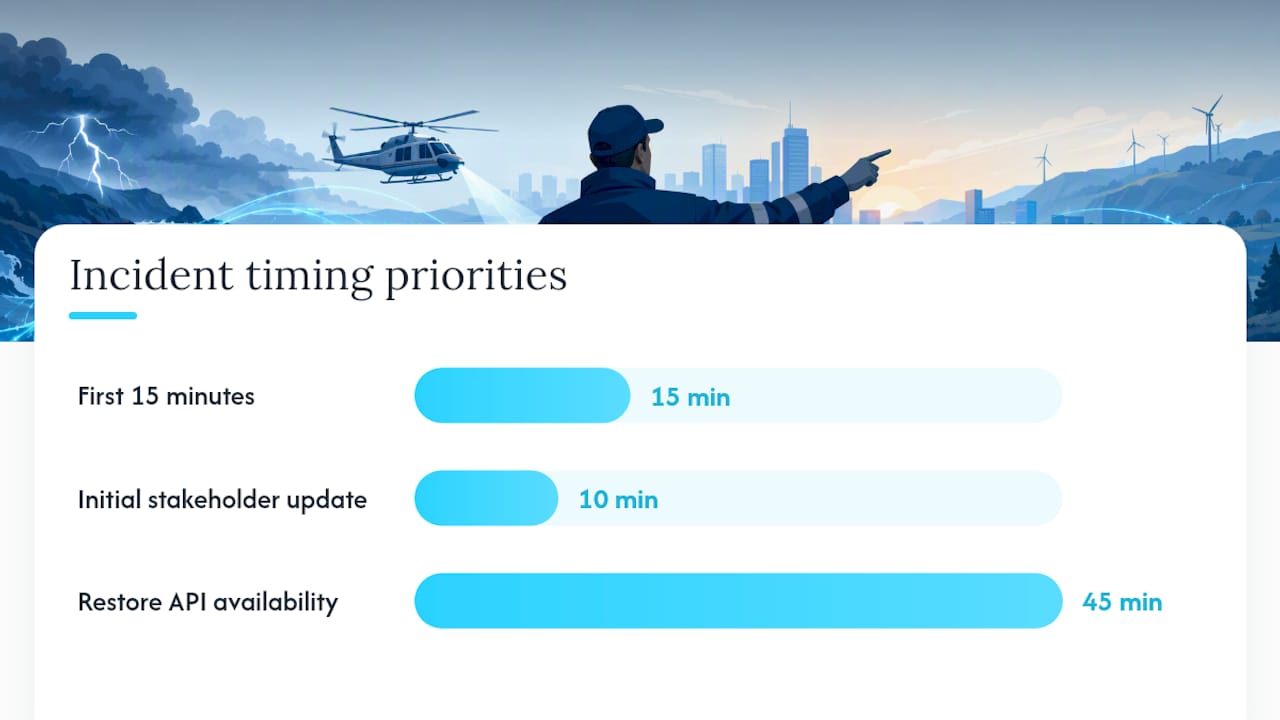
Use this during the first 15 minutes of any Sev-1 or Sev-2 incident.
Initial IC checklist:
- Confirm you have command (announce it in the incident channel).
- Establish the war room or bridge call (ICP equivalent).
- Confirm safety: no data exposure risk, no cascading blast radius expanding unchecked.
- Set the incident objective in one sentence: “Restore API availability for paying customers within 45 minutes.”
- Assign roles: Engineering Lead, Comms Lead, Scribe.
- Confirm the IAP equivalent is open: incident ticket, runbook link, action log.
- Approve the first operational period plan before execution begins.
- Send the initial stakeholder update within 10 minutes of assuming command.
Compact IAP template (paste into your incident ticket or war room doc):
- Incident objective: [One sentence. Measurable. Time-bound.]
- Current status: [Two sentences max. What is broken, what is the impact.]
- Operational period tactics: [Numbered list of actions, each with an owner and ETA.]
- Critical resources assigned: [Names, roles, and what they are working on.]
- Public status copy: [One sentence for the status page. Pre-approved by IC.]
- Exec summary: [Three sentences: what happened, current status, next update time.]
Communication templates:
Initial status update (internal): “Incident declared at [time]. IC: [name]. Current impact: [scope]. Engineering lead is [name], working on [action]. Next update in 15 minutes.”
Exec summary: “We are experiencing [brief description] affecting [customer scope]. Engineering is actively [action]. We expect to have an update by [time].”
Public status line: “We are investigating an issue affecting [service]. Updates will follow every [interval].”
Pro Tip: Use AI-assisted status drafts to generate the initial comms from your incident ticket fields. It cuts the IC’s first-10-minutes cognitive load significantly and keeps the language consistent across updates. Devopsaitoolkit’s incident response AI prompts include copy-paste templates for status updates, exec briefs, and post-incident summaries.
Common IC mistakes and how to avoid them
The most damaging IC failure mode is not a bad decision. It is the IC who stops commanding and starts engineering.
Do:
- Set clear, measurable objectives at the start of every operational period.
- Delegate tactical execution to Section Chiefs or functional leads immediately.
- Protect safety as a non-negotiable constraint, not a variable.
- Document every major decision in the incident log as it happens.
- Run an after-action review (AAR) within 48 hours of incident close.
Don’t:
- Micromanage the engineering lead’s implementation choices.
- Delay command transfer because you feel ownership of the incident.
- Release information to executives or the public without IC approval.
- Ignore demobilization: holding resources past their useful window creates fatigue and cost.
- Skip the AAR because the incident resolved. The AAR is where the next incident gets prevented.
Governance tips that reduce single-person failure risk:
Pre-authorize delegations in writing before incidents occur. Define which severity levels require a formal IC, which require a Deputy, and what the escalation path looks like. Maintain role playbooks so any qualified engineer can step into the IC role without improvising the structure. Set a mandatory AAR timeline (48 hours is a reasonable standard) and track completion.
One governance change that pays for itself quickly: require a documented IAP sign-off before any Sev-1 operational period begins. It forces clarity on objectives before execution starts and creates an audit trail that makes post-incident analysis faster and less contentious.
What I keep seeing ICs get wrong in the field
The IC who holds on to tactical tasks loses the room. I have watched this pattern repeat across incidents: a technically strong engineer assumes command, gets pulled into a debugging thread, and 20 minutes later nobody knows who is making decisions. The war room fragments. Parallel fix attempts collide. The incident drags.
The fix is not complicated. Delegate the moment you assume command. Announce it explicitly: “I am IC. [Name] owns engineering. [Name] owns comms. I am not in the fix thread.” Then stay out of it. Your job is to watch the whole board, not one piece.
The single action you can take before the next incident: write a one-paragraph IC delegation script into your runbook and practice saying it out loud in your next tabletop.
Sources
Recommended
- The Incident Commander Role Explained for Engineering Teams
- The Communications Lead Role in Incident Response
- Building an Incident War Room That Works: Tooling and Roles
- Freeing the Incident Commander With AI Status Comms
Get 500 Battle-Tested DevOps AI Prompts — Free
500 battle-tested, copy-paste AI prompts engineered by a senior systems engineer — every one with fill-in placeholders and safety/back-out notes. Drop your email and it's yours.
- 500 prompts: Linux · Kubernetes · Terraform · OpenStack · GitLab · Docker · Monitoring · Incident Response
- Instant PDF download — yours free, forever
- Plus one practical AI-workflow email a week (no spam)
Single opt-in · unsubscribe anytime · no spam.