
Cloud Egress Costs Explained for Engineers: Cut Bills Fast
Learn how to cut your egress costs cloud explained with three fast controls. Save money and avoid surprise bills with expert tips!

Cloud egress is a per-GB charge applied every time data leaves a cloud provider’s network boundary, whether that’s to an end user, another region, or a different cloud. It’s the line item that turns a $200 storage bill into a $2,000 surprise. The three controls that move the needle fastest: put a CDN in front of public-facing content, replace NAT Gateway paths to S3 and DynamoDB with VPC gateway endpoints, and start tracking egress as a named metric in your monitoring stack rather than reading it off a month-end invoice.
- CDN/edge caching removes repeated origin egress for cached hits, often the single largest reduction for media-heavy workloads.
- VPC gateway endpoints eliminate NAT Gateway processing fees (a significant additional charge on AWS) for S3 and DynamoDB traffic from private subnets.
- Treat egress as a metric by exporting billing data to BigQuery or Athena and setting spend alerts, so you catch runaway flows before they compound.
Internet egress rates from major hyperscalers typically open close to $0.09/GB for the first tier (for example, AWS and Azure), while dedicated private connectivity can drop that to roughly $0.02/GB at sustained volumes. The gap between those two numbers is where most optimization work lives.
Table of Contents
- What exactly counts as egress on your cloud bill?
- Ingress vs. egress: what’s free and what you’ll pay for
- Why cloud providers charge egress fees at all
- How egress fees are calculated on your invoice
- Provider pricing snapshots: AWS, GCP, Azure, Cloudflare, and Backblaze
- Operational scenarios that commonly drive high egress charges
- How to measure, monitor, and forecast egress before it surprises you
- Practical tactics to reduce egress costs, ranked by impact
- Trade-offs and tactics that commonly backfire
- Worked example: a month of egress costs broken down
- Should you optimize in place, repatriate, or go multi-cloud?
- Key Takeaways
- The egress bill is an architecture review in disguise
- Devopsaitoolkit gives you the playbooks to act on this today
- Useful sources and official pricing pages
What exactly counts as egress on your cloud bill?
Data egress is any outbound data flow that crosses a provider-defined network boundary and triggers a billable transfer event. The boundary isn’t always the public internet; it can be an availability zone line, a regional border, or a peering point.
Concrete examples engineers encounter daily:
| Flow type | Billing trigger | Typical surprise level |
|---|---|---|
| User downloads from S3 / Blob Storage | Internet egress per GB | Low (expected) |
| Cross-region replication (S3, GCS) | Inter-region transfer per GB | Medium |
| Private subnet → S3 via NAT Gateway | NAT processing + internet egress | High |
| Container image pull (ECR in private subnet) | NAT processing per GB | High |
| API response to external client | Internet egress per GB | Medium |
| Cross-AZ service mesh calls | Inter-AZ transfer per GB | High (volume) |
| On-premises backup via VPN/internet | Internet egress per GB | Medium |
The flows that most often catch teams off guard are the NAT path and cross-AZ chatty traffic. A Kubernetes cluster where every pod-to-pod call crosses an AZ boundary can generate hundreds of GB of inter-AZ egress per day without any single request looking expensive.
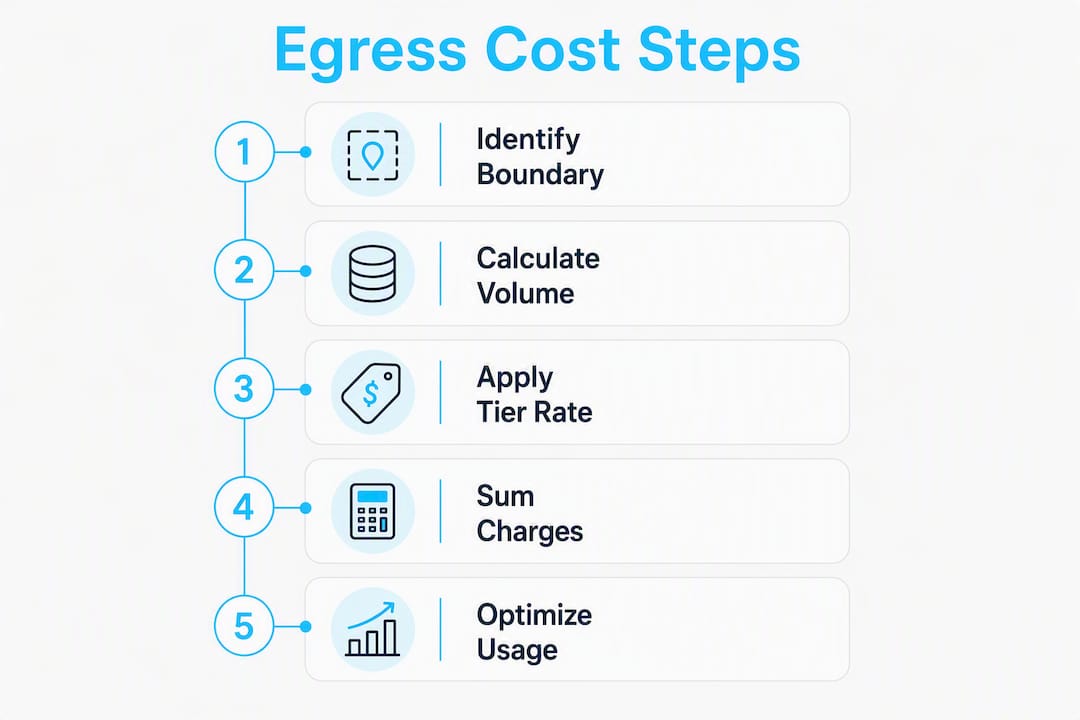
Provider boundary diagram (simplified):

  [Private Subnet]
       |
  [NAT Gateway] ← $0.045/GB processing fee
       |
  [Internet Gateway] ← $0.09/GB egress fee
       |
  [End User / External API]

  Alternative path (VPC Gateway Endpoint):
  [Private Subnet]
       |
  [VPC Gateway Endpoint] ← $0.00 processing
       |
  [S3 / DynamoDB] ← no internet egress charged
Pro Tip: Enable VPC Flow Logs and filter for REJECT and cross-AZ flows before you start optimizing. The log data tells you which source IPs and destination ports are generating volume, so you’re not guessing at the biggest offenders.
Ingress vs. egress: what’s free and what you’ll pay for

Ingress is free in virtually every standard cloud scenario. Data flowing into a provider’s network costs you nothing on the transfer line. Egress is billed, and the rate depends on which boundary the data crosses.
| Flow direction | Boundary | Typical cost |
|---|---|---|
| Inbound from internet | Any region | Free |
| Outbound to internet | First 100 GB/month (AWS) | Free tier, then ~$0.09/GB |
| Inter-AZ (same region) | AZ boundary | ~$0.01/GB each direction |
| Inter-region | Regional boundary | ~$0.02/GB (varies by pair) |
| To CDN edge (CloudFront) | Origin to edge | Reduced or free on some clouds |
| Dedicated connectivity (Direct Connect) | Private circuit | ~$0.02/GB (port fee separate) |
The “ingress is free” rule has real exceptions worth knowing:
- Cloudflare R2 and Backblaze B2 — offer zero egress to the public internet, but you’re still paying for API request counts and storage.
Why cloud providers charge egress fees at all
Egress pricing is deliberately asymmetric: ingress is free to encourage data inflow, and egress is priced to recover transit costs and, critically, to make leaving expensive. That second part is the lock-in mechanism. Once your data is inside a provider’s ecosystem, every GB you move out costs money, which raises the effective switching cost for any migration.
The economic model is sometimes called “data gravity.” Large datasets attract more compute and services over time because moving the data out is costly, so workloads tend to stay where the data already lives. Providers benefit from this directly.
On the regulatory side, the EU Data Act introduced requirements for cloud providers to waive switching fees when customers move to a different provider. That’s a meaningful step for full-provider migrations. What it does not address is day-to-day application egress: every API response, every user download, every cross-region replication event still runs at standard rates. Engineers managing live production traffic can’t rely on regulatory relief for their monthly bills.
How egress fees are calculated on your invoice
Egress billing has three layers: the flow boundary determines which rate applies, volume determines which tier you land in, and ancillary processing fees stack on top of the base transfer charge.
| Line item | Example rate | When it applies |
|---|---|---|
| Internet egress (first tier) | ~$0.09/GB | Data leaving to public internet |
| Internet egress (next tier, 10+ TB) | $0.09/GB | Volume discount, same flow |
| Inter-region transfer | ~$0.02/GB | Moving data between AWS regions |
| Inter-AZ transfer | ~$0.01/GB each way | Cross-AZ flows within a region |
| NAT Gateway processing | ~$0.045/GB | Private subnet traffic through NAT |
| Transit Gateway processing | ~$0.02/GB | Traffic routed via Transit Gateway |
| Interface VPC endpoint | ~$0.01/hr + ~$0.01/GB | Private connectivity to AWS services |
| Load balancer data processing | $0.01/GB | Traffic processed by ALB/NLB |
The line items that most commonly blindside teams:
- NAT Gateway processing stacks on top of internet egress. A private subnet sending 1 TB to the internet pays ~$0.09/GB egress plus ~$0.045/GB NAT processing, for an effective rate of ~$0.135/GB.
- Interface endpoint hourly charges accumulate even when traffic is low. Three interface endpoints across three AZs cost roughly $21.60/month before any data moves.
- Load balancer data processing is charged per GB processed, not per GB egressed, so it applies to inbound traffic too.
- Transit Gateway adds $0.02/GB for every GB that traverses it, including inter-region and VPN attachments.
Pro Tip: For any S3 or DynamoDB traffic from private subnets, replace NAT Gateway with a VPC gateway endpoint. Gateway endpoints are free to create and carry no processing fee, eliminating the ~$0.045/GB NAT charge entirely for those flows.
Provider pricing snapshots: AWS, GCP, Azure, Cloudflare, and Backblaze
Internet egress rates across the major hyperscalers open in a narrow band around $0.08–$0.09/GB for the first tier, but the ancillary charges, free allowances, and zero-egress alternatives create meaningful differences in total cost.
| Provider | Free egress allowance | Internet egress (first tier) | Inter-region egress | Notable ancillary charges | Zero-egress / waiver option |
|---|---|---|---|---|---|
| AWS | 100 GB/month | ~$0.09/GB | ~$0.02/GB | NAT Gateway ~$0.045/GB; Transit Gateway ~$0.02/GB | Direct Connect ~$0.02/GB; CloudFront origin shield |
| Google Cloud | 200 GB/month (some services) | ~$0.08/GB (Americas) | ~$0.01–$0.08/GB | Cloud NAT per-GB; Interconnect port fee | Cloud Interconnect; CDN Interconnect partners |
| Azure | 100 GB/month | ~$0.09/GB (first tier) | ~$0.02/GB | VNet peering per-GB; NAT Gateway processing | ExpressRoute ~$0.025/GB; peering via Microsoft network |
| Cloudflare R2 | Unlimited egress to internet | $0.00 | N/A | API requests ($4.50/million Class B) | Zero egress by design |
| Backblaze B2 | 3x storage free via partners | $0.01/GB (direct) | N/A | API calls; no inter-region concept | Free via Cloudflare, Fastly, and other CDN partners |
A few operational notes per provider:
AWS has the most complex egress topology. The combination of NAT Gateway, Transit Gateway, and interface endpoint charges means the effective per-GB cost for private-subnet traffic can be 1.5–2x the headline internet egress rate. CloudFront’s origin-to-edge transfer is not charged as internet egress for AWS origins, which makes it a natural first optimization.
Google Cloud offers CDN Interconnect partnerships with major CDNs that reduce egress rates significantly for qualifying traffic. The inter-region rates vary by region pair, with some cross-continental pairs reaching $0.08/GB, close to internet egress rates.
Azure charges for VNet peering traffic in both directions, which surprises teams running hub-and-spoke architectures. ExpressRoute reduces internet egress costs but requires a circuit and a gateway, both of which carry fixed monthly charges.
Cloudflare R2 is the most disruptive option for storage-heavy workloads. Zero egress to the internet means the cost model is purely storage plus API requests. The trade-off is a smaller feature set compared to S3 or Azure Blob.
Backblaze B2 pairs with Cloudflare, Fastly, and other CDN partners through the Bandwidth Alliance, making egress effectively free for traffic routed through those partners. At $0.01/GB for direct egress, it’s also the cheapest non-zero option among major providers. For zero-egress storage architectures, B2 plus a CDN partner is a proven pattern.
Operational scenarios that commonly drive high egress charges
Not all egress is equal. Some flows are high-volume but low-frequency; others are low-volume but happen thousands of times per hour. Here’s where to look first, roughly ordered by cost impact:
- Media and static content without CDN caching. Every cache miss on a video or large image file hits origin egress at full rate. A misconfigured cache-control header that sets
max-age=0on a 50 MB asset served 10,000 times/day generates 500 GB of origin egress daily. - Cross-region replication and DR. Replicating 1 TB daily between regions produces roughly 30 TB/month. At $0.02/GB cross-region, that’s approximately $600/month from a single replication job, before any application traffic.
- Analytics exports and data warehouse loads. Pulling raw event data from cloud storage to an external analytics tool or a different-cloud warehouse generates internet egress at full rate. A 5 TB nightly export costs roughly $450/month at $0.09/GB.
- Sync-and-share workflows with full-file re-downloads. Repeated full-file syncs multiply egress by the number of clients and sync events. A 10 GB project file synced to 20 clients daily generates 200 GB/day of egress.
- Container image pulls in private subnets. Each pull from ECR or a private registry through NAT Gateway pays both the image transfer cost and the NAT processing fee. A 2 GB image pulled 100 times/day generates 200 GB/day of NAT-processed traffic.
- Multi-cloud data joins. Joining datasets across AWS and GCP requires moving one dataset to the other cloud, paying internet egress at the source and ingress (free) at the destination. The egress cost is often invisible until the first bill.
- Chatty inter-AZ microservice calls. Service meshes and microservice architectures where pods are not AZ-pinned generate continuous inter-AZ traffic. At $0.01/GB each way, a service processing 10 TB/day of internal traffic across AZs adds $200/day.
For each scenario, the first place to check is the network section of your cloud cost and usage report, filtered by UsageType containing DataTransfer or Bytes. Cross-reference with VPC Flow Logs to identify source and destination.
How to measure, monitor, and forecast egress before it surprises you
Treat egress as a first-class metric, not a line item you review after the bill arrives. The operational recipe has four steps.

Step 1: Enable billing export to a queryable store. Export your cloud cost and usage report to S3 (AWS), BigQuery (GCP), or a storage account (Azure). This gives you row-level data per resource, per usage type, and per day.
Step 2: Tag your resources by workload and team. Without tags, egress attribution is guesswork. Apply consistent tags (team, env, workload) to every resource that generates network traffic. Most providers support tag-based cost allocation in their billing exports.
Step 3: Build boundary-separated queries. Ingest billing export data into BigQuery or Athena and pre-build queries that separate network line items by boundary type.
Example Athena query (pseudocode):
SELECT
  resource_tags['workload']        AS workload,
  line_item_usage_type,
  SUM(line_item_usage_amount)      AS gb_transferred,
  SUM(line_item_unblended_cost)    AS cost_usd
FROM cost_and_usage_report
WHERE line_item_usage_type LIKE '%DataTransfer%'
  AND line_item_usage_start_date >= DATE_TRUNC('month', CURRENT_DATE)
GROUP BY 1, 2
ORDER BY cost_usd DESC;
Step 4: Set spend alerts by boundary type. Create budget alerts for internet egress, inter-region, and NAT processing separately. A single combined “network” alert masks which boundary is growing.
| Monitoring action | Tool | Alert threshold suggestion |
|---|---|---|
| Internet egress spend | AWS Budgets / GCP Budget Alerts | 20% above 3-month rolling average |
| NAT Gateway processing | CloudWatch metric: BytesOutToDestination | Absolute GB/day threshold |
| Inter-region transfer | Billing export query, daily | 10% week-over-week increase |
| VPC Flow Log anomalies | CloudWatch Logs Insights / Athena | Top-10 source IP by bytes |
Pro Tip: Model the Direct Connect or ExpressRoute break-even before you commit. Take your average monthly internet egress in TB, multiply by $0.09/GB, then compare against the fixed port cost plus $0.02/GB. Break-even typically occurs between 1–5 TB/month depending on your circuit pricing. Run the model quarterly as traffic grows.
For broader infrastructure monitoring patterns that complement egress tracking, the same observability stack applies.
Practical tactics to reduce egress costs, ranked by impact
The top three moves cover the majority of egress spend for most teams: CDN caching, VPC endpoints, and processing data in-cloud rather than exporting it raw.
-
Deploy a CDN in front of public-facing content. For static assets, a CDN cache hit generates zero origin egress. CloudFront-to-S3 origin pulls are not charged as internet egress for AWS origins. Configure aggressive TTLs for versioned assets (CSS, JS, images) and shorter TTLs for dynamic content. This is the highest-ROI action for any team serving media or web assets.
-
Replace NAT Gateway with VPC gateway endpoints for S3 and DynamoDB. Gateway endpoints are free, require no hourly charge, and eliminate the ~$0.045/GB NAT processing fee. For a workload transferring 10 TB/month through NAT to S3, that’s roughly $450/month saved on processing alone, before counting any reduction in internet egress.
-
Process and aggregate data in-cloud before exporting. Run your analytics queries, transformations, and aggregations inside the cloud where the data lives. Export only the result set, not the raw dataset. A 5 TB raw export that produces a 50 GB aggregated result cuts egress by 99%.
-
Use byte-range streaming instead of full-file downloads for large assets. Streaming only the bytes needed can reduce total transferred volume by 70–90% for large media files. Implement HTTP range requests on your storage layer and client-side caching to avoid re-fetching unchanged segments.
-
Enable edge peering and bandwidth alliance partnerships. Backblaze B2 paired with Cloudflare, Fastly, or other Bandwidth Alliance members eliminates egress fees for traffic routed through those CDNs. For GCP, CDN Interconnect partners offer reduced egress rates.
-
Pin services to a single AZ where latency allows. Inter-AZ traffic at $0.01/GB each way adds up fast for chatty microservices. Use AZ-aware load balancing and topology spread constraints in Kubernetes to keep traffic within a single AZ for non-critical internal calls.
-
Implement delta-sync and compression for backup and replication. Compress data before transfer and use incremental/delta sync rather than full-file replication. A 1 TB daily backup compressed to 300 GB cuts cross-region replication costs by 70%.
-
Batch transfers and schedule off-peak. Some providers offer reduced rates for bulk transfer services (AWS Snowball, Azure Data Box). For large one-time migrations, these often cost less than internet egress at scale.
-
Model and deploy dedicated private connectivity. Direct Connect, ExpressRoute, and Cloud Interconnect reduce internet egress rates to roughly $0.02/GB. The fixed port cost means this only makes sense at sustained volumes, typically 1–5 TB/month and above.
-
Negotiate committed-use discounts and enterprise agreements. At sufficient scale, hyperscalers will negotiate custom egress rates. This requires volume commitments and a procurement engagement, but teams moving 100+ TB/month have real leverage.
Pro Tip: For large media assets, never serve the full file when a preview or stream will do. A video player that streams 10% of a 4 GB file before the user closes the tab costs $0.036 in egress. Serving the full file costs $0.36. Multiply by a million plays and the difference is $324,000.
Trade-offs and tactics that commonly backfire
Some optimizations look good on paper but shift costs rather than reduce them, or introduce operational complexity that outweighs the savings.
| Tactic | Common failure mode | What to check instead |
|---|---|---|
| Aggressive cross-region replication | 30 TB/month at $0.02/GB from a single job | Audit replication scope; replicate metadata, not full datasets |
| Naive CDN configuration | Cache misses on dynamic endpoints hit origin at full rate | Verify cache-hit ratio in CDN analytics before claiming savings |
| Switching to zero-egress provider | API request charges, missing features, migration egress cost | Model total cost including API calls and one-time migration egress |
| Interface VPC endpoints for all services | Hourly charges per AZ exceed processing savings at low volume | Use gateway endpoints (free) for S3/DynamoDB; interface endpoints only where justified |
| Compressing already-compressed data | CPU cost exceeds egress savings for media files | Only compress text, JSON, logs; skip media and pre-compressed formats |
On negotiation: enterprise pricing discussions take months and require volume commitments. If you’re at 5 TB/month of internet egress, the math on Direct Connect is more reliable than a negotiation timeline. Model the break-even first, then use it as leverage in the conversation.
Measuring net benefit before architectural changes is non-negotiable. A multi-cloud move to avoid egress fees at one provider can generate migration egress, new inter-cloud transfer costs, and operational overhead that exceeds the original bill for 12–18 months.
Worked example: a month of egress costs broken down
Adding a CDN to a media workload and replacing NAT Gateway paths with VPC gateway endpoints cuts a $1,847 monthly egress bill to roughly $347, a reduction of about 81%.
| Flow | Volume (GB) | Rate ($/GB) | Monthly cost |
|---|---|---|---|
| Origin internet egress (no CDN) | 10,000 | $0.09 | — |
| NAT Gateway processing (S3 traffic) | — | $0.045 | — |
| NAT Gateway internet egress (S3) | — | $0.09 | — |
| Cross-region replication (daily 1 TB) | — | $0.02 | — |
| Inter-AZ microservice traffic | — | $0.01 | — |
Step-by-step optimizations:
-
Add CDN (CloudFront) in front of origin. Assume 90% cache-hit ratio on the 10,000 GB of origin egress. Origin egress drops to 1,000 GB at $0.09/GB = $90. CDN egress to users: ~$0.0085/GB for CloudFront at volume, 10,000 GB = $85. Net saving: $900 minus $175 = $725 saved.
-
Replace NAT Gateway with VPC gateway endpoint for S3. Routing S3 traffic through a gateway endpoint eliminates associated internet egress and processing charges, because S3 traffic via gateway endpoint doesn’t traverse the internet gateway. Net saving: $225 + $450 = $675 saved.
-
Scope cross-region replication to metadata only. Reducing replicated volume at inter-region rates substantially cuts costs Net saving: $540 saved.
| Flow | Optimized volume (GB) | Rate ($/GB) | Optimized cost |
|---|---|---|---|
| Origin egress (CDN cached) | 1,000 | $0.09 | — |
| CDN egress to users | 10,000 | $0.0085 | — |
| NAT/S3 processing | 0 | $0.00 | $0.00 |
| Cross-region replication (scoped) | — | $0.02 | — |
| Inter-AZ traffic (unchanged) | — | $0.01 | — |
Sensitivity notes: If traffic doubles to 20,000 GB of CDN-served content, CDN egress rises to $170 but origin egress stays at $90 (cache ratio holds). If the cross-region replication scope creeps back to 10,000 GB/month, that adds $200. The NAT elimination saving is fixed regardless of volume growth, making it the most durable single change.
To adapt this to your billing CSV: filter line_item_usage_type for DataTransfer-Out-Bytes, NatGateway-Bytes, and DataTransfer-Regional-Bytes. Map each to the rate in your pricing tier and sum by workload tag.
Should you optimize in place, repatriate, or go multi-cloud?
Optimize in place first. Repatriation and multi-cloud moves are high-effort, high-risk decisions that rarely pencil out unless egress costs are a sustained, large fraction of your total cloud bill.
| Signal | Threshold | Recommended action |
|---|---|---|
| Monthly internet egress spend | Under $500 | Optimize in place (CDN, endpoints, compression) |
| Monthly internet egress spend | $500–$— | Model Direct Connect / ExpressRoute break-even |
| Monthly internet egress spend | Over $— | Negotiate enterprise pricing; evaluate dedicated connectivity |
| Cross-region replication volume | Over 10 TB/month | Audit replication scope; consider data locality redesign |
| Cross-cloud data joins | Daily or more frequent | Evaluate co-location or data mesh with local copies |
| Regulatory data residency requirement | Any | Locality is non-negotiable; design for it first |
| Migration egress for repatriation | Over 6 months of current bill | Delay until contract renewal or negotiate waiver |
For Direct Connect or ExpressRoute, run a proof-of-value when your sustained egress exceeds 2 TB/month and you have a predictable traffic profile. The fixed port cost (roughly $0.30/hour for a 1 Gbps Direct Connect port, or about $216/month) only makes sense when the per-GB savings on the variable egress exceed that fixed cost. At 2 TB/month, the math is marginal; at 5 TB/month, it usually clears.
For teams planning a migration or evaluating multi-cloud architectures, a structured cloud migration strategy that accounts for transfer costs at each stage prevents the common pattern of discovering egress costs mid-migration.
Key Takeaways
Cloud egress costs are billed per-GB at every provider boundary, and the fastest reductions come from CDN caching, VPC gateway endpoints, and treating egress as a monitored metric rather than a month-end surprise.
| Point | Details |
|---|---|
| Egress is billed at every boundary | Internet, inter-region, inter-AZ, and NAT processing each carry separate per-GB charges. |
| NAT Gateway doubles effective cost | Private-subnet traffic to S3 via NAT pays ~$0.09/GB egress plus ~$0.045/GB processing; gateway endpoints eliminate the processing fee. |
| CDN is the highest-ROI first move | A 90% cache-hit ratio on 10,000 GB of origin egress cuts that line item from $900 to $90/month. |
| Direct Connect breaks even at 1–5 TB/month | Model the fixed port cost against per-GB savings before committing to dedicated connectivity. |
| Devopsaitoolkit prompt libraries and audit playbooks | Provide ready-to-run monitoring queries, VPC endpoint enforcement prompts, and CDN config automation to operationalize these reductions. |
The egress bill is an architecture review in disguise
I’ve seen the same pattern more times than I’d like: a team spends two weeks optimizing storage costs, shaves 15% off the bill, and then notices the network section is three times larger than storage. The egress charges were always there; nobody had a query that surfaced them by boundary type.
The NAT Gateway processing fee is the one that gets me every time. It’s not in the headline pricing. It’s buried in a UsageType column that says NatGateway-Bytes, and it stacks silently on top of the internet egress charge. I’ve watched teams run container workloads in private subnets for months, pulling images from ECR through NAT, paying $0.045/GB on every pull, before anyone noticed. A single VPC endpoint for ECR fixes it permanently.
The other lesson: CDN configuration is not a one-time task. A cache-control header misconfiguration that sets no-cache on a static asset can undo months of optimization overnight. Build a cache-hit ratio alert into your CDN monitoring. If it drops below 80% for a workload that should be mostly static, that’s your signal to investigate before the bill arrives.
The AI-assisted cost reduction workflows that pair well with this kind of egress work are the ones that automate the attribution queries and surface anomalies daily, not monthly. Egress is a fast-moving metric. Monthly reviews are too slow.
Devopsaitoolkit gives you the playbooks to act on this today
Knowing the tactics is one thing. Having the automation, queries, and enforcement configs ready to deploy is what actually moves the bill.
Devopsaitoolkit’s AI prompt libraries and automation playbooks include ready-to-run Athena and BigQuery queries for egress attribution by boundary type, Terraform snippets to enforce VPC gateway endpoints across all S3-bound private subnets, and CDN cache-control configuration prompts for CloudFront and Cloudflare. The monitoring recipe templates wire directly into Prometheus and CloudWatch so you’re alerting on egress anomalies within a day, not a billing cycle.
- CDN configuration automation: — cache-control and origin-shield setup prompts for CloudFront, Cloudflare, and GCP Cloud CDN.
Check the automation prompt library for free copy-paste prompts, or review the full toolkit and consulting options if you want a structured egress audit for your production environment.
Useful sources and official pricing pages
| Source | Why it’s useful |
|---|---|
| UK CMA Egress Fees Working Paper | Regulatory analysis of egress fee structure and competitive harm; useful for understanding the policy context and lock-in mechanics. |
| Cloudflare: What are data egress fees? | Clear conceptual explainer with definitions of egress, bandwidth fees, and how they differ from storage costs. |
| Backblaze: Cloud Egress Fees Explained | Practical breakdown from a zero-egress provider perspective; useful for understanding the alternative pricing model. |
| Akamai: Cloud Ingress and Egress | Technical definition of ingress and egress in cloud networking context; good reference for team onboarding. |
| SpeedTestHQ: Cloud Egress Costs Explained | Worked examples, representative per-GB figures, and NAT/Transit Gateway fee breakdowns; the most operationally detailed public guide available. |
| CloudCostRoom: Data Egress Charges Explained | Attribution methodology and billing export query guidance; useful for the measurement and forecasting workflow. |
| LucidLink: Cloud Egress Fees Explained | Access-pattern analysis and streaming vs. download egress reduction data; strong on sync-and-share and media workflows. |
| GetDeploying: Data Egress Reference | Concise per-provider rate reference with regional breakdowns; useful for quick cross-provider comparisons. |
Recommended
- Cutting Cloud Bills With Infracost in Your Terraform
- Pricing — DevOps AI ToolKit
- How DevOps Teams Use AI to Reduce Cloud Costs (FinOps)
- GCP Cost Optimization With AI: CUDs and Rightsizing
Get 500 Battle-Tested DevOps AI Prompts — Free
500 battle-tested, copy-paste AI prompts engineered by a senior systems engineer — every one with fill-in placeholders and safety/back-out notes. Drop your email and it's yours.
- 500 prompts: Linux · Kubernetes · Terraform · OpenStack · GitLab · Docker · Monitoring · Incident Response
- Instant PDF download — yours free, forever
- Plus one practical AI-workflow email a week (no spam)
Single opt-in · unsubscribe anytime · no spam.