
AI Tools for Infrastructure Risk Assessment: 2026 Guide
Discover how AI tools for infrastructure risk assessment enhance vulnerability management. Learn to streamline processes and ensure compliance.

AI tools infrastructure risk assessment is defined as the automated process of discovering, scoring, and remediating vulnerabilities across physical and digital infrastructure components using machine learning and policy enforcement. This discipline has moved from optional to mandatory for most IT organizations. Infrastructure failure costs the global economy approximately USD 2.3 trillion annually when indirect effects are included. That number alone explains why risk managers are replacing spreadsheet audits with continuous, AI-driven analysis. The NIST AI Risk Management Framework and ISO 42001 now give teams a structured vocabulary for this work, and the EU AI Act adds legal weight to compliance gaps.
What are the prerequisites for AI tools infrastructure risk assessment?
Effective AI infrastructure risk analysis starts with knowing what you actually have. 86% of organizations have zero visibility into their AI data flows. That statistic means most teams are scoring risks against an incomplete picture of their own environment.
Before you run any assessment tool, build a complete inventory of your AI assets. That means cataloging:
- AI models and agents deployed in production or staging
- MCP servers (Model Context Protocol servers) that orchestrate agent actions
- Vector databases storing embeddings and retrieval data
- API orchestrators connecting models to downstream services
- Integration points with CI/CD pipelines, monitoring stacks, and cloud IAM
Access to these components is non-negotiable. A tool that cannot reach your Kubernetes namespaces, OpenStack tenants, or GitLab pipelines will produce a partial score at best.
You also need awareness of the regulatory frameworks that apply to your organization. NIST AI RMF, ISO 42001, and the EU AI Act each define different control categories. Knowing which frameworks apply before you start lets you map findings directly to compliance requirements rather than retrofitting them later.
| Feature category | What it does | Why it matters |
|---|---|---|
| Asset discovery | Finds models, agents, MCP servers, vector DBs | Prevents shadow AI from escaping assessment |
| Compliance scoring | Maps findings to NIST, ISO, EU AI Act controls | Produces audit-ready evidence automatically |
| Access control analysis | Reviews model permissions and IAM bindings | Catches over-privileged agents before they cause damage |
| Runtime monitoring | Detects behavioral drift and policy violations | Catches risks that appear only under live traffic |
| Evidence trail generation | Logs rationale behind every score | Supports repeatable, defensible audits |
Pro Tip: Run continuous AI asset discovery, not just point-in-time scans. Shadow AI, meaning models and agents deployed outside official channels, is the fastest-growing source of unmanaged risk in enterprise environments.
How to execute a step-by-step AI infrastructure risk assessment
A structured process prevents the most common failure mode: teams that scan once, fix the obvious issues, and then assume they are done. Effective AI risk management requires a documented evidence trail, repeatability, and ongoing reassessment of residual risks after mitigation. Here is the process that actually holds up under audit.
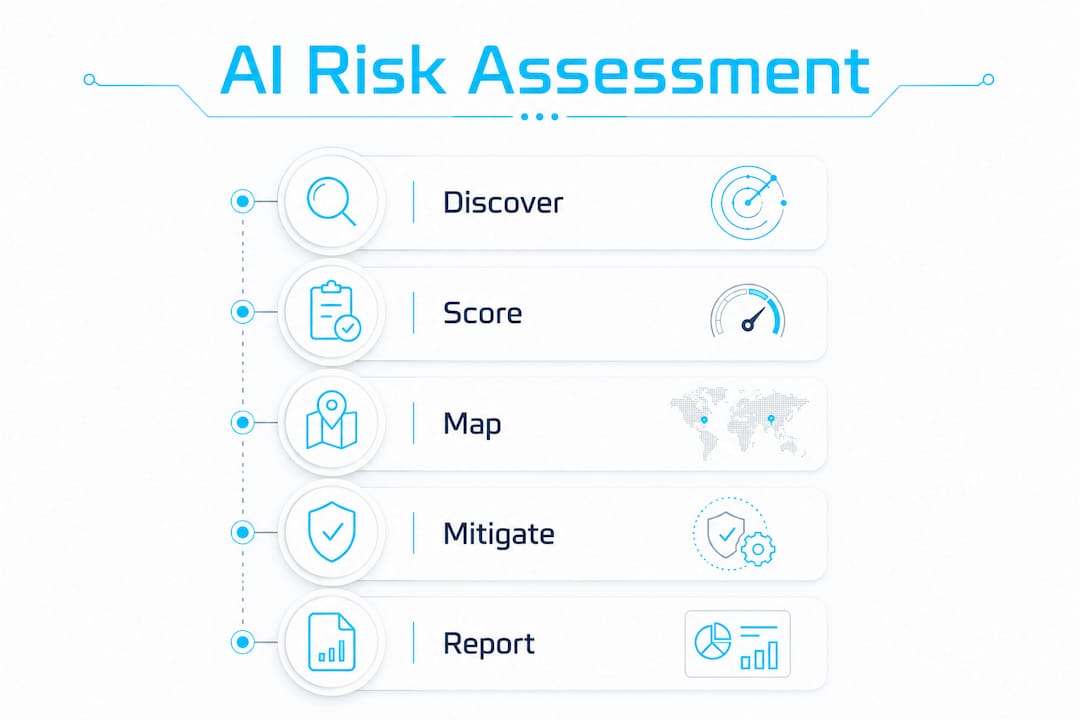
Step 1: Continuous discovery and inventory
Run automated discovery across your environment to find every AI asset. Do not rely on a manually maintained register. Tools that integrate with Kubernetes, cloud APIs, and CI/CD pipelines can detect new deployments within minutes of launch. This step feeds every subsequent stage.
Step 2: Automated risk scoring across critical domains
Score each asset across seven domains: infrastructure configuration, access controls, data flows, model permissions, tool integrations, runtime behavior, and compliance posture. Assessments can score across all seven domains in under 10 minutes. That speed matters when you are managing hundreds of services.

Step 3: Map findings to compliance frameworks
Link each finding to the specific control it violates in NIST AI RMF, ISO 42001, or the EU AI Act. Mapping technical findings to regulations automatically produces audit-ready compliance records and avoids the error-prone manual methods that cause audit failures. Cryptographic hashing of risk scores creates a traceable, tamper-evident evidence trail.
Step 4: Track mitigation actions and reassess residual risk
Assign each finding to an owner with a remediation deadline. After the fix is applied, restore the asset to confirm the residual risk is within your accepted threshold. Do not close a finding until the restore confirms improvement.
Step 5: Report to stakeholders and update policies
Generate reports that translate technical scores into business language. Risk managers need to see exposure in terms of regulatory liability and operational impact, not just CVSS scores. Update your security policies to reflect new controls introduced during remediation.
| Approach | Speed | Evidence quality | Scalability |
|---|---|---|---|
| Manual spreadsheet audit | Slow (days to weeks) | Low, error-prone | Poor beyond 50 assets |
| Semi-automated with templates | Moderate | Medium | Moderate |
| Fully automated AI-driven | Fast (minutes) | High, cryptographically verifiable | Handles thousands of assets |
What common pitfalls arise in AI infrastructure risk assessments?
Most teams hit the same walls. Knowing them in advance saves weeks of rework.
- Tool sprawl without integration. Tool sprawl and lack of integration with CI/CD pipelines reduce real-world effectiveness. A tool that sits outside your deployment pipeline produces findings that engineers never see during the build phase.
- Overemphasis on AI models. Teams fixate on the model itself and ignore the surrounding infrastructure. Securing data pipelines and execution contexts like MCP servers and vector databases is often more critical than focusing only on the model weights. These components are common breach entry points.
- Insufficient documentation. Scores without rationale fail audits. Regulators and internal audit teams want to see why a score was assigned, not just what it was.
- Ignoring dynamic risk factors. Infrastructure degrades. A system that passed assessment in january may drift out of compliance by april due to dependency updates, configuration changes, or increased traffic patterns. Static assessments miss this entirely.
- Treating compliance as a destination. Passing an audit is not the same as managing risk. Teams that optimize for the audit date rather than continuous posture end up with a clean report and a vulnerable environment.
Pro Tip: Use platforms that generate cryptographically verifiable audit records automatically. Manual compliance tracking is where evidence trails break down, and that is exactly where auditors look first.
For teams working on CI/CD pipeline security, integrating risk scoring directly into the build process catches misconfigurations before they reach production.
How does ongoing monitoring improve AI infrastructure risk management?
A one-time assessment is a snapshot. Your infrastructure changes daily, and so does your risk posture. Continuous monitoring converts a snapshot into a live view.
The core capabilities that make ongoing monitoring effective are:
- Drift detection: Alerts when a previously compliant asset changes configuration or behavior
- Runtime policy enforcement: Blocks or flags agent actions that violate defined policies before they cause damage
- AI control planes: Centralized governance layers that apply policies across all deployed models and agents
- Structured impact assessments: Formal evaluations triggered when a high-risk AI system is updated or expanded
AI Security Posture Management (AI-SPM) is the next evolution beyond Cloud Security Posture Management. It targets AI-specific threat vectors including model permissions, tool poisoning, and unmanaged agent behavior. AI-SPM and infrastructure security posture must be unified, not managed in separate silos.
Dynamic risk environments also benefit from probabilistic modeling. Managing deteriorating infrastructure risks requires dynamic frameworks like Markov Decision Processes that balance lifecycle costs against hazard probabilities. This approach is particularly relevant for long-lived infrastructure components where degradation is gradual and cumulative.
Linking technical findings to regulatory language automatically is what separates teams that are audit-ready from teams that spend two weeks scrambling before every review. Integrated governance workflows eliminate that scramble by keeping compliance evidence current at all times.
For teams managing access controls in cloud environments, continuous monitoring of IAM bindings and model permissions is the single highest-value control you can implement.
Key Takeaways
The most effective AI infrastructure risk assessment combines continuous asset discovery, automated compliance mapping, and cryptographically verifiable evidence trails to maintain a defensible security posture at scale.
| Point | Details |
|---|---|
| Start with full inventory | Catalog every AI asset including MCP servers, vector DBs, and API orchestrators before scoring. |
| Automate compliance mapping | Link findings to NIST AI RMF, ISO 42001, or EU AI Act controls automatically to stay audit-ready. |
| Secure the full stack | MCP servers and vector databases are higher-risk entry points than the AI models themselves. |
| Build an evidence trail | Cryptographic audit records make scores defensible and repeatable across review cycles. |
| Monitor continuously | Drift detection and runtime enforcement catch risks that point-in-time scans miss entirely. |
Where I’ve landed after running these assessments in production
The part that surprises most engineers is how little of the risk actually lives in the model. I’ve spent time reviewing assessment outputs across production environments, and the pattern is consistent: the model is usually fine. The MCP server talking to three external APIs with over-permissioned credentials is not fine. The vector database with no encryption at rest and a service account that hasn’t rotated in 14 months is not fine.
The second thing I’ve learned is that tool interoperability is the real bottleneck. You can have the best risk scoring engine in the world, but if it doesn’t push findings into your Jira board, your Slack channel, or your CI/CD gate, engineers will never act on them. The findings sit in a dashboard that nobody checks. AI DevOps tools that integrate natively with your existing workflow get far more remediation throughput than standalone platforms.
The third thing is the evidence trail problem. I’ve watched teams fail compliance reviews not because their infrastructure was insecure, but because they couldn’t prove it was secure. Scores without rationale, timestamps, and cryptographic verification are not evidence. They are opinions. Platforms that generate verifiable records from day one save enormous pain when the auditor shows up.
My honest recommendation: treat your first assessment as a discovery exercise, not a compliance exercise. You will find things you didn’t know existed. That is the point. Build the inventory, score everything, fix the critical findings, and then set up continuous monitoring so you never start from zero again. The DevOps security practices that stick are the ones baked into the deployment workflow, not bolted on afterward.
— James
Devopsaitoolkit and your AI risk assessment workflow
Devopsaitoolkit is built for engineers who manage real production infrastructure, not demo environments. The platform provides prompt libraries, workflow guides, and tool reviews specifically for teams running Kubernetes, OpenStack, GitLab, Prometheus, and Linux in production.
If you are building or refining an AI infrastructure risk assessment process, Devopsaitoolkit covers the workflows that matter: continuous discovery, CI/CD integration, compliance mapping, and governance automation. The AI workflow guides on the platform are written by engineers who have run these processes under real audit pressure, not theoretical scenarios. Start with the tool reviews to identify which assessment platforms integrate cleanly with your existing stack, then use the prompt libraries to automate the evidence collection that auditors actually want to see.
FAQ
What is AI infrastructure risk assessment?
AI infrastructure risk assessment is the systematic process of identifying, scoring, and remediating vulnerabilities across AI components and the infrastructure they run on, including models, agents, MCP servers, and data pipelines.
Why do most organizations lack visibility into AI risks?
86% of organizations have zero visibility into their AI data flows, primarily because AI assets are deployed faster than governance processes can track them, creating shadow AI exposure.
What frameworks apply to AI infrastructure risk assessments?
NIST AI RMF, ISO 42001, and the EU AI Act are the three primary frameworks. Each defines control categories that automated assessment tools can map findings to directly.
How often should you reassess AI infrastructure risk?
Continuous monitoring is the standard. Point-in-time assessments miss configuration drift, new deployments, and behavioral changes that occur between scheduled review cycles.
What makes an AI risk assessment audit-ready?
Audit readiness requires a documented evidence trail with rationale behind every score, cryptographic verification of records, and direct mapping of findings to regulatory controls rather than generic security categories.
Get 500 Battle-Tested DevOps AI Prompts — Free
500 battle-tested, copy-paste AI prompts engineered by a senior systems engineer — every one with fill-in placeholders and safety/back-out notes. Drop your email and it's yours.
- 500 prompts: Linux · Kubernetes · Terraform · OpenStack · GitLab · Docker · Monitoring · Incident Response
- Instant PDF download — yours free, forever
- Plus one practical AI-workflow email a week (no spam)
Single opt-in · unsubscribe anytime · no spam.