
AI Ops in OpenStack Management: A 2026 Practical Guide
Discover the role of AI Ops in OpenStack management. Learn how to integrate AIOps for better automation and faster incident response in 2026.
- #openstack
- #aiops
- #automation
- #incident-response
- #devops

AI Ops in OpenStack management is defined as the integration of AI-driven tools, agents, and assistants into OpenStack infrastructure workflows to reduce manual operator effort, accelerate incident response, and enforce consistent automation. The role of AI ops in OpenStack management has moved from theoretical to operational in 2026, with real implementations like Mirantis MOSK 26.1 embedding AI assistants directly into the operator console. The industry term for this practice is AIOps, short for Artificial Intelligence for IT Operations. This guide covers how AIOps integrates with OpenStack components, where security guardrails are non-negotiable, and how to adopt it without breaking your production environment.
What is the role of AI ops in OpenStack management?
AIOps in OpenStack management covers three distinct functions: operational guidance, automated monitoring, and natural language control of infrastructure services. Each function targets a different layer of operator pain.
The most immediate value is in reducing time-to-answer. Mirantis MOSK 26.1 ships with an embedded AI assistant that gives operators targeted documentation and troubleshooting guidance without leaving the management console. That matters because the average OpenStack operator wastes significant time hunting across docs, mailing lists, and internal wikis before finding the right answer.

Beyond documentation assistance, the MCP-OpenStack-Ops project enables natural language control of OpenStack services across compute, network, storage, identity, and image domains. You can ask it to list all instances in a project, describe a network topology, or check quota usage, all without writing a single CLI command. That lowers the barrier for operators who are competent but not yet fluent in every OpenStack service API.
AI Ops also integrates with observability and incident management systems. The OpenSRE framework connects AI SRE agents with over 60 tools covering monitoring, alerting, and operational actions. That kind of integration means an AI agent can correlate a Nova compute failure with a Prometheus alert and surface the relevant runbook automatically.
Key capabilities AI Ops delivers to OpenStack operators
- Documentation retrieval: AI assistants surface relevant OpenStack docs and runbooks based on the operator’s current task or error state, cutting search time significantly.
- Natural language queries: Tools like MCP-OpenStack-Ops let you query compute, network, and storage state in plain English, removing the need to memorize service-specific CLI syntax.
- Incident correlation: AI SRE agents connect alerts from Prometheus or Zabbix with OpenStack service logs to identify root cause faster than manual log triage.
- Automated monitoring: AI-driven monitoring watches resource utilization trends and flags anomalies before they become outages.
- Upgrade guidance: AI assistants draft upgrade plans and flag pre-condition failures, though human approval remains required before execution.
Pro Tip: Start with read-only AI Ops modes before enabling any mutating operations. MCP-OpenStack-Ops ships with a read-only safety configuration precisely for this reason. Validate your AI agent’s outputs against known-good state before you let it touch anything.
What security risks come with AI Ops in OpenStack?
Security is where AI Ops in OpenStack can go badly wrong if you skip the guardrails. The OpenStack Security Guide sets the baseline: management interface hardening, TLS on all API endpoints, and strict data privacy controls. Any AI Ops implementation that bypasses these controls is not a productivity tool. It is a liability.
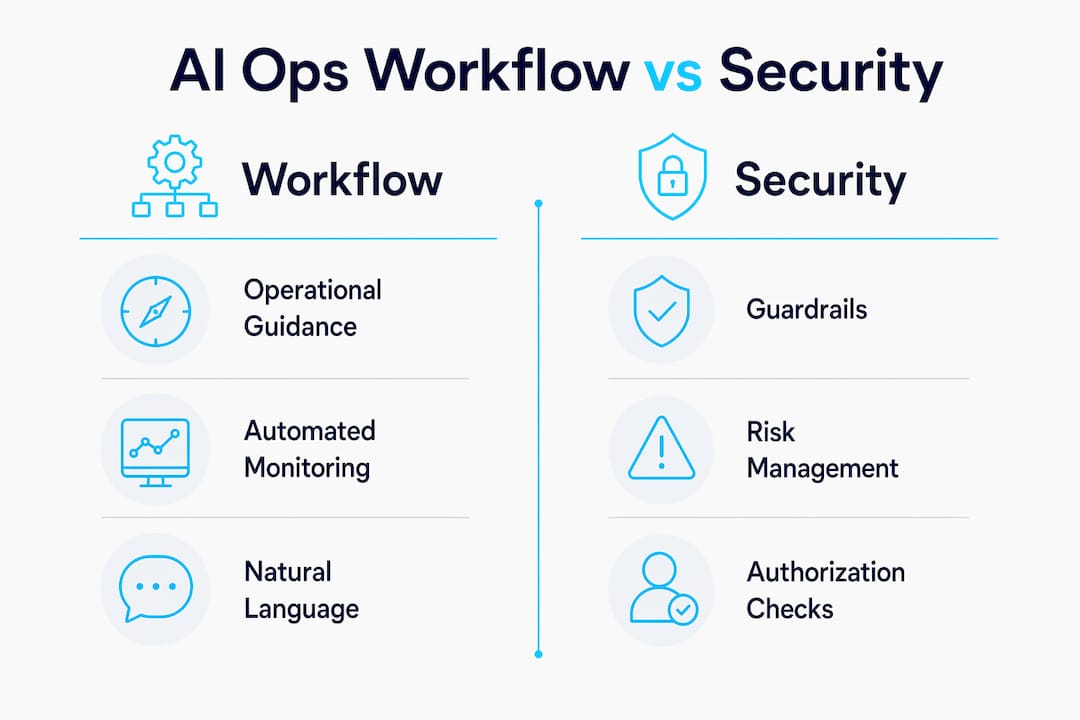
The 2026 Cyborg vulnerabilities make this concrete. CVE-2026-40213 and CVE-2026-40214 allow unauthorized users to manipulate accelerator resources across tenant boundaries. If an AI Ops agent operates without proper project ownership checks, it can trigger exactly this class of failure at scale. The AI does not need to be malicious. A missing authorization check in the agent’s workflow is enough.
CVE-2026-40214 specifically involves improper ownership management, meaning an AI agent that does not enforce project scoping could delete or disrupt another tenant’s accelerator resources. That is a multi-tenant disaster waiting to happen.
Security principle for AI Ops in OpenStack: AI agents must never hold permissions that exceed the human operator’s own access level. Enforce the principle of least privilege at the agent credential layer, not just at the human user layer.
The security checklist for any AI Ops deployment in OpenStack includes:
- Enforce TLS on all API endpoints the AI agent contacts, following OpenStack Security Guide recommendations.
- Scope all AI agent credentials to a specific project. Never use admin credentials for routine AI Ops tasks.
- Audit every mutating action the AI agent performs. Log to an append-only store.
- Validate project ownership before any accelerator operation, given the Cyborg authorization gaps documented in 2026.
- Review AI agent permissions quarterly as your OpenStack environment evolves.
How should AI Ops handle OpenStack upgrades safely?
Upgrade automation is where AI Ops can save hours or cause outages, depending entirely on how you structure the workflow. The OpenStack-Ansible upgrade notes for 2026.1 are explicit: automated playbooks do not automate all changes. Operators must verify system state before proceeding. That is not a limitation to work around. It is a design principle to preserve.
The correct model for AI-assisted upgrades follows this sequence:
- Pre-flight assessment: The AI agent reads current service versions, checks for known incompatibilities, and reports on cluster health. This is read-only and safe to automate fully.
- Plan generation: The AI drafts an upgrade plan including sequence, rollback steps, and estimated downtime. A human operator reviews and approves this plan before anything changes.
- Pre-condition validation: The AI runs pre-condition checks, such as verifying that all services are healthy and that no in-progress operations exist. It reports pass or fail. The human decides whether to proceed.
- Gated execution: Playbooks run in stages. The AI monitors each stage and halts on failure. A human must explicitly approve each major phase transition.
- Post-upgrade verification: The AI queries service endpoints, checks API health, and compares resource inventories before and after. It flags any drift.
Pro Tip: Never let an AI agent apply an OpenStack-Ansible upgrade playbook without a human-approved pre-flight report. The playbook will run. The question is whether your environment was actually ready for it.
The key insight here is that AI Ops earns trust through read operations first. Once you have validated that the AI agent reads state accurately, you can extend it to limited write operations with human gates. Full autonomous upgrades are not the goal in 2026. Accurate, fast pre-flight checks are.
AI Ops capabilities by OpenStack service: a comparison
AI Ops does not apply uniformly across OpenStack services. The risk profile and automation maturity differ significantly by component. The table below maps current AI Ops capabilities and security considerations per service domain.
The Nova scheduler deserves special attention. CVE-2026-46448 documents a scheduler hint injection vulnerability that allows bypass of scheduling constraints, creating resource exhaustion risk. An AI Ops agent that passes unvalidated user input to the Nova scheduler API is directly exposed to this class of attack. Validate and sanitize all scheduler hints before the AI agent submits them.
Cyborg is the highest-risk service for AI Ops right now. The 2026 authorization failures show that even well-intentioned automation can trigger cross-tenant effects if project ownership is not enforced at every step. If you are managing accelerators with AI, treat every write operation as requiring explicit human confirmation until the authorization model matures.
Key Takeaways
AI Ops in OpenStack management delivers the most value when it starts with read-only guidance and expands to gated automation only after security controls and human approval workflows are firmly in place.
What I’ve learned from running AI agents against OpenStack
I want to be direct about something the vendor announcements tend to gloss over. There is a meaningful difference between an AI assistant and an AI operator. An AI assistant answers questions and surfaces information. An AI operator takes actions. Most teams in 2026 are ready for the former and should be cautious about the latter.
I have seen engineers get excited about natural language control via MCP-OpenStack-Ops and immediately try to enable all mutating operations on day one. That is the wrong sequence. The read-only mode exists for a reason. Use it for at least two weeks. Build confidence in what the agent reports before you let it change anything.
The security gaps in Cyborg and Nova are not abstract. They represent real authorization logic that was missing from production code. If your AI Ops workflow does not explicitly enforce project ownership and validate scheduler hints, you are adding automation on top of a broken foundation. Fix the foundation first.
My honest expectation for AI Ops maturity in OpenStack is that 2026 is the year of AI assistants, not AI operators. The tools are genuinely useful for documentation retrieval, incident correlation, and pre-flight validation. Full autonomous remediation is a 2027 or 2028 story, and only after the authorization model across Cyborg, Nova, and Placement is significantly hardened. Start now, move carefully, and build the human approval gates into your workflows from day one.
— James
AI workflows built for OpenStack engineers
If you are ready to move beyond reading about AI Ops and start building actual workflows for your OpenStack environment, Devopsaitoolkit is built for exactly that.
Devopsaitoolkit provides prompt libraries, automation guides, and tested AI workflows for engineers managing OpenStack, Kubernetes, Prometheus, GitLab, and Linux in production. The AI workflows for cloud engineers cover everything from Nova scheduler debugging to Cyborg accelerator management, with security-first patterns built in. Check the pricing and support options to find the plan that fits your team’s scale. If you manage OpenStack in production, these workflows will save you real hours.
FAQ
What is AIOps in OpenStack?
AIOps in OpenStack is the integration of AI-driven tools and agents into OpenStack infrastructure workflows to automate monitoring, accelerate troubleshooting, and reduce manual operator effort across compute, network, storage, and identity services.
Which OpenStack component carries the highest AI Ops security risk?
OpenStack Cyborg carries the highest current risk. CVE-2026-40213 and CVE-2026-40214 document cross-tenant access vulnerabilities that AI Ops agents can trigger if project ownership is not enforced at every operation.
Can AI Ops fully automate OpenStack upgrades?
No. OpenStack-Ansible upgrade notes confirm that automated playbooks do not handle all changes. AI Ops can generate upgrade plans and run pre-flight checks, but human approval is required before executing any upgrade phase.
What is MCP-OpenStack-Ops?
MCP-OpenStack-Ops is an open-source project that enables natural language management of OpenStack services including compute, network, storage, identity, and image domains, with a read-only safety mode for safe initial deployment.
How does the OpenSRE framework relate to OpenStack AI Ops?
OpenSRE is an AI SRE agent framework that integrates with over 60 tools including observability and incident management systems. It provides a practical pattern for connecting AI agents to OpenStack monitoring and operational workflows.
Recommended
- How to Build a Production-Ready OpenStack Cloud (2026 Guide)
- Deploying OpenStack with Kolla-Ansible: A Practical Guide — DevOps AI ToolKit
- Debugging Heat Orchestration Stacks in OpenStack
- Managing Quotas and Capacity Planning in OpenStack
Get 500 Battle-Tested DevOps AI Prompts — Free
500 battle-tested, copy-paste AI prompts engineered by a senior systems engineer — every one with fill-in placeholders and safety/back-out notes. Drop your email and it's yours.
- 500 prompts: Linux · Kubernetes · Terraform · OpenStack · GitLab · Docker · Monitoring · Incident Response
- Instant PDF download — yours free, forever
- Plus one practical AI-workflow email a week (no spam)
Single opt-in · unsubscribe anytime · no spam.