
AI Ops Cloud Management Explained for IT Teams
Discover how AI ops cloud management explained can boost your IT operations. Learn essential capabilities for a successful cloud strategy.

AI ops cloud management is defined as the application of machine learning, big data analytics, and automation to enhance IT operations across cloud environments. Gartner coined the term AIOps in 2016, and by 2026 the four capabilities that define a mature platform are multi-source data ingestion, ML anomaly detection, event correlation, and automated response. The industry term is AIOps, short for Artificial Intelligence for IT Operations. Understanding what AIOps does, how it fits into your cloud management strategies, and where it fails is the difference between a productive rollout and a very expensive science project.
What are the core capabilities of AI ops in cloud management?
AIOps is not a single feature. It is a layered architecture that handles four distinct jobs, each building on the last.
- Multi-source data ingestion. An AIOps platform pulls logs, metrics, events, and traces from every cloud service, container, and network device into one normalized data stream. Without this step, the machine learning models downstream work on incomplete pictures.
- ML anomaly detection. Static thresholds catch obvious problems. ML models catch the subtle ones, like a memory leak that grows 2% per hour or a latency spike that only appears on one availability zone. First-generation platforms focused here but struggled to go further.
- Event correlation. A busy Kubernetes cluster can fire hundreds of alerts for a single root cause. Correlation groups related events into one incident, cutting alert noise to a manageable signal. This is where most teams see the fastest return.
- Automated response. Agent-native architectures introduced in 2024 and beyond close the AIOps loop by executing remediation actions, not just recommending them. This requires policy envelopes, safety checks, and trust scores before any action runs.
AIOps is distinct from traditional automation and from AI SRE. Traditional automation runs scripts on a fixed schedule or trigger. AI SRE focuses on reliability engineering practices. AIOps sits above both, using ML to decide what to automate and when, based on live telemetry.
Pro Tip: Start with event correlation before you touch automated remediation. Reducing alert noise gives your team breathing room and builds confidence in the platform’s accuracy before you let it touch production.

You can see how AI-driven cloud automation applies these capabilities in practice across real engineering workflows.
How does AI ops integrate with cloud management strategies at scale?
Plugging an AIOps tool into a siloed environment does not fix the underlying problem. Native cloud tools are often siloed, creating invisible cloud waste and governance gaps that no amount of ML can compensate for. The platform needs a unified observability framework that consolidates spend, security policies, and health metrics into one control plane.
Organizational structure matters as much as tooling. The models that work in practice are:
- Centralized cloud ops. One team owns the platform and all tooling. Fast to govern, slow to scale with product velocity.
- Federated teams. Product teams own their stacks. Governance is harder but autonomy is higher.
- Platform engineering. A central team builds internal developer platforms. Product teams consume them. This model pairs well with AIOps because the platform team can embed observability and policy enforcement by default.
- SRE integration. SRE teams define SLOs and reliability targets. AIOps monitors against those targets and escalates or remediates when they are at risk.
Operational disciplines like FinOps, policy-as-code, GitOps, and continuous compliance do not disappear when you add AIOps. They become the governance layer that AIOps enforces. Top CIOs focus on operating models built around Measure, Route, Comply, and Recover rather than chasing the next tool. Tagging standards, identity management, and cost allocation policies must be in place before AIOps can act on them meaningfully.
AIOps supports human expertise. It does not replace it. The platform surfaces patterns and executes pre-approved actions. Engineers make judgment calls on edge cases, define policy boundaries, and own the outcomes.
Pro Tip: Before selecting any AIOps platform, map your tagging taxonomy and identity model first. An AIOps system that cannot distinguish between a dev and a prod workload will make expensive mistakes.
For a practical look at how teams apply these disciplines to reduce spend, the AI and FinOps guide from Devopsaitoolkit covers real cost optimization workflows.
What architectural considerations are essential for effective AI ops?
The architecture of an effective AIOps system follows a closed feedback loop. Closed-loop AI ops architecture includes seven stages: telemetry collection, anomaly detection, remediation planning, evaluation, orchestration, execution, and post-remediation verification. Each stage feeds the next, and the last stage feeds back into the first for continuous learning.
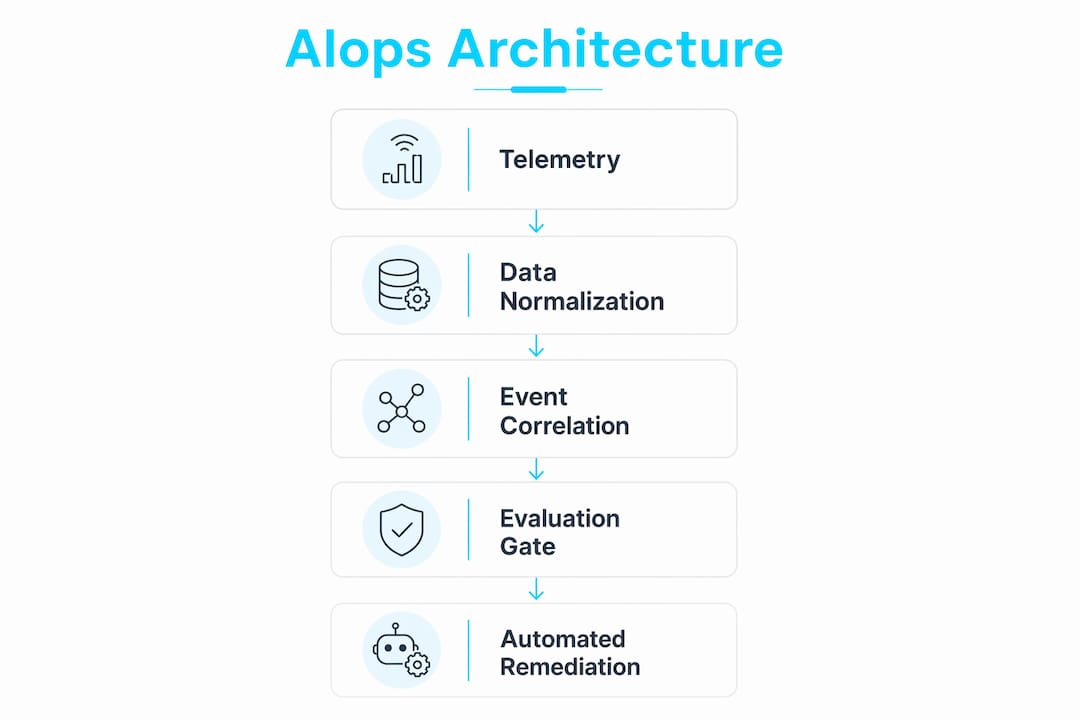
The prerequisite for all of it is a consistent observability fabric. You need logs, metrics, traces, and events flowing from every environment, normalized to a common schema. Without this observability fabric, AIOps platforms produce inaccurate or misleading insights. Experts describe this as the “garbage-in, garbage-out” problem, and it is the most common reason AIOps rollouts underperform.
The evaluation stage is the one most teams underinvest in. Before any remediation plan executes, an AI evaluator reviews it against policy, safety thresholds, risk tolerance, and confidence scores. Evaluator components prevent unsafe automation from running. Without this gate, an AIOps system can turn a minor incident into a cascading failure.
The table below shows the architectural layers and what each one requires to function correctly.
| Architectural layer | What it requires |
|---|---|
| Telemetry collection | Normalized logs, metrics, traces, and events from all environments |
| Anomaly detection | Trained ML models with enough historical data to establish baselines |
| Remediation planning | Defined playbooks and runbooks the AI can reference |
| Evaluation | Policy rules, safety thresholds, and confidence score minimums |
| Orchestration and execution | API access to cloud services, functions, and infrastructure controls |
| Post-execution verification | Automated checks confirming the remediation resolved the incident |
Multi-layer telemetry sources include infrastructure metrics from Prometheus, distributed traces from OpenTelemetry, application logs from your logging pipeline, and cloud provider events from services like AWS CloudWatch or Azure Monitor. Each source adds context. The more complete the picture, the more accurate the ML models become over time.
What are common misconceptions about AI ops in practice?
The biggest misconception is that AIOps eliminates the need for skilled engineers. AI ops delivers practical leverage, not full automation. It lets a team of ten manage what previously required thirty, but those ten need to be sharper, not less experienced.
The practical pitfalls that derail real implementations are:
- Poor telemetry quality. Teams rush to deploy the AIOps layer before fixing gaps in their observability stack. The ML models then train on incomplete data and produce false positives that erode trust.
- No safety policy definition. Automated remediation without clear thresholds and rollback mechanisms causes cascading failures. Define what the system is allowed to touch before you turn it on.
- Skipping the evaluation stage. Teams configure detection and jump straight to execution. The evaluation gate exists for a reason. Do not bypass it to move faster.
- Organizational resistance. Product teams that feel AIOps is a central team watching their work will route around it. Governance needs to feel like a service, not surveillance.
The realistic timeline for autonomous remediation is measured in quarters, not weeks. A phased approach works: start with observability consolidation, then add anomaly detection and alerting, then event correlation, and finally introduce automated response for low-risk, well-understood incident types. Build trust with the platform before you expand its authority.
Pro Tip: Run your AIOps platform in “suggest mode” for the first 60 days. It recommends actions but takes none. Review every recommendation manually. This builds the confidence data you need to safely expand automation scope.
For practical AI ops in OpenStack environments, Devopsaitoolkit has a hands-on guide covering real implementation steps.
Key Takeaways
AIOps cloud management requires a complete observability fabric, a closed-loop architecture with an evaluation gate, and an organizational model that pairs central governance with product team ownership.
| Point | Details |
|---|---|
| Start with observability | Normalize telemetry from all environments before deploying any ML or automation layer. |
| Use the evaluation gate | Every remediation plan must pass policy, safety, and confidence checks before execution. |
| Adopt a phased rollout | Begin with correlation and alerting, then expand to automated response for low-risk incidents. |
| Align organizational models | Pair AIOps with platform engineering or SRE structures to enforce governance at scale. |
| Expect leverage, not magic | AIOps multiplies team capacity. It does not replace the need for skilled engineers. |
Where I’ve seen AI ops implementations go wrong
I’ve watched teams spend six months selecting an AIOps platform and six weeks deploying it, then spend the next year wondering why it keeps firing false positives. The platform is almost never the problem. The observability stack underneath it is.
The teams that get this right spend the first phase doing unglamorous work: fixing tagging, closing telemetry gaps, defining SLOs, and writing the policy rules the evaluator will enforce. That work is not exciting. It does not show up in a vendor demo. But converting telemetry into understanding and then into safe action is the entire point of AIOps. You cannot skip the foundation.
The organizational piece is harder than the technical piece. I have seen platform teams deploy AIOps as a top-down mandate and watch product engineers route around it within a month. The model that works is empowering product teams to own their stacks under a central governance framework, not a central control framework. There is a real difference between those two things.
The future direction is autonomous resilience: systems that detect, plan, evaluate, act, and learn without waiting for a human in the loop for routine incidents. That future is real and closer than most teams think. But it is built on trust, and trust is built incrementally. Start small, verify everything, and expand authority only when the data supports it.
— James
Devopsaitoolkit and AI ops-driven cloud management
Devopsaitoolkit builds AI workflows specifically for engineers running production infrastructure on Linux, Kubernetes, OpenStack, GitLab, and Prometheus. The tools are designed for the reality of cloud operations, not the demo version of it.
The AI DevOps tools suite covers incident response, automated review workflows, and cloud management automation that maps directly to the AIOps capabilities covered in this article. For engineers who want to accelerate day-to-day operations with AI prompts built for real infrastructure work, the Linux Admin Prompt Pack gives you 100 battle-tested prompts ready to use. See the full Devopsaitoolkit pricing to find the right plan for your team.
FAQ
What is AIOps in simple terms?
AIOps is the use of machine learning and automation to manage IT operations at scale. It ingests telemetry, detects anomalies, correlates events, and executes remediation actions based on defined policies.
How does AI ops differ from traditional automation?
Traditional automation runs fixed scripts on fixed triggers. AIOps uses ML models to decide what action to take based on live telemetry patterns, making it adaptive rather than rule-bound.
What is the biggest risk in an AI ops implementation?
Poor telemetry quality is the most common failure point. If the observability data feeding the ML models is incomplete or unnormalized, the platform produces misleading insights and erodes team trust.
How long does it take to implement automated remediation with AI ops?
A phased approach typically takes several quarters. Teams start with observability consolidation and event correlation, then introduce automated response for low-risk, well-understood incident types after building confidence in the platform.
Does AI ops replace cloud engineers?
No. AI ops delivers practical leverage, allowing smaller teams to manage greater scale and complexity. It handles routine, well-defined incidents while engineers focus on architecture, policy, and edge cases.
Recommended
- AI Ops in OpenStack Management: A 2026 Practical Guide
- AI Workflows for Real Cloud Engineers — DevOps AI ToolKit
- How DevOps Teams Use AI to Reduce Cloud Costs (FinOps)
Get 500 Battle-Tested DevOps AI Prompts — Free
500 battle-tested, copy-paste AI prompts engineered by a senior systems engineer — every one with fill-in placeholders and safety/back-out notes. Drop your email and it's yours.
- 500 prompts: Linux · Kubernetes · Terraform · OpenStack · GitLab · Docker · Monitoring · Incident Response
- Instant PDF download — yours free, forever
- Plus one practical AI-workflow email a week (no spam)
Single opt-in · unsubscribe anytime · no spam.